
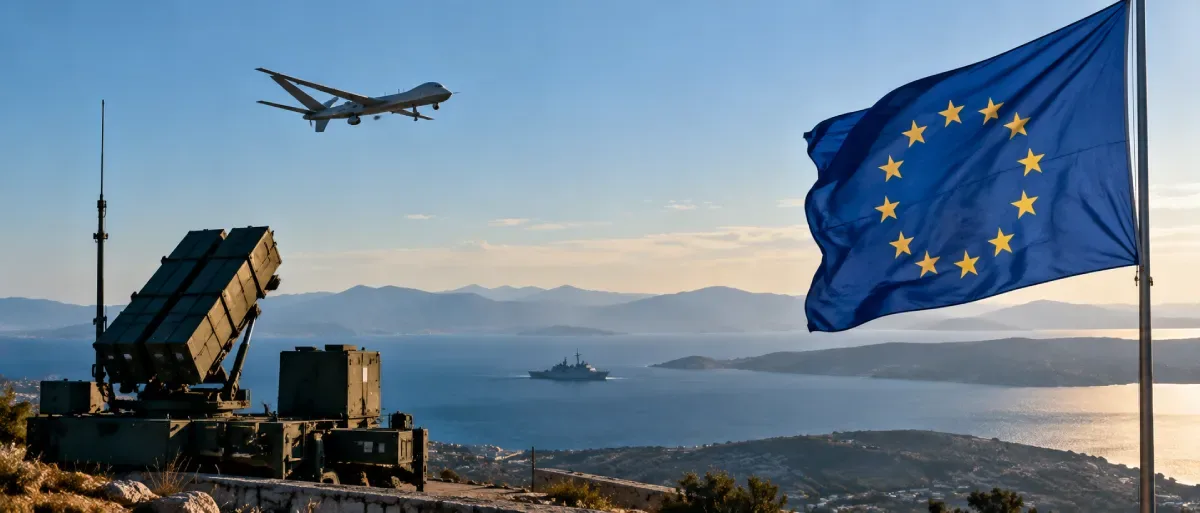
The European Union is moving from higher defence spending towards the development of common military capabilities. On September 28, the Council approved the first five European Defence Projects of Common Interest (EDPCIs), opening the way for multinational programmes covering unmanned systems, maritime and seabed defence, space, integrated air and missile defence and protection of Europe's eastern flank.
The projects are intended to address one of the longstanding weaknesses of European defense: fragmented systems and procurement despite shared operational requirements. DECODER focuses on drones and counter-drone capabilities; Integrated Maritime and Seabed Defense covers maritime surveillance, underwater capabilities and the protection of ports, pipelines, cables and offshore installations; SPACE includes early warning, military satellite communications, intelligence, surveillance and secure navigation. EU-FIAMD seeks to connect national sensors, command systems and interception assets, while Eastern Flank Watch concentrates on persistent surveillance and stronger defense along Europe's eastern flank.
The financial scale is much larger than the initial EU funding. The European Commission puts the combined financial ambition of the five programmes at about €190 billion through 2036, although the figure represents separate estimates rather than a single budget. The European Defence Industry Programme has €1.5 billion available, including €325 million for the initial development of the EDPCIs. Most of the required investment will therefore have to come from governments and industry. Turning the programmes into military capability will require sustained orders and investment in production lines, technology and supply chains.
That raises the question of where the new capabilities will be produced. The EU wants a larger share of rising defense expenditure to remain within the European economy and strengthen its industrial and technological base. But drones, air defense, space, maritime surveillance and critical-infrastructure protection are also NATO priorities. Europe will have to avoid incompatible standards, duplicated structures and competing procurement systems while preserving access to a wider allied defense market.
The economic issue is equally important. Permanently higher military spending does not automatically mean cuts to pensions, healthcare or social programmes, but it does require lasting financing through public revenues, borrowing, spending choices or economic growth. Defense expenditure that supports European production, research and employment can strengthen the industrial base; expenditure directed mainly towards imports may meet immediate military needs while creating less productive capacity inside Europe.
The five EDPCIs therefore establish common priorities but leave the hardest questions unresolved: who will build the systems, who will finance them and how a stronger European defense-industrial base will coexist with transatlantic cooperation. For Sideris, the success of Europe's rearmament will ultimately depend on whether higher spending can be converted into common capabilities and greater production capacity without unnecessary parallel structures or damage to the fiscal and social balance of member states.
This analysis was originally published in full by IBNAEU. Read the original version here.