
By Bosphorus News Geopolitics Desk
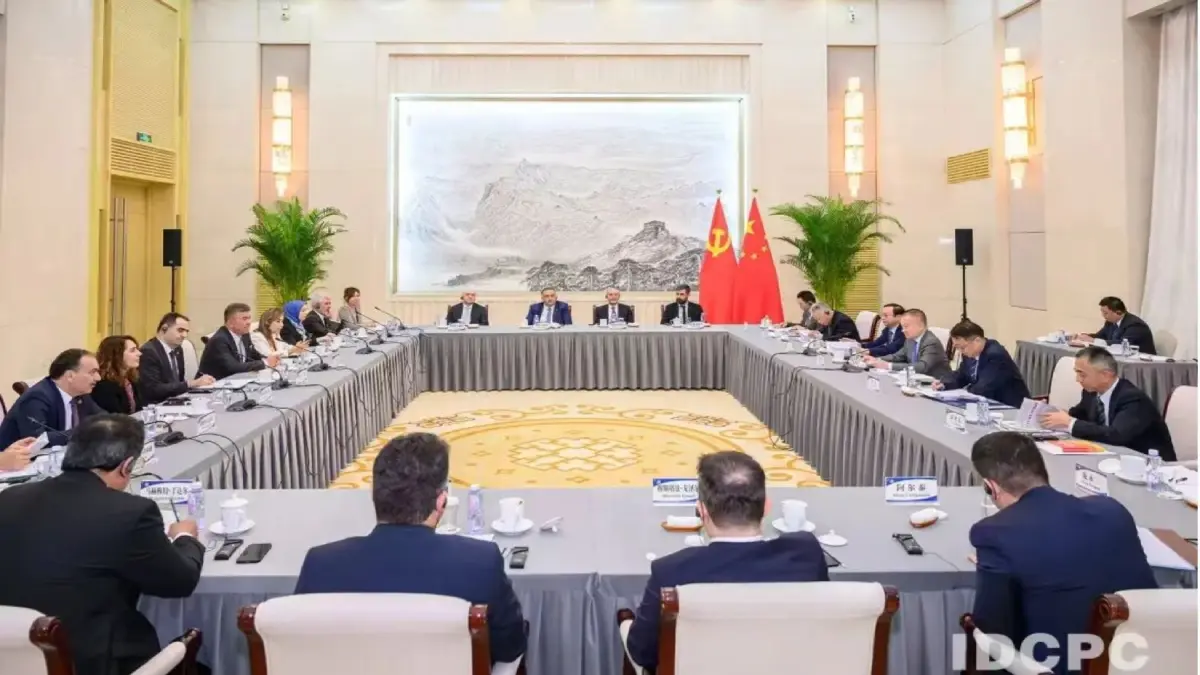
A multi-party Turkish delegation met senior Communist Party of China (CPC) officials in Beijing on June 11, placing Türkiye's Middle Corridor initiative, China's Belt and Road policy and party-to-party diplomacy inside the same channel.
The meeting was held with Liu Haixing, minister of the International Department of the CPC Central Committee, according to a Chinese party statement republished by Friends of Socialist China. The delegation was headed by Ersin Erçin, vice president of the Türkiye-China Friendship Foundation, and Türkiye's ambassador to China, Selçuk Ünal, was also present.
The Chinese statement listed representatives from the Justice and Development Party (AK Party), Peoples' Equality and Democracy Party (DEM Party), Good Party (İYİ Party), Democracy and Progress Party (DEVA), Future Party, Felicity Party, New Welfare Party and Workers' Party of Türkiye (TİP). The Republican People's Party (CHP), Türkiye's main opposition party, was not listed in the published account.
The meeting gives China a broad Turkish political-party channel at a time when Ankara is balancing NATO summit diplomacy, corridor politics and expanding economic ties with Asia.
Liu said China-Türkiye relations had remained stable under President Xi Jinping and President Recep Tayyip Erdoğan, and that the Belt and Road Initiative had aligned closely with Türkiye's Middle Corridor initiative in recent years. He pointed to cooperation in trade, energy, infrastructure, digital economy, education, culture and multilateral platforms.
The statement also said the CPC wanted to increase exchanges with Turkish political parties and use a "political party+" platform for cooperation between local governments, media, think tanks and social organizations. Liu briefed the delegation on China's 15th Five-Year Plan, according to the account.
The Turkish side was quoted collectively, without named party-by-party attribution, as saying Türkiye regards China as an important partner and sees the Middle Corridor and Belt and Road as mutually supportive and complementary. The statement also said the Turkish side appreciated China's position on the Middle East.
That attribution needs caution. The Chinese account presents the delegation's position as a collective statement, but does not specify which Turkish party representative made which comment. Bosphorus News is therefore treating the meeting as a party-diplomacy signal rather than as a single Turkish parliamentary position.
The political range of the delegation is the news point. Beijing's published list reaches from the ruling AK Party to opposition, conservative, nationalist, pro-European, Kurdish political and left-wing party representatives. That gives the CPC a wider Turkish contact map than a normal government-to-government meeting.
Türkiye-China Channel
The meeting sits inside a corridor competition that is becoming more political. The Middle Corridor is usually discussed through transport, customs, railways and Caspian routes; Beijing's published account shows China also treating it through party networks, policy messaging and long-term political access.
The visit does not mark a change in Türkiye's alliance position. It shows that the China channel remains active below formal state diplomacy as Ankara prepares to host NATO leaders and continues to market itself as a transit state between Europe, the Caucasus, Central Asia and the Middle East.
Sources: International Department of the CPC Central Committee, Friends of Socialist China, Bosphorus News review and reporting.