
By Bosphorus News Economy Desk
Türkiye's first visible steps into artificial intelligence-backed precision farming are coming through greenhouse automation, sensor-based monitoring and satellite-supported land analysis, as global agriculture shifts toward tools that can cut input waste, detect crop risks earlier and make farm decisions more data-driven.
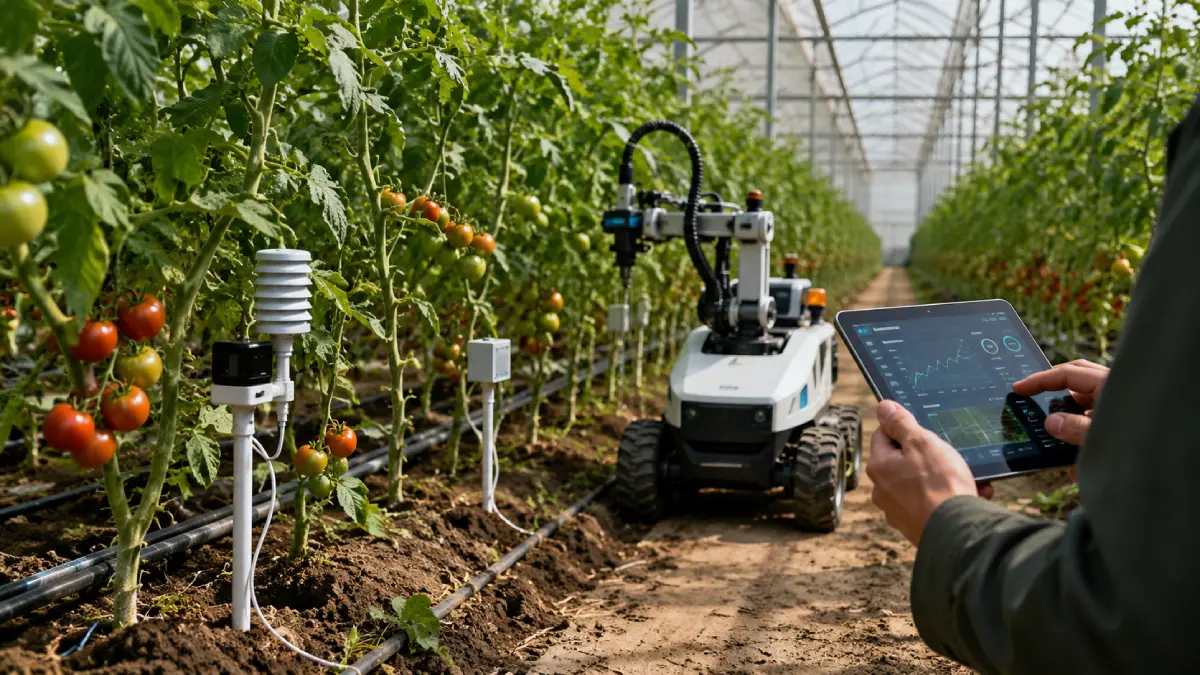
The Directorate of Plant Protection Central Research Institute, under Türkiye's Agriculture and Forestry Ministry, said on January 9, 2026, that it was a project partner in the "Design and Development of an Autonomous Greenhouse Robot Capable of Artificial Intelligence and Image Processing-Based Precision Fertilization, Spraying and Harvesting" project. The institute said the project was approved under the Scientific and Technological Research Council of Türkiye's (TÜBİTAK) 1711 Artificial Intelligence Ecosystem Call, began on January 1, 2026, and is planned to run until December 31, 2027.
At provincial level, the Antalya Provincial Directorate of Agriculture and Forestry said it held an "Artificial Intelligence-Supported Smart Agriculture and Digital Agriculture Promotion Demonstration" in Kepez on March 5, 2026. The directorate said the tomato-greenhouse event introduced precision soil-moisture sensors, climate measurement stations, temperature and humidity tracking systems, and digital infrastructure allowing real-time monitoring of plant development.
These are early Turkish examples, but they match the direction of the wider market. The Food and Agriculture Organization (FAO) treats digital agriculture and artificial intelligence as tools for precision farming, climate-smart agriculture, supply-chain monitoring and food security. Its plant-health work includes AI-based early pest warning systems that classify and count pests from trap images taken by farmers, allowing threats to be detected before they become larger crop losses.
That link matters for Türkiye because the country's early projects sit in the same chain: crop monitoring, controlled fertilization, spraying decisions, greenhouse conditions and land-use data. The issue is not whether AI can be attached to agriculture, but whether those tools can become reliable enough for daily production decisions.
The Organisation for Economic Co-operation and Development (OECD) places the same technology inside farm management. Its 2026 review of artificial intelligence in European Union agriculture says AI-supported robots, predictive analytics and crop, soil and livestock monitoring can reduce manual labour, improve targeted pesticide and herbicide use, and support soil-health decisions.
The OECD review also shows why adoption can lag behind availability. It cites a 10-hectare vineyard case in which the owner needed three years before trusting and applying the system's recommendations in the field. That is directly relevant to Türkiye's agricultural structure, where small and medium-sized producers remain central and where the success of precision farming will depend on trust, financing, advisory services and local data rather than hardware alone.
StartUs Insights, a startup and technology intelligence platform, cites market and consultancy data saying the AI in agriculture market could reach $4.7 billion by 2028, with a compound annual growth rate of 23.1 percent. It also cites adoption estimates of 81 percent among large farms, 76 percent among medium-sized farms and 36 percent among small farms. Those numbers are market-facing estimates, not guaranteed farm outcomes, but they underline the scale gap that Türkiye will also have to manage if AI tools are to move beyond larger or better-capitalized producers.
ICL Group, an Israel-based specialty minerals, fertilizers and crop-nutrition company, describes a market moving away from AI hype toward return on investment and climate resilience. Its 2026 agriculture outlook focuses on precision harvesting robots, remote crop monitoring, drone and sensor alerts, and tools that help growers manage heat, water stress and crop-health risk with less waste.
Türkiye's greenhouse robot and Antalya sensor demonstrations belong in that return-on-investment test. Their value will not be measured by the presence of artificial intelligence in the system, but by whether they reduce unnecessary fertilizer and pesticide use, improve harvest timing, detect crop stress earlier or help producers manage water more precisely.
Academic literature is more cautious. A 2025 review in Food Chemistry X, a peer-reviewed scientific journal, lists machine learning, deep learning, Internet of Things systems and decision-support tools among the main AI applications in agriculture, with uses ranging from precision irrigation and pest control to product-quality monitoring. It also flags high cost, privacy concerns, limited infrastructure and lack of technical knowledge as barriers to wider adoption.
Some field studies cited in the literature show why input efficiency has become central to the AI farming argument. Variable-rate nitrogen application has been linked to wheat yield increases of 1 percent to 10 percent and nitrogen savings of 4 percent to 37 percent, while precision agriculture systems using sensors, drones and software have been associated with water and fertilizer savings in European farm settings. Those results do not move automatically from one crop, region or farm size to another.
Bushel, a North American farm software and digital payments company, shows how uneven early adoption remains. Its 2026 State of the Farm report, based on more than 1,400 farmers in the United States and Canada, says only 14 percent currently use artificial intelligence. Among larger farms using AI, half use it for business or financial analysis, while only a quarter use it for yield prediction or agronomy.
That warning also applies to Türkiye. AI may reach farm accounting, grant applications, input planning or land monitoring before it becomes a trusted agronomy tool in the field. The next stage will depend on whether official projects, provincial demonstrations and satellite-backed monitoring can connect with producer-level advice that farmers are willing and able to use.
Türkiye's AI farming file remains early, but it is now visible in greenhouse robotics, smart sensors, crop-pattern detection and unused-land monitoring. The harder task is building the financing, connectivity, local data and advisory chain that can turn those first applications into working tools for farms with different crops, costs and technical capacity.
Sources: Türkiye's Agriculture and Forestry Ministry, Directorate of Plant Protection Central Research Institute, Antalya Provincial Directorate of Agriculture and Forestry, Food and Agriculture Organization, Organisation for Economic Co-operation and Development, StartUs Insights, ICL Group, Bushel, Food Chemistry X, Bosphorus News review and reporting.