
By Bosphorus News Geopolitics Desk
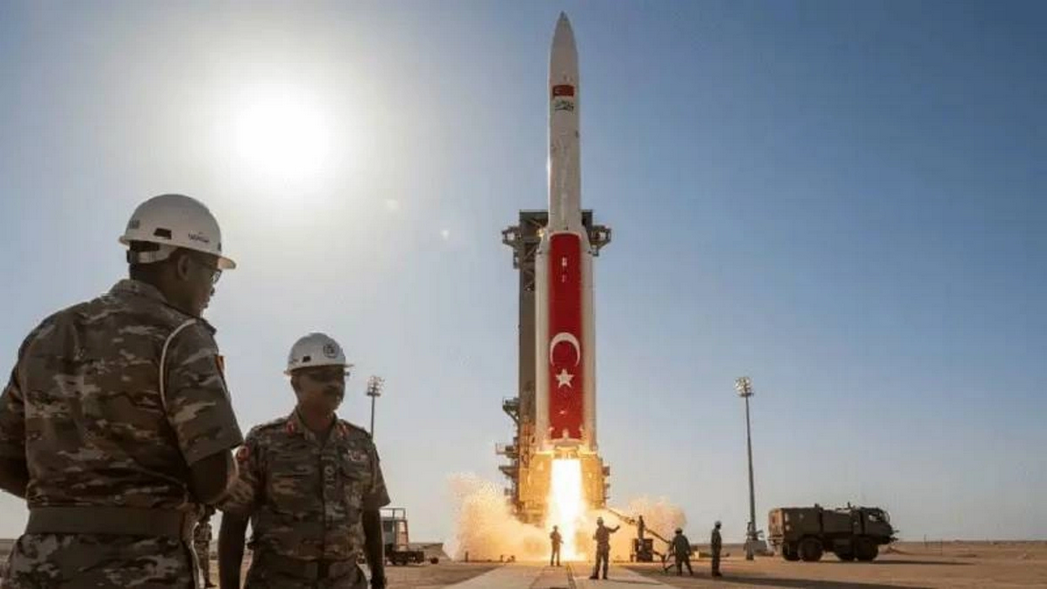
Türkiye's plan to build a spaceport in Somalia has moved from a national space program file into a broader strategic debate after reports linked the facility to long-range missile testing and Ankara's expanding security footprint in the Horn of Africa.
President Recep Tayyip Erdoğan announced the Somali spaceport plan on December 30, 2025, during a joint press conference in Istanbul with Somali President Hassan Sheikh Mohamud. Turkish officials have framed the project as a major step toward independent access to space, commercial satellite launches and future rocket operations from a site close to the equator.
Sanayi ve Teknoloji Bakanı Mehmet Fatih Kacır said feasibility and design work had been completed and that the first construction phase had begun. Türk Uzay Ajansı President Yusuf Kıraç later described Somalia's location as a technical advantage, saying proximity to the equator would allow more efficient launches, heavier payload capacity and lower fuel use.
That official line places the Somali facility inside Türkiye's long-term space agenda. As Bosphorus News reported in its coverage of Türkiye's 2027 Moon mission, national rocket program and Somalia spaceport push, Ankara has increasingly tied its space ambitions to sovereign launch capability rather than reliance on foreign infrastructure.
The project's military sensitivity comes from reporting around its possible dual use. Bloomberg reported in September 2024 that Türkiye was discussing a site in Somalia for both space rocket launches and missile tests. In May 2026, Bloomberg reported that Türkiye planned to test its Yıldırımhan long-range missile from Somalia, citing people familiar with the plans.
As Bosphorus News reported when Türkiye unveiled the Yıldırımhan ICBM prototype and placed the system inside a wider NATO deterrence debate, the missile program had already moved Ankara's defence posture beyond short and medium-range systems. If the Somali site is used for long-range testing, the facility would connect Türkiye's space infrastructure to a deterrence issue already watched by NATO allies and regional powers.
Türkiye has not confirmed an intercontinental ballistic missile test from Somalia. The official record still describes the project as a spaceport. The military debate rests on reporting, satellite scrutiny and the logic of geography: Somalia's Indian Ocean coastline gives Türkiye a long, open test corridor that it does not have at home.
The reported location near Kismayo and the Jamaame dune area has attracted attention because it sits on the Indian Ocean, away from crowded Mediterranean and Black Sea airspace. Analysts tracking the project say such a site could reduce risks linked to rocket stages or missile debris falling over populated areas or across another country's territory.
That geography also explains why the project is drawing external scrutiny. A launch site on the Somali coast would place Türkiye's space and rocket infrastructure near the Gulf of Aden, the Red Sea approach, the Arabian Sea and the wider Indian Ocean. The facility would therefore carry strategic meaning beyond satellite launches.
Selçuk Bayraktar, Baykar's chairman, said at Take Off Istanbul in December 2025 that the state had started construction and that Roketsan would also use the site. His remarks added weight to the view that the Somali project cannot be read only through a civilian space lens. Roketsan is central to Türkiye's rocket and missile ecosystem, and its expected role links the site to Ankara's wider defence industry trajectory.
Somalia is already one of Türkiye's most important external strategic theatres. Türkiye opened its largest overseas military training facility in Mogadishu in 2017 and has trained Somali military and police units for years. In 2024, Ankara and Mogadishu signed a maritime security agreement that gave Türkiye a larger role in protecting Somali waters and offshore resources. In 2026, Türkiye launched its first overseas deep-sea drilling mission off Somalia, adding energy exploration to the same strategic map.
The spaceport now sits inside that layered relationship. It follows years of Turkish military training, defence cooperation, maritime security support and offshore energy activity. It also comes as Somalia's coastline becomes more important to Türkiye's access to the Indian Ocean system.
Policy circles critical of Ankara have already framed the facility as a potential missile range. Middle East Forum argued that the Somali site could support long-distance tests by Turkish defence firms over open ocean areas. Turkish Minute and other outlets have linked the facility to possible testing of Turkish ballistic missile systems, although those claims remain outside official confirmation.
Those reports require caution. Türkiye has not publicly defined the Somali site as a missile range. Yet the scrutiny will remain because the same infrastructure that supports orbital launches can also serve advanced rocket testing, especially for a country seeking longer-range capabilities.
The political sensitivity is clear in Washington and other Western capitals. A Turkish-run launch facility on the Somali coast would give Ankara a new strategic platform in a region where the United States, China, Gulf states and European powers already compete for influence. It would also deepen Türkiye's role in the Horn of Africa at a time when Red Sea security, maritime chokepoints and Indian Ocean access are moving higher on NATO and Gulf security agendas.
The Somali government has presented the project as an opportunity for jobs, income and technological cooperation. That argument matters for Mogadishu, which has welcomed Turkish investment, military support and energy engagement while trying to strengthen state authority and maritime sovereignty.
The harder question is how the facility will be read outside Somalia. A spaceport built by Türkiye, used by Turkish agencies and linked in public remarks to Roketsan will be judged not only by Ankara's official explanation, but by what the site can technically enable. Somalia gives Türkiye an Indian Ocean launch corridor. That is why a project announced as a spaceport is now being watched as part of a larger debate over rockets, deterrence and Ankara's strategic reach beyond its immediate region.
***Sources: Reuters, Anadolu Agency, Bloomberg, Middle East Forum, Turkish Minute, Janes, OYAK, Bosphorus News.