
By Bosphorus News Energy Desk
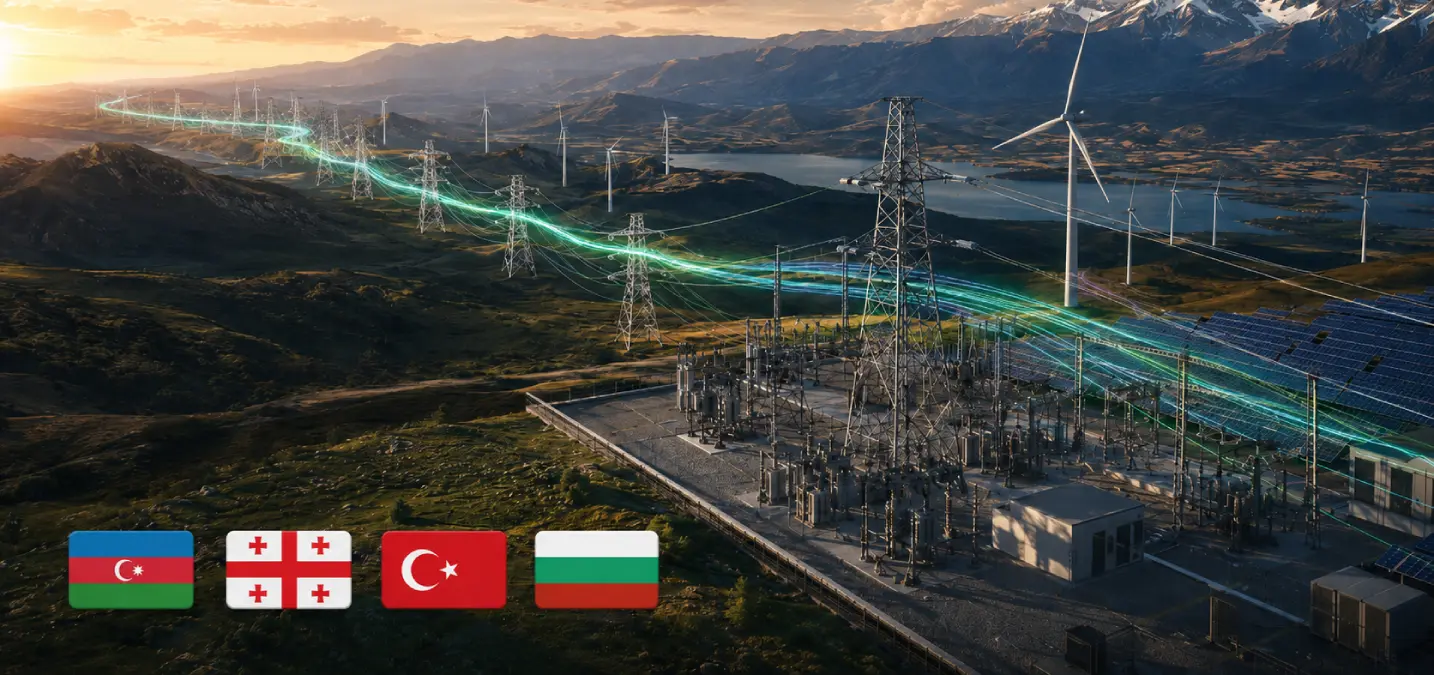
Türkiye, Azerbaijan, Georgia and Bulgaria agreed on Friday to establish a joint company to oversee the financing and implementation of a green electricity transmission corridor stretching from the Caspian basin to European markets, at a quadrilateral ministerial meeting held in Istanbul. The decision marks the most concrete operational step taken since the four countries signed a memorandum of understanding on the project in Baku in April 2025.
The meeting was attended by Türkiye's Minister of Energy and Natural Resources Alparslan Bayraktar, Azerbaijan's Minister of Energy Parviz Shahbazov, Georgia's Minister of Economy and Sustainable Development Mariam Kvrivishvili, and Bulgaria's Deputy Minister of Energy Kirill Temelkov. Azerbaijan's state news agency AZERTAC confirmed that the four countries' electricity transmission system operators had agreed to create the joint company, which will manage the technical feasibility study and coordinate project implementation. The feasibility work is already underway, and the initiative is expected to be finalised within months.
The project envisions electricity generated from renewable sources in Azerbaijan and Georgia being transmitted through Türkiye's national power grid to Bulgarian interconnection points, and from there into broader European electricity markets. The framework also includes a connection through Nakhchivan, Azerbaijan's exclave territory on Türkiye's eastern border, as well as potential links via the Zangazur Corridor to Central Asian energy flows.
What the Corridor Is and How It Got Here
The Azerbaijan-Georgia-Türkiye-Bulgaria Green Electricity Transmission and Trade Initiative has been in development since at least May 2025, when the four countries first agreed at an Istanbul energy forum to advance the concept. A memorandum of understanding was signed at the project's second ministerial meeting in Baku on April 4, 2025, formalising the framework and directing transmission operators to begin technical work. The document covers joint investment projects, electricity infrastructure development and integration with the European Network of Transmission System Operators for Electricity, known as ENTSO-E. Friday's Istanbul meeting was the third at ministerial level, and the first to produce a concrete institutional decision: the joint company that will now take the project from concept to engineering.
Azerbaijan is the primary energy source for the corridor. The country has set an ambition of developing more than 10,000 megawatts of renewable energy capacity, with plans to export approximately 4,000 megawatts to European markets. Its existing energy export infrastructure, including the Southern Gas Corridor and the Trans-Anatolian Natural Gas Pipeline (TANAP), has established a track record of cross-border energy transit that the green electricity project builds on directly.
Türkiye occupies a dual role in the project. It is a transit country for Azerbaijani and Georgian electricity flowing toward Bulgaria and Europe, and it is also a destination market, able to draw on the corridor's capacity for its own grid. The Turkish Electricity Transmission Corporation, known as TEIAŞ, signed an operational cooperation agreement with Azerbaijan's Azerenerji state electricity producer in April 2025, providing the institutional foundation for the transit arrangement. Under that agreement, Türkiye's existing Nakhchivan connection carries 75 megawatts of import capacity and 40 megawatts of export capacity.
Bulgaria is the European anchor of the corridor. A NATO and EU member with established grid connections to central and southeastern European electricity markets, Bulgaria provides the entry point through which Caspian-sourced green electricity reaches the broader European network. The project aligns with the EU's energy diversification strategy and its push to reduce dependence on Russian energy through alternative corridors and sources.
The Hormuz Backdrop
Friday's agreement arrived against a backdrop of sustained energy market disruption. Iran's effective closure of the Strait of Hormuz since late February has removed approximately 20 percent of global liquefied natural gas supply from circulation, according to the International Energy Agency, with cascading effects on European gas and electricity prices. European natural gas benchmark prices, measured by the TTF index, remain roughly 50 percent above pre-conflict levels.
In that environment, overland and alternative maritime routes for energy supply have gained strategic weight at a pace that no policy document anticipated. Türkiye's Energy Minister Bayraktar addressed the shift directly a day before the Istanbul ministerial, speaking at the International Natural Resources Summit in Istanbul on May 22. "The world has entered an age of uncertainty marked by wars, supply chain disruptions, energy crises and intensifying global competition over critical minerals and strategic infrastructure," he said. He outlined Türkiye's ambitions to reshape regional energy routes, including the green electricity corridor and a separate electricity interconnection project running from Saudi Arabia through Jordan and Syria into Türkiye.
Shahbazov framed the corridor in similar terms. In a post confirming the Istanbul meeting on X, he described Azerbaijan as "shaping new regional cooperation through green energy" and emphasised the country's role as a reliable energy partner for Southeastern Europe. In a separate statement the previous day, he said a new electricity link through the Zangazur Corridor connecting Azerbaijan's mainland to Nakhchivan and then to Türkiye would further strengthen Türkiye's role as a regional energy hub, and could eventually carry Central Asian electricity flows westward.
Part of a Wider Architecture
The green electricity corridor is one component of a broader energy architecture Türkiye presented at the Istanbul Natural Resources Summit this week. On the same day as Friday's ministerial meeting, state pipeline operator BOTAŞ signed a memorandum of understanding with Italy's Edison S.p.A. on potential cooperation in natural gas and liquefied natural gas, including a study of a possible hydrogen-ready gas interconnection between Türkiye and Italy. As Bosphorus News reported, Bayraktar described the new energy architecture as covering gas, LNG, electricity transmission, renewables, nuclear power and critical minerals inside the same strategic basket, with Türkiye as the connector between producers and European consumers.
Trans-Caspian shipping demand surged by an estimated 450 to 500 percent in the weeks following Hormuz's effective closure, as operators sought alternatives to routes running through Iranian territory. The four-country electricity project adds a new dimension to that shift. Unlike oil and gas pipelines, which are fixed infrastructure with long construction timelines, electricity transmission corridors can draw on existing grid assets and upgrade them incrementally. The feasibility study now under joint management will determine how much new transmission infrastructure is required and at what cost.
For Türkiye, the project reinforces the argument Bayraktar and other officials have been making throughout 2026: that Ankara's geographic position between European demand and Caspian and Gulf supply makes it an indispensable node in the continent's energy security architecture. That argument has gained practical weight in Brussels as Russian energy has been cut and Hormuz has tightened. Whether it translates into faster movement on pending EU-Türkiye files, including the Customs Union modernisation that Türkiye flagged as a priority in recent diplomatic conversations with Berlin and Brussels, remains to be seen.
The joint company will be established by the four countries' transmission operators. No timeline for incorporation or capitalisation was announced at the Istanbul meeting. The feasibility study is expected to conclude within the coming months.
***Sources: AZERTAC (Azerbaijani state news agency), Azernews, Report.az, Azerbaijani Ministry of Energy (minenergy.gov.az), Turkish Ministry of Energy and Natural Resources, Georgian Embassy official notice, Energy Minister Alparslan Bayraktar X post (May 22, 2026), Energy Minister Parviz Shahbazov X post (May 23, 2026).