
By Bosphorus News Energy Desk
Türkiye used the İstanbul Natural Resources Summit on May 22 to set out a wider energy architecture built around gas, LNG, electricity links and regional connectivity, as state pipeline operator BOTAŞ signed a memorandum of understanding with Italy's Edison S.p.A. on potential cooperation in natural gas and LNG.
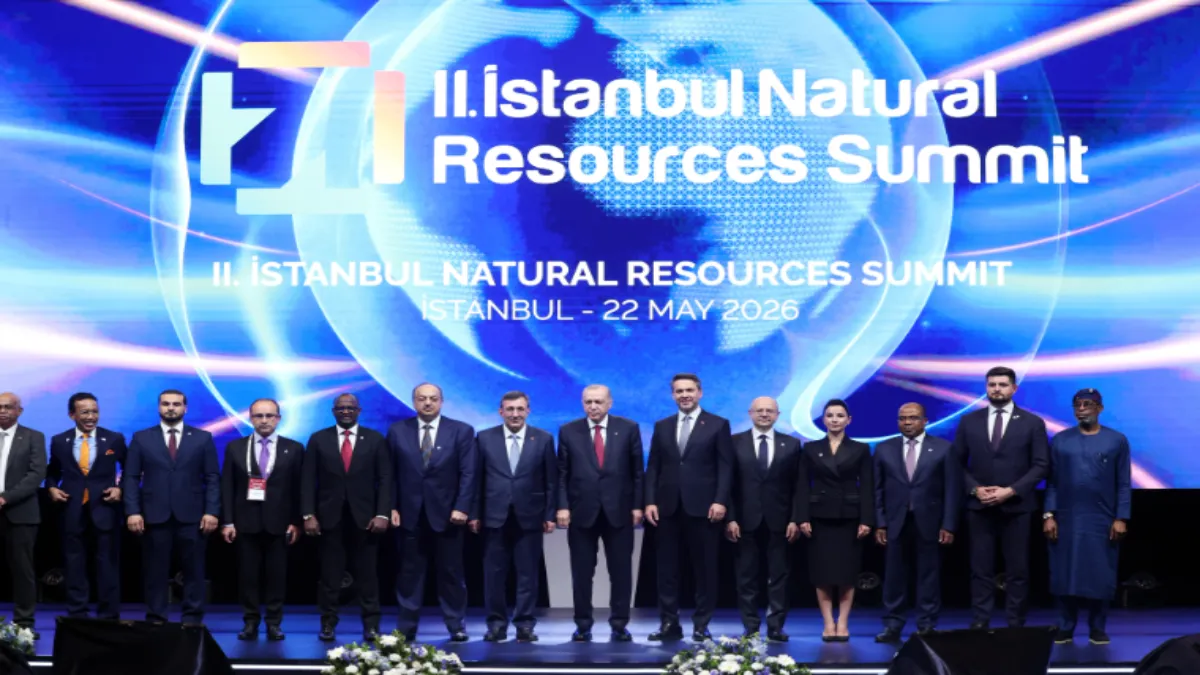
The summit, held at the Lütfi Kırdar Congress Center under the auspices of the Ministry of Energy and Natural Resources, brought together officials and sector representatives from 45 countries. President Recep Tayyip Erdoğan opened the event, while Energy and Natural Resources Minister Alparslan Bayraktar hosted the gathering.
Erdoğan said Türkiye had become "the strongest bridge" between energy-rich geographies and countries that need those resources, describing the country as both a transit point and a junction. He said recent crises in the region had strengthened Türkiye's role as a reliable partner in energy transmission and as a diplomatic actor seeking stability.
"Türkiye is the strongest bridge and crossing point between geographies rich in energy resources and countries that need them," Erdoğan said, according to the ministry's statement.
The president linked that role to Türkiye's growing gas infrastructure. He said the country's daily natural gas entry capacity had increased from about 90 million cubic meters when his government came to power to 495 million cubic meters today. He said Türkiye now receives gas through five pipelines, two from Russia, two from Azerbaijan and one from Iran, and has become a major energy infrastructure country sourcing gas from 39 countries and more than 50 companies.
Erdoğan also said Türkiye would raise its daily LNG regasification capacity from 161 million cubic meters to 200 million cubic meters through new investments. The message was clear: Ankara wants pipeline supply, LNG flexibility, storage and transit infrastructure to work together as part of a larger hub strategy.
Bayraktar gave the policy frame a more detailed infrastructure map. He said Türkiye was preparing a new energy architecture aimed at ending external energy dependence, strengthening supply security, increasing regional integration and turning the country into a central energy state.
The minister said Ankara wants existing routes such as TANAP, TürkAkım, the Baku-Tbilisi-Ceyhan pipeline and the Iraq-Türkiye crude oil pipeline to operate at full capacity. He also identified the extension of the Iraq-Türkiye oil pipeline to Basra and the delivery of Turkmenistan gas to Türkiye and Europe through a Trans-Caspian natural gas route as priority items for the new period.
Electricity connectivity formed the second layer of Bayraktar's message. He said Türkiye aims to carry renewable electricity produced in Azerbaijan to Europe through the Azerbaijan-Georgia-Türkiye-Bulgaria Green Electricity Transmission agreement signed last year in Baku. He also said work is under way on a mega electricity transmission line extending from Saudi Arabia to Türkiye and integrated with neighbouring countries.
BOTAŞ' agreement with Edison gives the summit's broader energy narrative a concrete European link. The memorandum of understanding was signed on the margins of the İstanbul Natural Resources Summit to evaluate potential cooperation in natural gas and LNG.
BOTAŞ said the agreement covers natural gas and LNG supply opportunities, joint commercial opportunities and the creation of a Joint Working Group. That group will study a possible hydrogen-ready natural gas interconnection between Türkiye and Italy from technical, commercial and regulatory perspectives.
The Italy track is significant because it places Türkiye's hub ambition inside a wider Mediterranean and European supply discussion. A hydrogen-compatible gas link, even at study stage, points to how Ankara is trying to connect near-term gas security with longer-term transition infrastructure.
BOTAŞ said the strategic partnership is expected to contribute to the development of both countries, Mediterranean connectivity and regional energy supply security. The wording matters. It frames the Edison MoU not only as a company-level cooperation document, but as part of a broader attempt to position Türkiye as a connector between suppliers, European consumers and future low-carbon infrastructure.
The summit also showed that Ankara is placing natural gas, LNG, electricity transmission, renewables, nuclear power and critical minerals inside the same strategic basket. Bayraktar said Türkiye's new energy architecture would require more connectivity and more infrastructure projects, and that stronger gasification infrastructure would allow higher LNG volumes to be delivered to Southeastern Europe and other neighbours.
The timing gives the message added weight. Energy routes around the Eastern Mediterranean, the Gulf, the Black Sea and the Caspian are all under new pressure from war risk, sanctions, shipping disruptions and Europe's search for more diversified supply. Türkiye's argument is that its location, existing pipeline network, LNG capacity and planned electricity corridors make it harder to bypass in the next phase of regional energy planning.
The BOTAŞ-Edison MoU does not by itself create a new pipeline or immediate gas flow. It does, however, give Türkiye's summit message a practical European file: a Turkish state company and an Italian energy group will now study gas, LNG and a possible hydrogen-ready connection at the same time Ankara is presenting itself as the strongest bridge between energy producers and consumers.