
Bosphorus News Geopolitics Desk
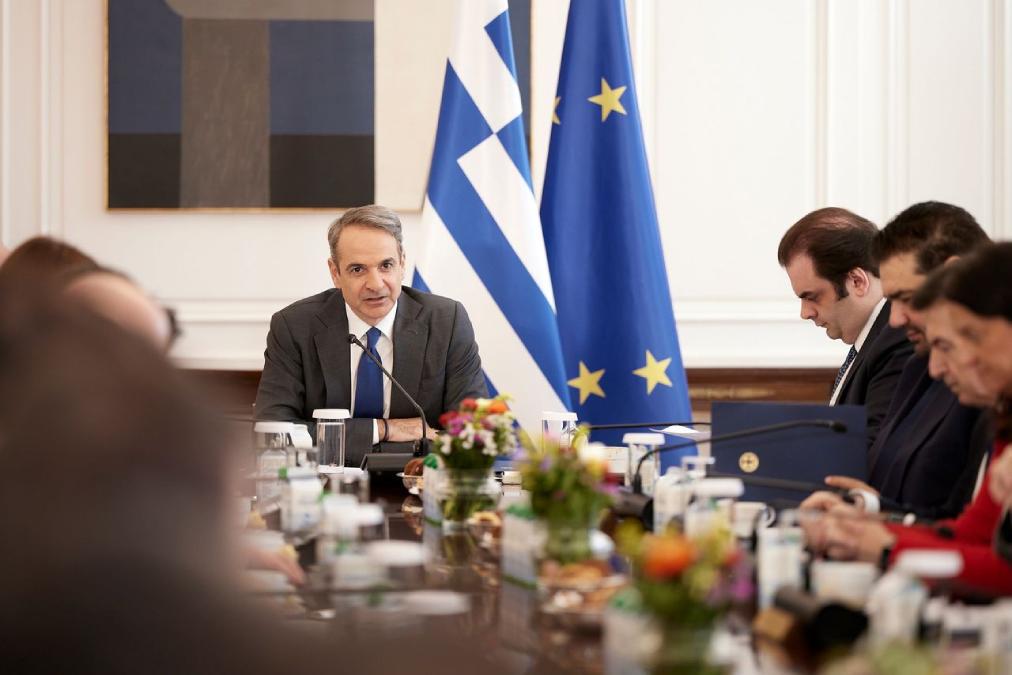
Greek Prime Minister Kyriakos Mitsotakis opened a cabinet meeting by placing his government's energy agenda inside a wider claim about a shifting international system. "We are meeting today at what I would call a decisive moment," he said, arguing that "international alignments are being shaken and the world is changing," under conditions in which "old alliances and geopolitical balances are being questioned."
"In the midst of this exceptionally fluid state of affairs, the only certainty is uncertainty," Mitsotakis added, before turning to what he presented as a practical answer. He treated the energy track as a package that carries more than investment headlines, with sovereignty language, corridor infrastructure, and alliance messaging placed side by side.
Offshore names, onshore leverage
Mitsotakis said ExxonMobil and Chevron, which he described as "two of the largest" and "leading" companies in the sector, are now investing "in our country, in our waters," partnering with major Greek firms "such as HELLENiQ ENERGY and Energean."
He presented their involvement as outside validation. "They underline that they trust the stability, the prospects, and the future of our country," he said. He added that "the potential investments we are discussing exceed by far one billion euros," and that the public benefit is "estimated at 40% of profits."
He then delivered the sovereignty line that he returned to repeatedly. "Greece is exercising its sovereign rights in practice and not in words," he said, placing exploration, investment, and state authority inside the same argument.
Corridors and gateways: the Vertical Corridor and Alexandroupoli
From offshore activity, Mitsotakis shifted to regional energy logistics. He argued that Greece is becoming "the main gateway for the entry and distribution of natural gas for all the states of central and eastern Europe," explicitly naming "the tested Ukraine" as part of the destination map.
He linked that role to Europe's effort to reduce reliance on Russia and to the role of United States liquefied natural gas. "With American LNG playing a decisive role in Europe's decision to reduce its energy dependence on Russia," he said, he described "critical infrastructure" in that effort and identified a "crucial hub" as the backbone of the plan: the Vertical Corridor.
Mitsotakis argued that the project "substantially upgrades our country's position," with particular impact in "northern Greece, Macedonia and Thrace." He used Alexandroupoli to make the claim concrete. He said he had been there the day before and had seen up close "how all the investments being made in the area upgrade both our national position and the image of the city." "We are talking about a completely different Alexandroupoli compared to a few years ago," he said.
Bosphorus News analysis on February 20 described this northbound corridor push as a quiet redistribution of transit leverage across the Eastern Mediterranean, built around Alexandroupoli-linked LNG flows and interconnectors reaching toward the Balkans and Ukraine. The point is not to erase routes that run through Türkiye, but to add optionality and dilute exclusivity over time as parallel infrastructure accumulates.
3+1 as the alignment frame
Mitsotakis insisted that the energy agreements "go far beyond their narrow economic framework," describing them as initiatives with "a deep geopolitical footprint." He connected these developments to the Eastern Mediterranean 3+1 format. "It is not a coincidence that these developments are accompanied by the 3+1 platform in the Eastern Mediterranean," he said, defining it as cooperation between "Greece, Cyprus, Israel and the United States" in the wider region.
He offered the synthesis in direct terms: "our energy policy is emerging as a central pillar of our foreign policy."
Delimitation and discipline: Libya, "only Türkiye reacts", Washington
Mitsotakis also brought maritime delimitation into the same sovereignty frame. He said Greece is "already in talks with Libya on the delimitation of maritime zones," presenting the channel as a continuation of what Athens "did with Egypt." He argued that any positive outcome "should obviously be compatible with the progress of the exploration," a formulation that treats diplomacy as a track meant to run alongside offshore activity.
The speech turned openly combative when he moved to criticism at home. After mocking what he cast as habitual alarmism, he argued that the government's course faces a familiar kind of resistance. "Let them also consider that, so far, only Türkiye reacts to this national course of our country," he said. "Türkiye, and unfortunately they do too." The point was not subtle. Domestic doubt was pushed into the same box as the external rival he named.
That move also turns external opposition into a legitimacy claim at home. By presenting Ankara as the sole external objector, Mitsotakis casts the energy track as a national course tested by a familiar opponent, then tightens the frame by folding domestic critics into it. Dissent is treated less as a policy disagreement and more as a refusal to accept sovereignty "in practice."
He then leaned on timing to press the argument. "These objections are not only out of place, they are also out of time," he said, pointing to the foreign minister's visit to Washington. He noted that Greece's top diplomat was meeting his American counterpart "for a second time," with the aim of "deepening this very important bilateral strategic relationship."
He uses Washington as the reference point, placing the energy package next to alliance management and insisting it should be read beyond domestic politics.
A closing turn: patriotism, foreign policy, and culture in the AI era
Mitsotakis closed the main geopolitical thread with a blunt contrast between action and suspicion. "What undermines the country's position is not the use of its wealth and the practical affirmation of its sovereign rights," he said. "What undermines it is miserable doubt."
He framed patriotism as construction rather than anxiety. "True patriots are not those who constantly express fears," he said. "They are those who build a Greece that does not fear."
He then moved from energy security to cultural policy, describing two bills and a national strategy for artificial intelligence in culture. He said the plan runs from digitizing heritage data to using artificial intelligence to reconstruct lost texts from inscription fragments, while also addressing monument protection amid climate pressures. He tied the agenda to cultural diplomacy, including the return of antiquities, and to creator protections against the unlicensed use of work by artificial intelligence systems.