
Bosphorus News Energy Desk
Greek Prime Minister Kyriakos Mitsotakis' meeting with a bipartisan U.S. congressional delegation did more than reaffirm routine bilateral ties; it illuminated a structural adjustment already underway in the Eastern Mediterranean's evolving energy landscape. Official statements highlighted cooperation in energy, defense and investment, yet the constellation of projects under discussion suggested a more deliberate reconfiguration of regional positioning.
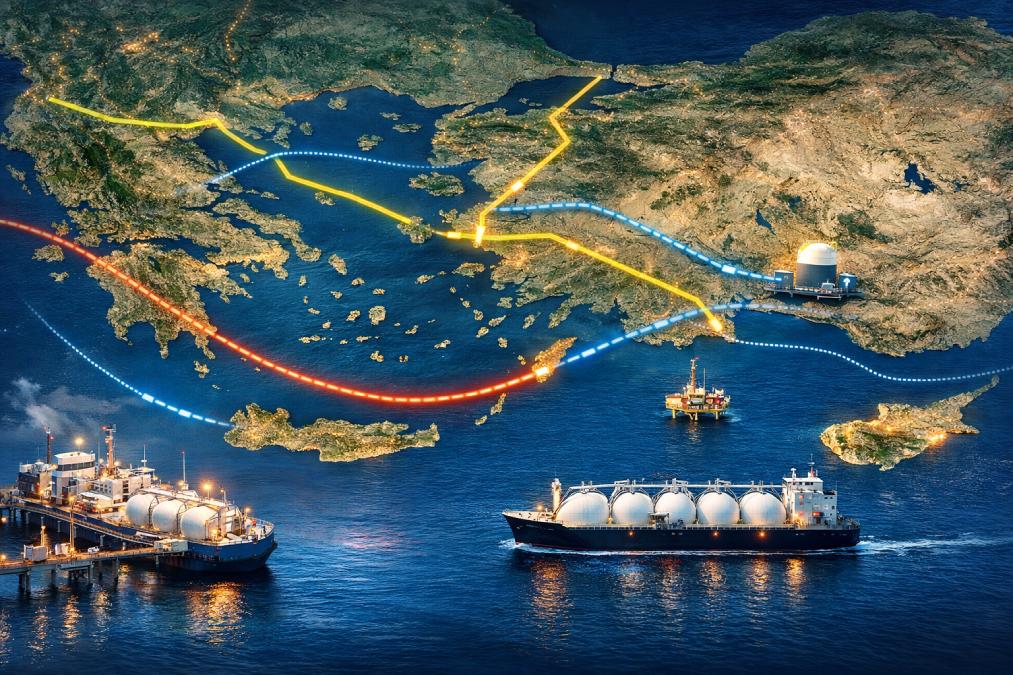
At the center stood the Vertical Corridor initiative, designed to move U.S. LNG from Alexandroupolis northward into the Balkans and toward Ukraine. Publicly framed as part of Europe's effort to diversify supply away from Russia, its deeper significance lies in the way it redistributes transit leverage across the region rather than simply adding another delivery route.
A new northbound corridor alters the geometry of energy transit in ways that do not replace existing flows through Türkiye but gradually dilute their exclusivity. For transit states, exclusivity is not symbolic; it underwrites bargaining power and strategic weight. As parallel routes accumulate and optionality expands, leverage becomes less a function of fixed geography and more a product of systemic flexibility.
Historically, transit influence has depended on concentration. Europe's current energy logic moves in the opposite direction, favoring dispersion and redundancy as safeguards against vulnerability. Over time, such diversification can reposition corridors that once occupied the center of the system without eliminating them altogether.
Mitsotakis' description of Greece as a "provider of energy security" for Southeastern Europe reflects ambitions that extend beyond domestic supply or storage capacity. Athens is seeking to establish itself as a structural node within a wider redistribution network built around LNG terminals, port infrastructure and interconnectors that channel flows northward. The objective is not merely to receive energy, but to intermediate it.
The meeting unfolded against renewed friction between Ankara and Athens over hydrocarbon blocks south of Crete, where Türkiye formally objected to Greece's agreement with Chevron on the grounds that certain areas overlap with maritime zones defined under the 2019 Türkiye–Libya memorandum. That dispute forms part of a broader contest over jurisdiction and offshore exploration rights in contested waters.
Although the U.S. delegation did not address the Chevron agreement directly, separating commercial expansion from congressional diplomacy would overlook how U.S. energy policy often operates in practice. As Bosphorus News reported on February 19, Ankara objected to Greece's Chevron-backed move south of Crete, citing legal concerns in a disputed basin. In sensitive offshore environments, major U.S. energy investments seldom proceed in isolation from Washington's broader strategic posture; corporate expansion, diplomatic engagement and congressional visibility tend to advance along converging lines, reinforcing each other without the need for overt coordination. In that sense, energy diplomacy functions not only as supply diversification, but as political framing for commercial activity in geopolitically charged waters.
This episode also fits within a wider acceleration of upstream energy activity across the Eastern Mediterranean. As Bosphorus News analysis noted on February 13, multinational agreements have been advancing across rival jurisdictions in close succession. Within weeks, Türkiye Petrolleri A.O. signed memoranda with bp, ExxonMobil and Chevron, while Chevron approved expansion at Israel's Leviathan field and ExxonMobil moved forward with offshore talks in Cyprus. If these framework agreements evolve into active drilling, commercial momentum and sovereignty disputes will proceed in parallel, tightening the interaction between market dynamics and unresolved maritime claims.
The competition now shaping the Eastern Mediterranean is less about naval signaling than about the infrastructure that determines long-term positioning. LNG terminals, interconnectors, port access and long-duration supply contracts increasingly define the tempo of influence, embedding geopolitical considerations within technical and commercial decisions.
Energy cooperation was discussed alongside defense ties and investment in artificial intelligence infrastructure not as isolated policy tracks, but as mutually reinforcing layers of a single strategic design. Reliable power underpins digital expansion, security guarantees protect critical systems, and capital tends to consolidate where both are aligned. By integrating energy, defense and technology planning, Greece is situating itself more deeply within U.S.-linked security and financial networks rather than treating energy as a stand-alone sector.
Türkiye, for its part, remains a central transit actor, linking Azerbaijani gas, Russian supply and global LNG flows to European markets through an extensive pipeline and LNG network. Its position is not collapsing; the surrounding architecture is evolving. In an environment defined by diversification, leverage becomes conditional on adaptability rather than guaranteed by location alone.
Ankara's long-standing ambition has extended beyond hosting pipelines toward translating geography into price-setting capacity. That objective entails the development of liquid trading platforms, regulatory authority and contractual centrality within European markets, all of which move the conversation from physical transit to rule-setting. As alternative corridors emerge, competition shifts from controlling routes to shaping the frameworks within which those routes operate.
The significance of the meeting therefore lies not in a single corridor or agreement, but in the direction it renders unmistakable. The Eastern Mediterranean energy map is being reorganized through cumulative infrastructure choices, commercial alignments and regulatory preferences that will endure beyond the current diplomatic moment. Geography still confers advantage, yet it no longer resolves the equation on its own; what increasingly determines influence is how markets are structured, how access is priced and who defines the operating terms of the system.