
By Murat YILDIZ
Türkiye is a middle power with genuine regional reach. But President Erdoğan has spent two decades selling something larger: a civilisational force, a global voice, a state that speaks for the Muslim world and answers to no one.
The deployments were the proof of concept. Somalia. Libya. Qatar. Azerbaijan. Each one was presented as evidence that Türkiye had broken free of its old constraints, that Ankara no longer waited for permission. But look at the list carefully. None of these theatres carry the weight of a defining national cause. Libya is a transactional interest. Somalia is a footprint. Qatar is a base. Azerbaijan is fraternal solidarity, not a live dispute that has shaped Türkiye's foreign policy identity for generations.
Cyprus is different. Cyprus is the one place where Türkiye's historical presence spanning centuries, its legal status as a guarantor power, and fifty years of unbroken diplomatic and military commitment come together. No other issue has cost Türkiye more internationally. No other issue has been defended more fiercely, or more consistently framed as a matter of national survival.
So when Cyprus came under fire in March 2026, the question was not whether Türkiye would lead the response. The question was whether it would show up at all.
It did not.
The Island Türkiye Has Always Called Its Own
Cyprus has never been a foreign policy issue for Türkiye. It has been a cause. Ottoman administration of the island lasted three centuries. The 1960 Treaty of Guarantee made Türkiye one of three guarantor powers. In 1974, Türkiye intervened militarily and has maintained a presence ever since.
The price has been real. Decades of international sanctions. Diplomatic isolation accepted as the cost of a principled position. No other issue has extracted more from Türkiye internationally.
In March 2026, as drones struck the island, Erdoğan was working the phones. Capital after capital. The "world leader" (dünya lideri) was mediating. The "world leader" was indispensable. The "world leader" would end the war. Cyprus had just been hit. Ankara was busy with history.
Cyprus was not the story.
Türkiye Shows Up. Except Here.
Türkiye operates a naval base in Somalia. It has deployed troops to Libya and maintains a military presence in Qatar. The images were carefully managed: Turkish warships cutting through distant seas, soldiers raising flags in African capitals, Erdoğan greeting commanders on foreign soil. And the drones. Bayraktar TB2. Akıncı. Weapons Erdoğan has turned into a personal brand, proof that Türkiye builds what others buy and fights where others hesitate. He sent them to Libya. To Ukraine. To Azerbaijan. Every deployment was a performance. Every performance carried the same line: when it matters, Türkiye shows up.
In March 2026, drones flew over Cyprus. They were not Turkish.
The Empty Seat at the Table
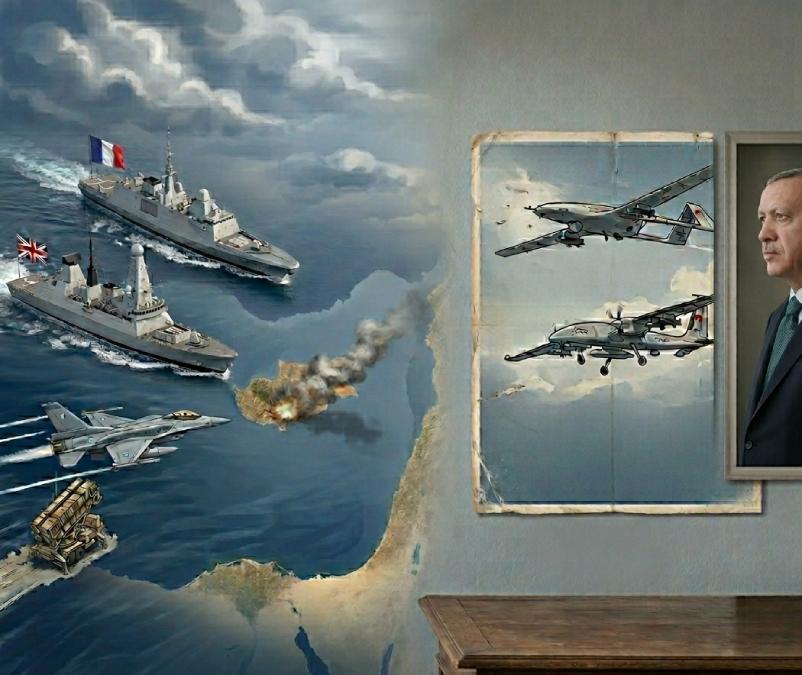
On 2 March 2026, an Iranian-made drone struck RAF Akrotiri. The response was immediate. France deployed a frigate and anti-missile and anti-drone systems. The United Kingdom sent HMS Dragon, a Type 45 destroyer, and Wildcat helicopters equipped with counter-drone capabilities. Greece activated its Unified Defence Doctrine, dispatched two frigates and four F-16s, and began deploying a Patriot system. Germany and Italy entered talks on further deployments. The European Commission convened an emergency Security College meeting.
One seat was empty. It had a name on it.
The Constraints Are Real. They Are Not Sufficient.
Ankara's constraints are not invented. Türkiye shares a 534-kilometre border with Iran. Active involvement risked refugee flows, energy disruption, and a border crisis its already strained economy could not absorb.
None of this is sufficient. For decades, Türkiye has defined itself internationally through Cyprus. It has fought diplomatic battles, defied international courts, and strained relations with the European Union and the United States over the island. No other issue has cost Türkiye more, or been defended more fiercely. To cite border security and economic fragility as reasons for inaction on Cyprus is not a strategic calculation. It is a contradiction.
A Choice, Not a Constraint
The deeper issue is not what Türkiye could not do. It is what Türkiye chose not to do.
Türkiye and Iran share a border, energy ties, and decades of managed coexistence through sanctions, proxy conflicts, and now war. Ankara has never pretended otherwise. NATO has always known this. So has Washington. It is not a surprise. It is a structural feature of Türkiye's regional position.
But Cyprus sits outside that calculation. Turkish Cypriots have lived under Ankara's security guarantee for half a century. When drones and missiles do not distinguish between north and south, that guarantee means something, or it should. A country that claims to lead the world in drone warfare, that has built Bayraktar into a global brand, did not send a single asset to protect its own people on the island it has defended diplomatically for generations.
Ankara chose not to test that.
Türkiye, France, Greece, and the United Kingdom are all NATO members. There was no unfamiliar coalition to join, no new architecture to accept. The framework already existed. Ankara chose not to use it. It went further: Türkiye denied the United States access to its airspace, land, and maritime space. That decision had consequences beyond Cyprus.
Greece activated its Common Defence Doctrine and deployed frigates and F-16s to the island. France sent a frigate. The United Kingdom sent a destroyer. For decades, Türkiye has positioned Greece as the adversary on Cyprus, the power working against Turkish Cypriot rights. In March 2026, that same Greece was defending the island Ankara would not.
A state that closes its doors to its allies, watches its historic cause defended by those it calls rivals, and leaves its own silence as the only contribution to the crisis, has made a choice. That choice has a name. It is not neutrality.
The Cost of the Delusion
Erdoğan has a gift for the memorable line. "The world is bigger than five." "We can come suddenly one night." Slogans that have travelled far, that have been cheered at rallies, repeated on state television, and offered as proof that Türkiye speaks a language others are afraid to speak.
In March 2026, Cyprus was under fire. Nobody came suddenly one night. Nobody came at all.
The silence also raises a harder question. Türkiye's Blue Homeland doctrine, the strategic vision that asserts Türkiye's sovereign rights across vast stretches of the Eastern Mediterranean, has been presented for years as the ideological backbone of Ankara's maritime ambitions. Cyprus sits at the centre of that sea. Bosphorus News has previously argued that the doctrine carries a structural contradiction, in its analysis titled "Legitimate Claims, Faulty Framing: The Strategic Cost of Blue Homeland". "Blue Homeland has strengthened domestic mobilization. The evidence increasingly suggests it has constrained diplomatic elasticity." March 2026 did not just confirm that assessment. It exposed its military dimension. A doctrine that cannot be activated when the geography it claims comes under fire is not a strategic vision. It is a poster on a wall.
Erdoğan's foreign policy legacy will be measured not by the deployments to distant theatres, but by what Türkiye did and did not do when it mattered most. Somalia is far. Libya is manageable. Qatar is safe. Cyprus was none of those things. It was the real test.
Türkiye will go anywhere. Except Cyprus.