
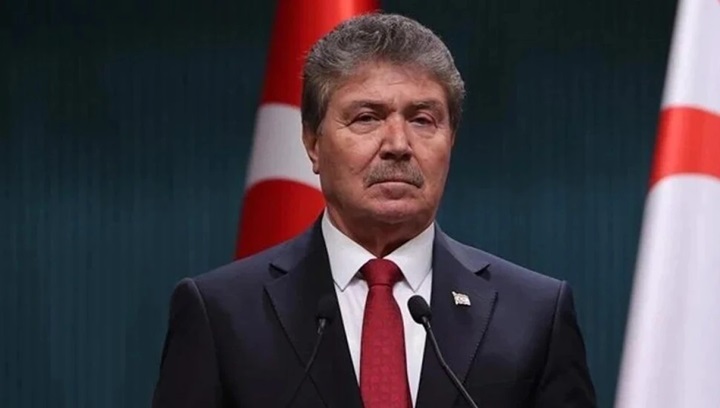
The Prime Minister of the Turkish Republic of Northern Cyprus (TRNC), Ünal Üstel, has framed Türkiye's presence on the island as a decisive security guarantee, using the war in Gaza as a reference point while addressing regional risks and the political context ahead of renewed Cyprus talks.
Speaking during a meeting with journalists in Northern Cyprus, Üstel argued that Türkiye's role has been critical in preventing large-scale insecurity. "If Türkiye had not been here, we would have experienced what is happening in Gaza," he said.
The remarks come as preparations continue for UN-facilitated Cyprus talks scheduled for 26–28 January, a process that has sharpened political messaging across the island.
Security framing and regional risk
Expanding on his argument, Üstel warned that the absence of Türkiye's backing would have left Turkish Cypriots exposed to severe pressure and violence.
"If the Republic of Türkiye were not our motherland, we would have faced the same pressures, oppression, and brutal violence inflicted by the Greek Cypriots," he said. "The reason they have not gone that far is the strong support we receive from the Republic of Türkiye. Otherwise, today they might have wiped out the Turkish Cypriots."
The Gaza reference was used to underline vulnerability and deterrence rather than to draw a direct parallel between conflicts. Üstel positioned Türkiye's political and military support as central to stability in Northern Cyprus, while criticising what he described as international silence in the face of humanitarian crises.
Allegations targeting the Greek Cypriot side
In the same appearance, Üstel raised concerns about public order and youth crime, accusing the Greek Cypriot administration of contributing to security risks on the island. "It is the Greek Cypriot side that supplied these young people with weapons," he said.
The allegation was presented as a claim and was not accompanied by publicly disclosed evidence. Greek Cypriot authorities have not issued a response.
Üstel also referred to steps taken in coordination with Türkiye to tighten security screening measures at entry points, citing internal security considerations.
Presidency, methodology, and the upcoming talks
Üstel's remarks also touched on the political context ahead of the late-January talks, referring to the position of Tufan Erhürman and suggesting that the president's language on the Cyprus issue has evolved over time.
"Mr Erhürman has changed his position," Üstel said, recalling Erhürman's earlier emphasis on a bi-zonal, bi-communal federal framework.
In recent public statements, however, Erhürman has placed less emphasis on labels and more on substance and sequencing. In an interview conducted at the Presidency in Lefkoşa, he argued that the core of the Cyprus problem lies in areas of shared authority that directly affect sovereignty and daily life, stating that "hydrocarbons, energy, maritime zones, trade routes, security, and European Union citizenship are shared authority areas," and adding that "these powers were taken away from us and must be exercised jointly, on the basis of political equality."
Erhürman has also said he does not intend to prioritise naming a solution model before agreeing on methodology. "For now, I will not attach a name to the form of the solution. I do not want to disrupt my methodology," he said.
With separate and joint meetings set to take place under UN auspices later this month, attention is now focused on how the presidency will articulate its position at the table. Which elements Erhürman chooses to foreground during the talks is being closely followed in Northern Cyprus.
Security language and political positioning
Üstel's statements reflect how security considerations and negotiation frameworks continue to shape political discourse in Northern Cyprus. By invoking Gaza, alleging external security risks, and questioning how the presidency will frame its approach, the prime minister outlined his government's priorities without presenting the issue as a direct political confrontation.
As the talks approach, the balance between security, methodology, and political equality remains central to the island's political agenda.