
By Bosphorus News Geopolitics Desk
Jim Krane's Gas and Geopolitics in the Eastern Mediterranean, published by Arab Center Washington DC on 1 October 2025, reads differently today. As pressure returns to the region's energy and security map, its central argument feels more relevant than when it first appeared. It does more than review reserves, export routes, and infrastructure options. Its real value lies elsewhere. It asks why Eastern Mediterranean gas failed to deliver the political effect once attached to it. The central argument is clear: gas did not soften the region's disputes. Instead, sovereignty, maritime boundary, and recognition conflicts spilled into the energy arena, making investment, infrastructure planning, and regional cooperation more fragile.
That argument matters because it pushes back against an assumption that shaped much of the early discussion around Eastern Mediterranean gas. New discoveries were expected to encourage cooperation, give Europe an additional source of supply, and create incentives for political accommodation among rival actors. That logic did not hold. Commercial constraints, unresolved disputes, and competing regional agendas prevented gas from becoming the stabilising force many had projected.
One of the strongest parts of the study is its treatment of infrastructure and market reality. The central question is not simply how much gas the region holds, but how that gas can reach consumers at a competitive cost and through a politically viable route. In that respect, the tone is notably sober. The much discussed pipeline options toward Europe have struggled to overcome financial and geopolitical obstacles, while Egypt's liquefied natural gas facilities remain the only functioning export outlet for regional gas to international markets.
That shifts the discussion away from headline reserve figures and back toward delivery, financing, and political access. Egypt appears here not simply as another producer, but as the practical hinge of the current export structure. Israel may hold important volumes and Cyprus may remain central to future planning, but without commercially workable routes and political alignment, those assets do not automatically turn into geopolitical weight.
Türkiye enters the picture at exactly this point. Ankara is not treated as a side actor reacting from the margins. The study places Türkiye inside the commercial and political reality of the region's unresolved energy routes, showing how geography, infrastructure, and market position shape what the Eastern Mediterranean gas map can and cannot become. That is one of its more useful judgments. It moves beyond the familiar habit of describing Türkiye only through friction and objection.
Türkiye's own gas production remains limited, but its wider energy position is anything but marginal. With pipeline connections to Russia, Azerbaijan, and other suppliers, alongside substantial LNG import capacity, Türkiye sits on infrastructure that already links producing regions to major markets. The point here is larger than Eastern Mediterranean gas alone. It is about access, transit, and the routes that make energy commercially meaningful.
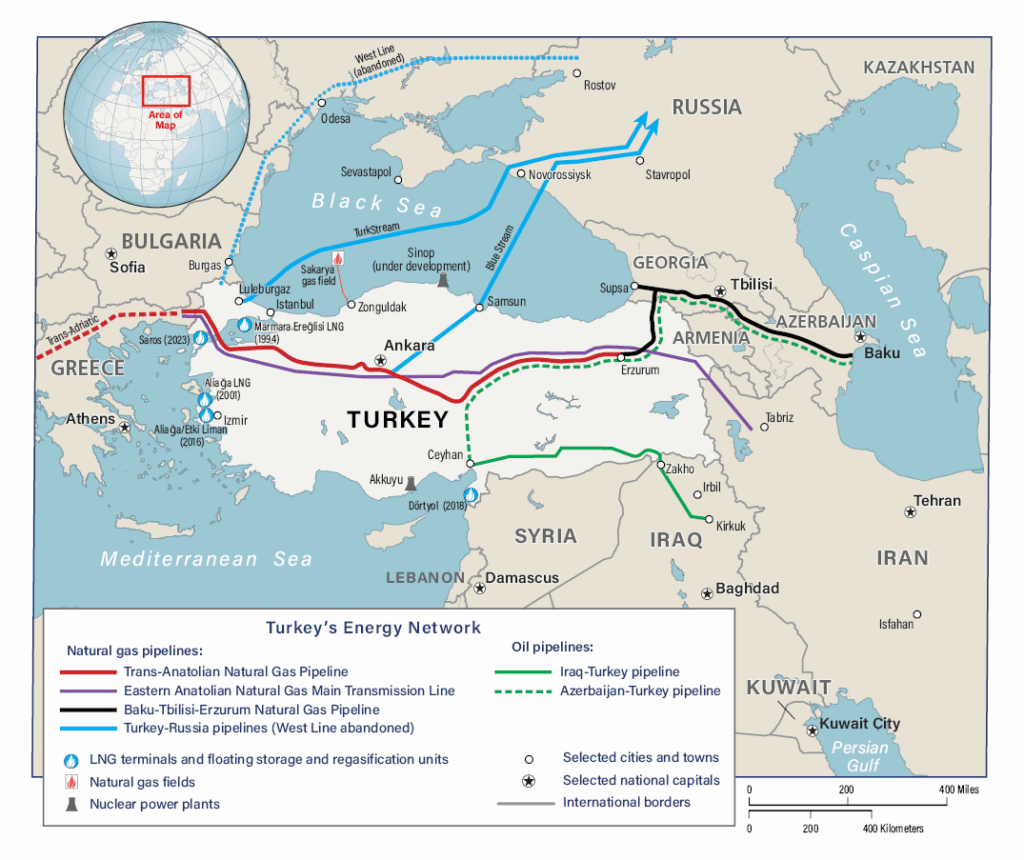
This is where Cyprus becomes central to the logic of the piece. Some of the most commercially sensible routes remain blocked not by geology or engineering, but by politics. A connection from Cyprus through Türkiye would be shorter and more practical than several of the alternatives long discussed in regional diplomacy. Yet the unresolved Cyprus dispute, the recognition issue, and wider maritime disagreements continue to shut that option off.
The Cyprus dimension carries more weight here than a narrow route discussion might suggest. Part of the original promise of Eastern Mediterranean gas rested on the hope that resource development would encourage boundary settlements, with Cyprus at the heart of that expectation. Instead, the dispute remained unresolved, commercially sensible options stayed blocked, and the island's offshore potential moved forward more slowly than the region's early optimism had suggested. Cyprus emerges here not just as another node in the gas map, but as one of the clearest examples of how political deadlock outlasted the promise of energy diplomacy.
Another strength is the way regional institutions are handled. The Eastern Mediterranean Gas Forum is not treated as a neutral container of cooperation. It is presented as an attempt to organise a regional energy framework whose political limits were visible from the start. Türkiye's exclusion mattered not only diplomatically but commercially, because a structure that leaves out one of the most important transit countries also narrows the range of workable export options. The problem, in other words, was never just unresolved disputes at sea. It was also the attempt to build an energy order around them without bringing all the key actors into the same framework.
That gives the study much of its wider value. It is not merely saying that politics got in the way of energy cooperation. It shows that the region tried to build energy cooperation on a political foundation that was already fractured. That helps explain why the early promise attached to Eastern Mediterranean gas began to fade. The obstacle was not only cost, distance, or technical difficulty. It was the absence of a political arrangement broad enough to support the infrastructure being imagined.
It is especially useful on one further point. It resists the old assumption that gas, by itself, can soften entrenched disputes. Energy is not treated as irrelevant. The argument is narrower and more convincing than that. Energy could not do this kind of political work on its own. In the Eastern Mediterranean, the reverse often happened. Political disputes shaped the energy map first, and commercial logic had to operate inside those limits. That is one reason this reads as a corrective to years of inflated expectations around the region's offshore discoveries.
It also helps that scale is kept in view. The significance of Eastern Mediterranean gas is not denied, but it is cut down to proportion. These resources matter, especially to nearby markets and to the states directly involved, yet they were never large enough to transform Europe's energy position on their own or to override the political fractures surrounding them. That restraint gives the argument credibility. It keeps the discussion anchored in market size, infrastructure limits, and regional politics rather than in the grand claims that so often accompanied the first wave of discoveries.
At the same time, this is not a text without limits. It gives Türkiye more weight than many Washington based energy discussions usually do, but it still approaches the regional picture from a framework in which Ankara often appears as the actor challenging an emerging order rather than as a country advancing its own legal and political case. That does not weaken its value, but it does shape how it should be read. Its strongest contribution lies less in normative balance than in its clear demonstration that no durable Eastern Mediterranean energy map can be built while Türkiye remains outside the core political and commercial equation.
One final reason it deserves attention is that it strips away the exaggerated strategic claims that once surrounded the region's offshore discoveries. Eastern Mediterranean gas matters, but this text makes clear that it was never likely to redraw Europe's energy balance on its own or to override the political fractures around it. That restraint is one of its strengths. It brings the discussion back to scale, cost, infrastructure, and political access, which is where a more serious assessment of the region has to begin.
That is also why it feels more useful now than it may have when it first appeared. The value of the study goes beyond a narrow energy debate. It offers a grounded explanation for why the Eastern Mediterranean produced so much geopolitical expectation and so little durable settlement. Gas did not dissolve the region's disputes. It moved through them and was constrained by them at every stage. Read today, it is less a snapshot of a passing debate than a clear account of the limits that have shaped the region's energy map from the start.
***Full report: Jim Krane, Gas and Geopolitics in the Eastern Mediterranean, Arab Center Washington DC, 1 October 2025.