
By Murat YILDIZ
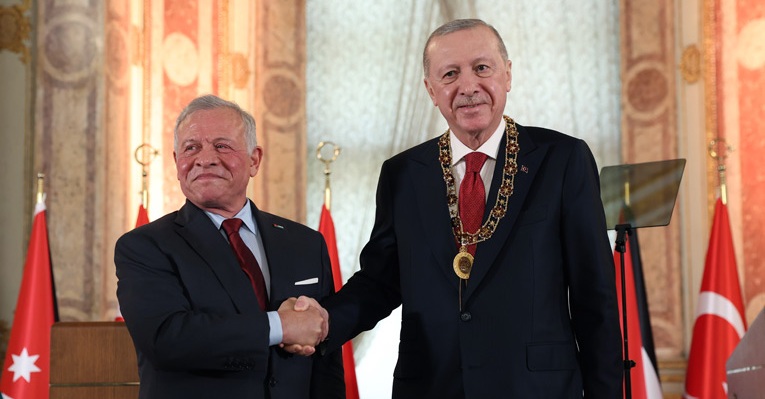
The presentation of the Hüseyin bin Ali Order to President Recep Tayyip Erdoğan by King Abdullah II of Jordan took place on February 7, 2026, during a decoration ceremony at the Presidential Dolmabahçe Working Office in Istanbul, following one on one and delegation talks between the two leaders. President Erdoğan said he was pleased to receive the order. The moment sits uneasily with the historical narrative that underpins much of Erdoğan's political language.
In Arab state memory. In Ottoman history, however, he is inseparable from the 1916 Arab Revolt against imperial rule, and in Türkiye's official historiography and today's Turkish collective memory he is often recalled less as a dynastic ruler than as a figure associated with the fragmentation of Ottoman authority in the Arab provinces during the First World War. The revolt was politically and militarily supported by Britain, most visibly through figures such as T. E. Lawrence, widely known as Lawrence of Arabia, whose role later became emblematic of external involvement in the dismantling of Ottoman authority in the Hijaz. The symbolism, at first glance, runs counter to Erdoğan's longstanding emphasis on Ottoman continuity, imperial sovereignty, historical grievance, and civilizational grandeur.
What makes the moment notable is not contradiction in a crude sense, but curation. Modern diplomacy rarely asks leaders to reconcile historical narratives in public. Instead, it asks them to suspend certain memories. In this case, the anti Ottoman dimension of Hüseyin bin Ali's legacy is not rebutted or reinterpreted. It is simply left unspoken. The honor functions less as a historical statement and more as a contemporary signal. One that relies on silence rather than synthesis.
In Jordan's official state narrative, Hüseyin bin Ali is remembered as the patriarch of Hashemite statehood and Arab self determination, a framing that deliberately detaches his legacy from its Ottoman context. This selective emphasis allows the figure to function as a unifying symbol domestically, even as his historical role carries different meanings elsewhere.
This is not unique to Türkiye, nor to Erdoğan. Comparable moments are not hard to find. Western leaders routinely receive decorations named after imperial or colonial figures without reopening debates about empire. Former adversaries exchange state medals whose origins reflect conflicts now diplomatically dormant. Revolutionary figures are recast as neutral founders once their disruptive meaning has been absorbed into statehood. These examples do not erase historical irony. They normalize it.
In Erdoğan's case, the episode reveals less about a shift in worldview than about hierarchy. Present day strategic relationships outrank historical consistency. Ottoman memory remains central in domestic political storytelling. Abroad, however, that memory becomes selective. Activated when useful. Muted when inconvenient.
What is striking, then, is not that the honor was accepted, but how effortlessly the tension was absorbed. Silence, in this case, carried the diplomatic and historical burden.