
Bosphorus News Geopolitics Desk
For years, the United States shipbuilding problem was discussed in familiar terms, a backlog shaped by procurement timelines and budget cycles rather than a constraint with strategic consequences. In 2026 it is being addressed more plainly as a limitation that cannot be repaired quickly enough inside the American industrial base, and that shift is reflected in the White House's Maritime Action Plan, which reaffirms the long term aim of rebuilding at home while also accepting that near term throughput may have to come from allied yards and supply chains that can absorb defined work packages without waiting for a generational rebuild of domestic capacity.
What stands out is the geography now under discussion, because the options being circulated do not point to a single partner or a single corridor but to parallel lanes in the Eastern Mediterranean designed to serve different political and industrial purposes at the same time. The Eastern Mediterranean appears here for practical reasons that go beyond proximity, since it sits on intersecting maritime routes and already contains yard ecosystems that can be tasked, expanded, and audited without inventing capacity from scratch. The region functions as an industrial reservoir of usable yard capacity, workforce depth, and supplier networks that can be activated faster than building a new industrial base from zero elsewhere, which is the kind of baseline Washington needs when speed matters and delays carry operational cost. One lane runs through Greece with South Korea presented as the industrial engine, while the other runs through Türkiye as a capacity and components option, and although these are not interchangeable projects, they reflect the same American reality in which time is scarce and production paths that can be activated quickly carry more weight than elegant plans that cannot clear domestic constraints. The search also carries a supply chain security dimension, because control over critical inputs and production choke points becomes harder to ignore when maritime competition hardens and the question turns to who can be integrated into the chain under pressure.
Greece as the packaged lane, built for scale and political legibility
In Athens, the United States Ambassador, Kimberly Guilfoyle, has been quoted describing a coming trilateral shipbuilding agreement between the United States, South Korea and Greece, framed as a presidential priority.
The attraction of this lane sits in the combination of industrial maturity and political presentation, because South Korea brings throughput, process discipline, and a shipbuilding ecosystem already integrated into defence industrial supply chains, while Greece offers yards, location, and a setting that allows Washington to present the effort as allied industrial coordination rather than a hurried workaround driven by American shortages. In practice, the lane is being assembled as a politically legible production pathway, with South Korean methods and oversight shaping what Greek yards can absorb and how quickly they can be brought into routines that match United States requirements, and legibility is central because it helps a cross-border production lane clear Washington's domestic threshold without being framed as outsourcing.
The China angle sits in the background of this lane. It is about control over maritime nodes and the ability to insulate supply chains when pressure rises.
Even within this packaged plan, the ceiling is real and it is set by Washington rather than by the yards themselves, because overseas naval construction quickly becomes a domestic political minefield in the United States where "build at home" is treated simultaneously as industrial policy, jobs policy, and national security. Early deliverables that can move first therefore tend to sit below the headline threshold and arrive in quieter forms, components and subsystems, modular production, maintenance packages, and training pipelines that can be defended as capacity relief rather than outsourcing, with any discussion of full platform construction remaining constrained by procurement rules, domestic politics, and the boundary between industrial cooperation and overseas naval building.
Türkiye as the plug-in lane, where existing capacity sets the terms
A separate line of discussion has centred on talks with Türkiye since last year on naval shipbuilding cooperation, with an agenda described not as a single contract but as a range of possibilities aimed at easing United States Navy bottlenecks through components, potential frigate related work, and other support arrangements.
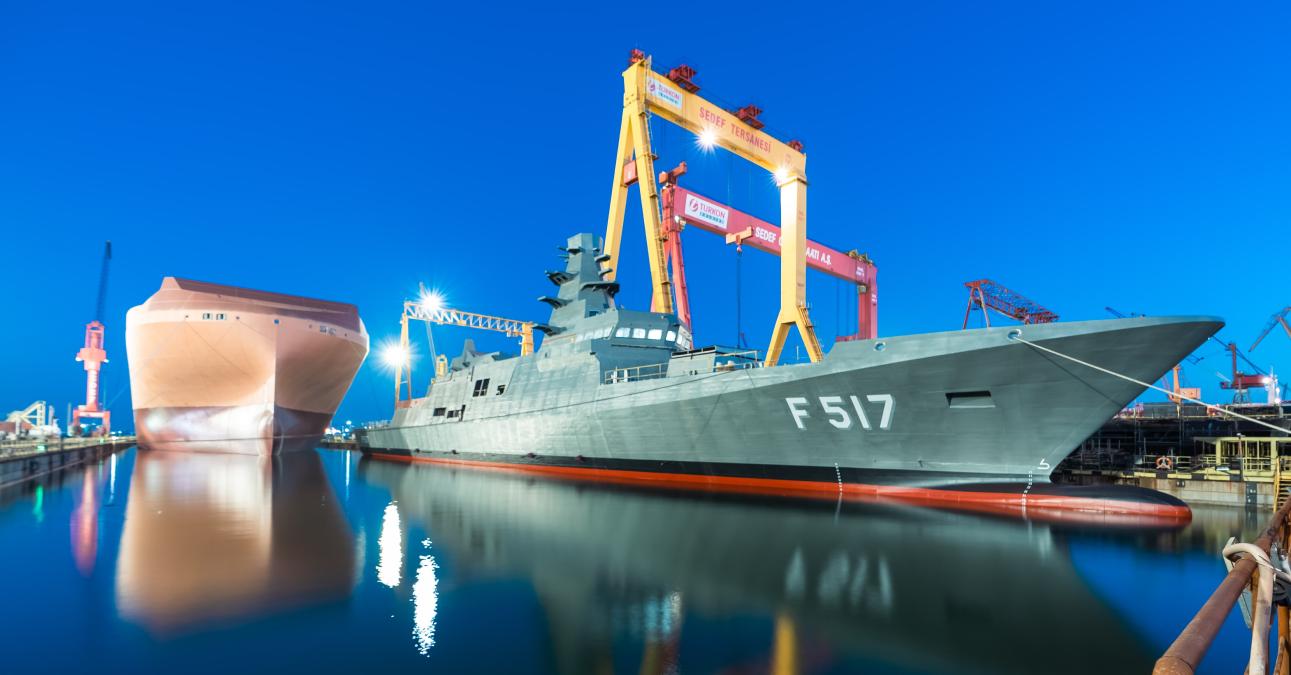
Here the attraction is operational capacity that already exists, and the question becomes how quickly it can be mobilised into United States demand without forcing a public leap. The case for Türkiye rests on existing capability rather than on a pre-built diplomatic architecture, because Türkiye combines shipbuilding capacity with programme experience through MİLGEM, the Milli Gemi national warship programme, and it also has the ability to run parallel output across a dense yard ecosystem, with İstanbul and its wider programme management capability repeatedly cited as the operational centre of gravity. Programmes like MİLGEM carry national prestige, which makes any cooperation vulnerable to a subcontractor label at home, and that is another reason the viable path runs through technical work packages and standards work rather than symbolic platform claims. Big platform headlines travel fast and they also provoke the fastest pushback, which is why the work that tends to survive first sits in less dramatic tiers such as subcontracting, standards alignment, and support packages that improve throughput without turning cooperation into a domestic political test.
This points to a portfolio logic, with deliverables shaped by the political threshold each lane can realistically clear and with the two lanes serving different roles in the same American effort to buy time. The Türkiye lane starts from a different premise, because capacity already exists at scale and the practical question is how that capacity can be activated and integrated into United States needs through parts, modular work, and support arrangements that can be executed without forcing a public commitment that would harden opposition.
The boundary line, what can be done quietly, and what cannot be said loudly
A Turkish Defence Ministry denial of claims about joint naval shipbuilding, including the notion of co-producing frigates, matters because it draws a boundary around what can be said publicly even if technical conversations exist behind closed doors, and it should be read as a sequencing cue because it tells you which work packages can move without becoming a political symbol and which ones will stall the moment they become a headline.
That boundary does not automatically rule out cooperation, but it narrows the forms that are likely to appear first and it clarifies why early movement, if it comes, will look technical and incremental rather than symbolic. The plausible early deliverables are the quiet ones, components supply, maintenance and repair, supply chain support, training, and standards alignment, sometimes backed by yard investment structures that avoid turning the issue into a sovereignty dispute or a sanctions row, while more meaningful progress tends to show up where nobody campaigns on it, vendor qualification and certification paths, standards compatibility work, subcontractor roles, and yard-to-yard routines that expand throughput without becoming a political symbol. Early movement, if it exists, will look like procurement plumbing, qualification, standards work, and defined scopes that can be signed without a public narrative.
Two lanes are not a coincidence, an industrial map is emerging
The overlap matters because two lanes in the same region, under the same United States maritime revival logic, are being discussed at roughly the same time, which suggests Washington is keeping multiple lanes open rather than making a single bet.
That overlap also pulls the Eastern Mediterranean into an industrial competition map rather than treating it solely as a theatre of naval presence, since yards, supply chains, workforce depth and throughput begin to carry strategic weight and start to compete with bases and deployments as strategic assets. For Türkiye, the implication is not that a major programme is secured, but that allied industrial scarcity is creating openings that come with leverage and exposure at once, because capacity becomes a bargaining asset in allied planning while the constraints that create the opening can also shut it quickly through United States domestic rules, sanctions politics, bilateral disputes, and the risk that political optics in Athens or Washington turns industrial cooperation into a contested symbol.
Washington is not shopping for one yard in the Eastern Mediterranean. It is keeping two lanes open, managing constraints as much as demand, and using political legibility in Greece and operational capacity in Türkiye to buy time against a shipbuilding problem it cannot solve quickly at home.