
By Bosphorus News Geopolitics Desk
Two Moves, One Week, Two Libyan Governments
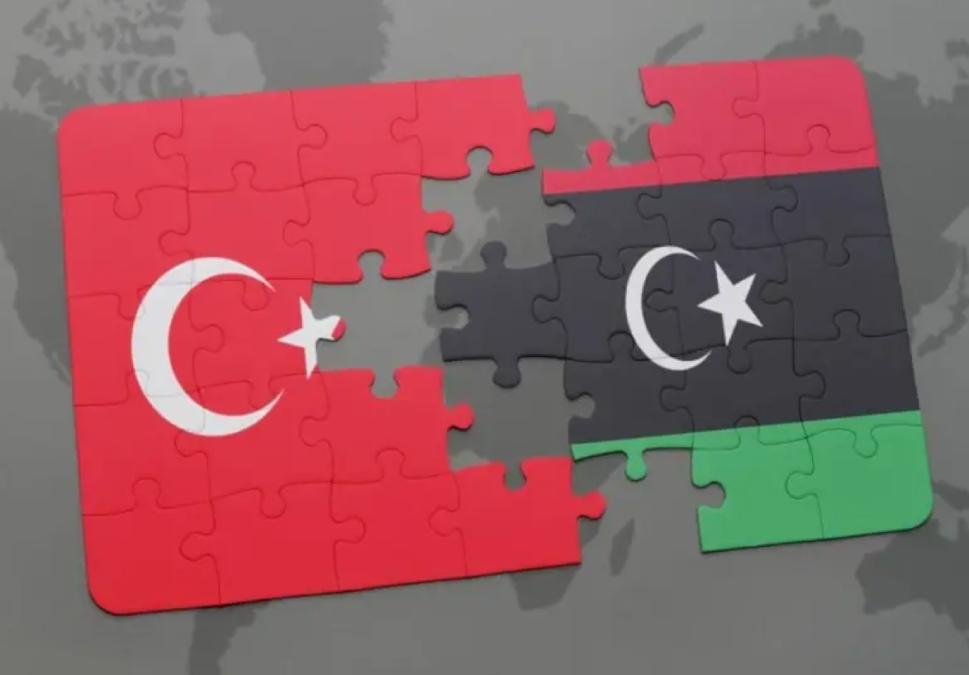
Libya's two rival governments, which agree on almost nothing, are sending the same signal this week. Eastern Libya's Field Marshal Khalifa Haftar met Greek Foreign Minister Giorgos Gerapetritis in Benghazi on 28 March. Western Libya's Prime Minister Abdulhamid Dbeibah ordered accelerated maritime boundary procedures with Greece and Malta on 30 March. Both moves point in the same direction, away from the 2019 Türkiye-Libya maritime memorandum and toward a delimitation framework built around international law. Türkiye has not responded to either development.
Gerapetritis inaugurated a new Greek General Consulate in Benghazi on 28 March, describing it as "a historic day for Greece, for the relations between Greece and Libya, and for Greece's footprint in the wider region." He met separately with Haftar and his son and chief of staff, General Khaled Haftar. He stressed the importance of EEZ and continental shelf delimitation based on international law. His scheduled follow-up visit to Tripoli on 1 April was postponed due to extreme weather.
Dbeibah's 30 March instruction directed the National Committee for Land and Maritime Border Demarcation, operating under the Ministry of Foreign Affairs, to expedite technical and legal coordination with Malta and Greece. The instruction was specific: accelerate the procedures.
These two moves, from eastern and western Libya within the same week, are not coincidental. They reflect a pattern that has been building since September 2025.
September 2025 to March 2026: How the Pattern Built
In September 2025, Belgassim Haftar, son of Field Marshal Haftar and director of Libya's Development and Reconstruction Fund, visited Athens and met Gerapetritis at the Greek Foreign Ministry. Greek newspaper Kathimerini reported that Benghazi officials confirmed during that visit that the Libyan House of Representatives would not ratify the Türkiye-Libya MoU. The Greek Foreign Ministry confirmed the visit and said both sides discussed enhancing cooperation in construction, energy, investment and transport.
The same month, Greece and Libya's Government of National Unity formally launched EEZ delimitation negotiations, established a joint technical committee and agreed that the next round of talks would be held in Tripoli.
In December 2025, the Speaker of the Libyan House of Representatives, Aguila Saleh, declared the 2019 memorandum "built on illegality" and non-binding on the Libyan state, citing the absence of parliamentary ratification. Saleh visited Athens on 4 and 5 December, meeting both the Greek parliament speaker and Gerapetritis. On 12 December 2025, Haftar met Egyptian President Abdel Fattah el-Sisi in Cairo to begin maritime demarcation discussions outside Turkish auspices entirely.
Gerapetritis's 28 March visit to Benghazi followed that sequence. Libya Observer reported in November 2025 that "Haftar seeks to maximize his political and financial gains to strengthen his influence in Libya, noting that he does not trust any party, especially Turkey," citing Greek government sources who described Athens as "the only country that maintains communication with all Libyan parties at various levels."
What the 2019 MoU Says and Why It Still Matters
The memorandum, signed on 27 November 2019 between Türkiye and the then-Government of National Accord in Tripoli, established an 18.6 nautical mile maritime boundary between Türkiye and Libya in the Eastern Mediterranean. It creates a corridor that, on paper, eliminates or severely restricts the Greek EEZ south of Crete. It was registered with the United Nations.
Greece, Egypt, Cyprus, the European Union and the United States have all rejected the agreement as incompatible with the UN Convention on the Law of the Sea. Türkiye considers it valid and ratified it in its own parliament in December 2019. Libya's eastern parliament, aligned with Haftar, has never ratified it.
In July 2025, Libya formally submitted a verbal note to the UN asserting maritime claims that extend the 2019 MoU boundary, including maps showing Libyan claims that overlap with Greece's licensed exploration blocks south of Crete. That submission contradicted the tacit assumption in Athens that Tripoli had accepted the Greek median line. The contradiction between Libya's formal UN positions and its bilateral political signals has defined the relationship ever since.
Türkiye Extended Its Deployment. It Is Still Present.
The pressure on the 2019 MoU does not mean it has been abandoned. Türkiye extended its military deployment in Libya to January 2028 in December 2025, citing the need to protect Turkish interests against armed groups. In February 2026, the Turkish state energy company TPAO signed a memorandum of understanding with BP covering collaboration in Iraq and Libya. The same month, Türkiye's intelligence chief visited Dbeibah in Tripoli.
Ankara has not issued a formal response to either Dbeibah's 30 March instruction or Gerapetritis's Benghazi visit. Türkiye's position has been consistent: the 2019 memorandum is a legitimate bilateral agreement under international law and will not be renegotiated under external pressure. Turkish Foreign Ministry Spokesman Oncu Keceli stated after the EU Council's June 2025 conclusions that the deal is "an entirely legitimate agreement" and called on the EU to "comply with international law."
Türkiye maintains military forces in Tripoli-aligned western Libya, has deepened economic ties with the same government, and holds a ratified treaty it considers legally sound. At the same time, the political leadership of both Libyan factions is actively exploring maritime arrangements with Greece and Egypt that would, if concluded, render the 2019 line operationally irrelevant.
The Iran War as Accelerant
The current acceleration of Libya-Greece contacts is not entirely unrelated to the Iran war that began on 28 February 2026. Türkiye is simultaneously managing four Iranian missile intercepts over its airspace, PJAK pressure on its eastern border, the Kıbrıs-Mısır energy corridor that bypasses it, and renewed Libyan pressure on the 2019 memorandum. All of these are active at once.
Dbeibah is accelerating maritime boundary procedures while Türkiye's bandwidth is constrained by events elsewhere. Haftar is using Gerapetritis's visit to signal to Ankara that eastern Libya's loyalty is not unconditional. Neither move formally repudiates Türkiye's position. Both make the 2019 MoU harder to defend.
Tripoli Next, Division Still the Obstacle
Gerapetritis is expected to visit Tripoli in the coming days once weather conditions allow. That meeting with Dbeibah's government will be the first test of whether Tripoli's technical acceleration translates into a substantive negotiating position or remains procedural.
The EU's June 2025 Council conclusions explicitly described the Türkiye-Libya memorandum as violating the sovereign rights of third countries and inconsistent with international law. Chevron's involvement in Greek offshore blocks south of Crete, directly in the area the MoU claims, gives the commercial dimension additional weight.
Libya's internal division remains the central obstacle. Any EEZ agreement with Greece would require a unified Libyan state to be legally durable. That state does not exist. But for the first time since 2019, both parts of a divided Libya are moving toward the same maritime outcome, for different reasons, under different pressures, without coordinating with each other.
***Dbeibah's 30 March instruction is sourced to North Africa Post and has not been confirmed by an official Libyan government statement. Gerapetritis's Benghazi visit is confirmed by the Greek Ministry of Foreign Affairs. Haftar's non-ratification assurance is sourced to Kathimerini, corroborated by the Greek Foreign Ministry spokesperson in September 2025. Haftar's position has been inconsistent: his son Saddam visited Ankara in April 2025 and a Libyan parliamentary source told Russia Today in June 2025 that the House was moving toward ratification. Saleh's December 2025 "invalid" declaration came alongside a statement that Libya remained open to renegotiation with all parties including Türkiye.