
By Bosphorus News Defense Desk
Türkiye displayed TCG Anadolu, Bayraktar TB3 unmanned combat aircraft and KARGU loitering munition swarms at EFES-2026, using the exercise's distinguished observer phase to present a field version of its defence industry before foreign military delegations.
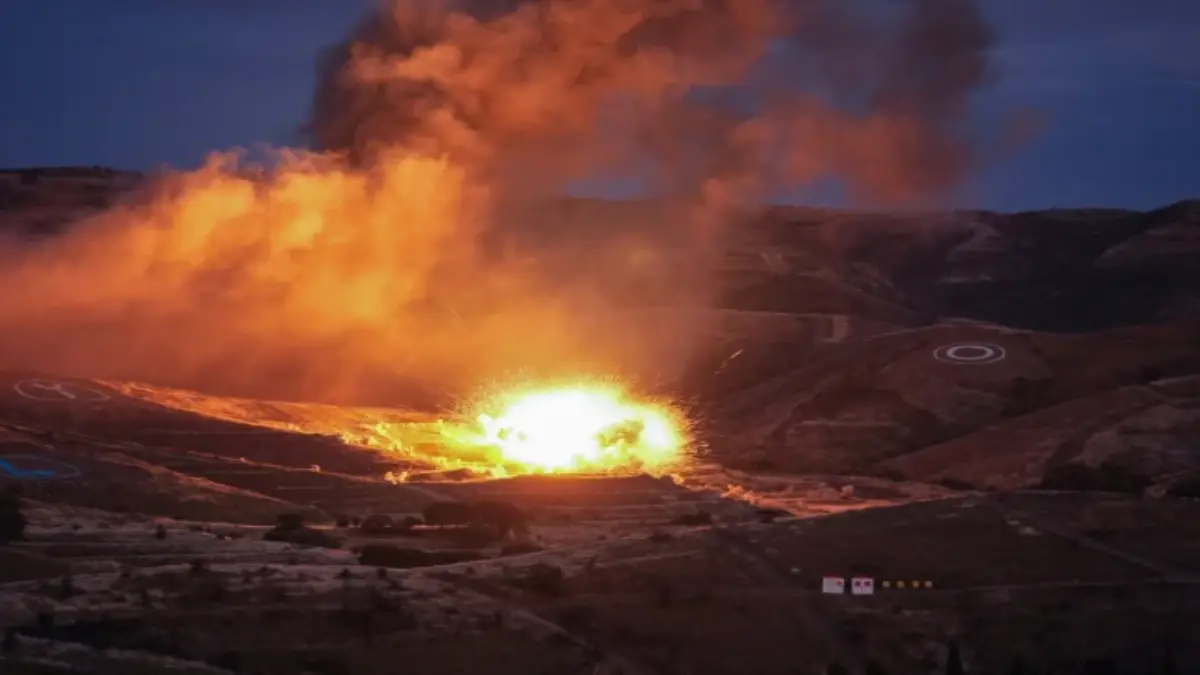
The live-fire phase of EFES-2026's distinguished observer programme took place on May 20 and 21 in İzmir, under the direction of the Turkish Armed Forces. Türkiye's Ministry of National Defence said the exercise brought together 10,388 personnel, including 1,305 from allied and partner countries, with defence ministers, chiefs of general staff and military delegations from 50 countries following the drills.
The exercise also carried a diplomatic layer. Bosphorus News reported earlier that EFES-2026 brought Syria, rival Libyan camps and NATO partners into the same field, turning the drill into more than a display of Turkish military hardware.
The strongest visual message came from TCG Anadolu. The amphibious assault ship operated off İzmir as Turkish forces displayed naval aviation, amphibious landing and ship-based unmanned warfare capabilities. Anadolu's role gave EFES-2026 a sharper meaning because Türkiye has built the ship into the centre of its sea-based unmanned aviation concept.
Bayraktar TB3 unmanned combat aircraft were shown operating from TCG Anadolu's flight deck, a milestone that Turkish officials and defence reporting have framed as part of Türkiye's shift toward carrier-based drone operations. The aircraft had already gained attention after earlier shipborne trials and NATO-linked deployments, but EFES-2026 placed the platform before a wider group of foreign military observers.
The second major message came from STM's KARGU loitering munition swarm. STM said KARGU systems demonstrated autonomous swarm capability during EFES-2026, with 20 systems controlled simultaneously by a single operator through domestic algorithms. The company has also described its January 27 live-fire swarm test at Polatlı, where 20 KARGU systems were used against three targets, as a world-first live-fire swarm operation.
The KARGU display matters because it moves the discussion beyond the individual drone. Türkiye is presenting coordinated unmanned systems, artificial intelligence-enabled mission software and swarm tactics as battlefield tools, not just export products. STM says KARGU is already operational in 15 countries across four continents.
EFES-2026 also showed the amphibious side of Türkiye's force posture. FNSS ZAHA amphibious assault vehicles were used in landing scenarios, while Karayel high-speed tactical boats were shown operationally at EFES for the first time. The boats, designed for rapid manoeuvre, commando insertion and coastal operations, added a littoral warfare layer to the TCG Anadolu display.
ASELSAN's air defence and electronic warfare systems added another dimension to the exercise. KORKUT-35, SİPER, HİSAR, GÖKBERK and related systems were presented as part of Türkiye's layered air defence and battlefield protection architecture. The message was not limited to drones and amphibious operations; Ankara also used EFES-2026 to show how air defence, electronic warfare and secure communications fit into the same operational picture.
The EFES display followed a wider defence-industry week in Türkiye, where Bosphorus News covered MKE's Attila and Uran howitzers at SAHA 2026, reinforcing Ankara's effort to show that domestic systems are moving from exhibition halls into operational military scenarios.
That timing gives EFES-2026 a wider NATO context. Türkiye is preparing to host the NATO Summit in Ankara in July, while alliance discussions are increasingly focused on defence production, capability delivery and burden sharing. EFES-2026 gave Ankara a military stage to show foreign delegations what that language means on the ground.
The exercise did not present Türkiye's defence industry as a catalogue. It placed TCG Anadolu, TB3, KARGU, ZAHA, Karayel and layered air defence assets inside a combined field scenario. That is the point Ankara wants allies and partners to see before the NATO summit: Turkish-made systems are being tied to operational concepts, multinational exercises and the geography of Türkiye's own security environment.