
Bosphorus News Sports Desk
European club football is moving toward another scale milestone. Top-division revenues are projected to pass €30 billion in 2025, extending an expansion that now looks structural rather than cyclical.
That growth is arriving with a price tag. Union of European Football Associations tracking points to non-wage operating costs rising as a share of revenue, from 30% in 2021 to a forecast 36% in 2025, a reminder that clubs are building heavier organisations to keep earning at the top line.
Türkiye sits inside that European picture in a way that is easy to miss if you only scan the broadcast headlines. In the leagues outside the Big 5, the report notes that good stadium infrastructure helped Dutch and Turkish clubs double gate revenue over the past decade, reaching €200 million and €147 million respectively.
This is the sort of number that matters because it is driven by factors clubs and leagues can actually shape: capacity, pricing, venue operations, and the matchday product.
The direction is also visible in the near-term data. Union of European Football Associations country figures put Turkish top-division gate receipts at €147 million, up 69% year on year.
It reinforces a simple point. Matchday is currently the most defensible growth line in the Turkish revenue mix because it is locally earned and operationally improvable.
The broadcast story is more complicated, and the report is explicit about why. In its rights table, Türkiye's 2024/25 to 2026/27 cycle is listed as +159% in local currency terms, but the same line shows "all rights" at €168 million and €66 million at current foreign exchange rates.
Union of European Football Associations also notes that rights are sold by the Turkish Football Federation and flags currency devaluation as a core distortion.
The practical implication is that percentage growth can look dramatic domestically while purchasing power in the euro priced ecosystem stays constrained.
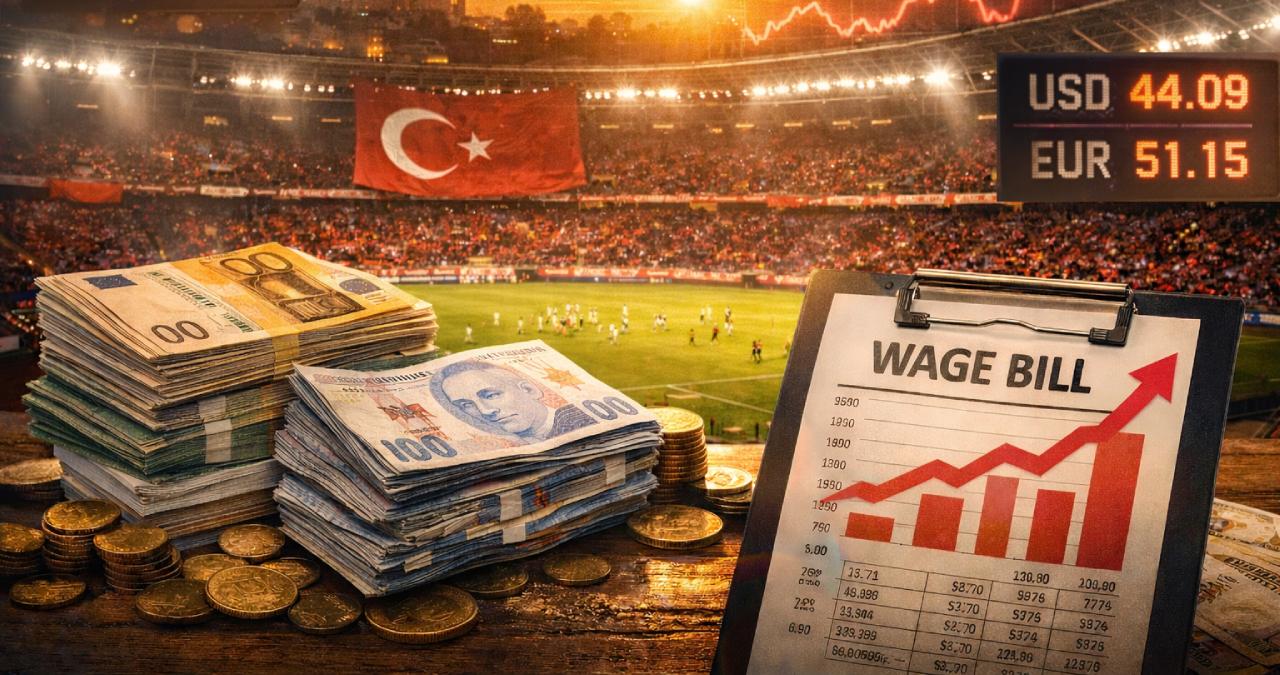
Cost structure is where the ceiling becomes harder. Union of European Football Associations country data shows total revenue up 64% year on year while the wage bill still absorbs 69% of revenue. A wage-to-revenue ratio near 70% narrows headroom for everything else, from squad-building errors to the less visible spending lines that make clubs sustainably competitive.
It also limits how far European prize money can carry the system. In the same dataset, Union of European Football Associations revenue is €65 million, or 7% of total revenue, alongside a total wage bill of €605 million. This is not an argument that Europe does not matter. It is an argument about scale. European income is volatile by design, while wage commitments are persistent, so treating Europe as a budget anchor tends to amplify downside risk when results swing.
Commercial performance adds another layer to how Turkish growth should be read. Union of European Football Associations notes that Türkiye's commercial revenue jump reflects major merchandising operations combined with International Accounting Standard 29 hyper-inflationary accounting, which affects comparability across countries and years.
Growth can be real and still be hard to translate into hard-currency purchasing power, which is ultimately where transfer fees, debt servicing and peer benchmarking are priced.
On the balance sheet, the margin for error remains narrow. Union of European Football Associations lists Türkiye's net equity at -€275 million, with 14 clubs in the scope showing negative equity.
This is another way of saying that the league is not short of revenue lines. It is short of room to absorb shocks when the cost base stays high and the currency translation turns against it.
The headline growth is real, but the league's constraint is not a lack of revenue stories. It is a cost base that stays heavy when results swing and a balance sheet that still looks thin. The more durable path is the unglamorous one: treat matchday and supporter-driven commercial income as compounding lines, and keep wage commitments from expanding faster than the revenue that holds its value.
Full Report: Union of European Football Associations, UEFA Intelligence Centre, The European Club Finance and Investment Landscape (2025 edition).