
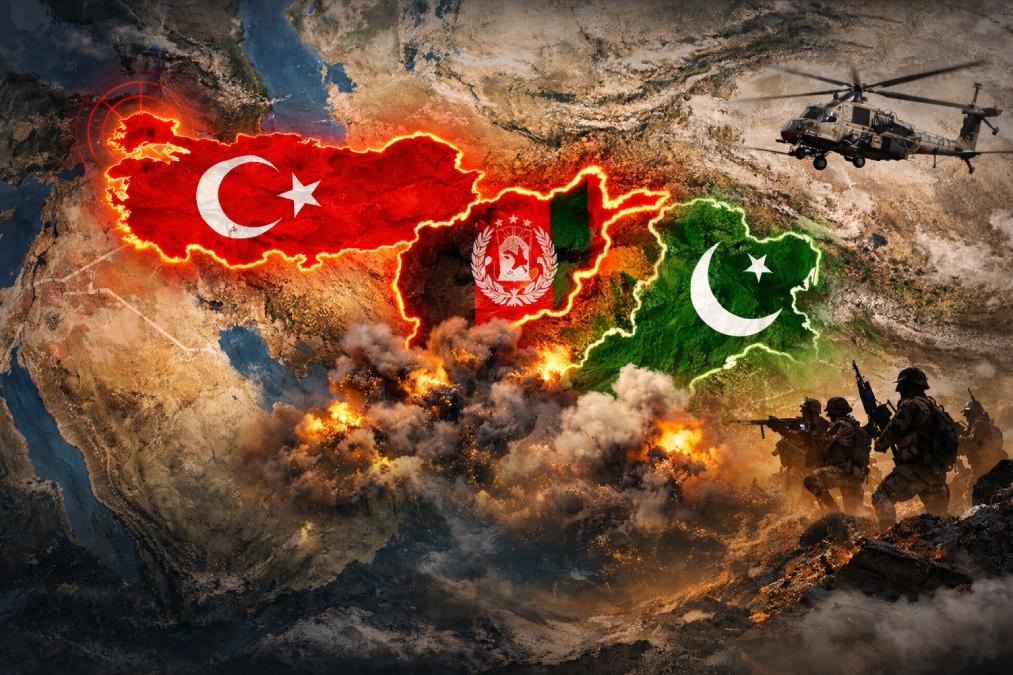
By Bosphorus News Geopolitics Desk
President Recep Tayyip Erdoğan spoke by telephone with Pakistani Prime Minister Shehbaz Sharif on Wednesday, the sixth day of continuous border fighting between Pakistan and Afghanistan. According to a statement from the Turkish presidential office, Erdoğan "condemned the terrorist attacks in Pakistan" and said Türkiye would seek to "contribute to the reestablishment of the ceasefire between Pakistan and Afghanistan."
Sharif's office did not directly confirm Erdoğan's offer but acknowledged that the two leaders discussed tensions along the 2,611-kilometre Afghan-Pakistan border and said they "exchanged views on recent developments" and would remain in closer "contact in our shared pursuit of peace and stability in the region."
How the Fighting Started
The latest round of hostilities began after Afghanistan launched cross-border attacks in retaliation for Pakistani airstrikes the weekend prior. Islamabad declared it was in a state of "open war" with Kabul, sending alarm through regional and international capitals.
The violence collapsed a ceasefire that Qatar and Türkiye had helped broker in October, following a previous near-war between the two neighbours. That agreement, reached in Doha, led to six days of follow-up talks in Istanbul and an extension of the truce. A third round of negotiations in November produced no agreement, and the diplomatic process ground to a halt.
In January, regional outlets Ariana News and MEPA News reported that Türkiye had quietly withdrawn from its facilitation role, concluding that conditions no longer supported a constructive mediation effort. Ankara issued no official comment. Bosphorus News covered that development on 10 January 2026: Wednesday's move signals a reversal of that posture.
Fidan's Earlier Engagement
The re-engagement had been building at the foreign minister level before Erdoğan's call. Foreign Minister Hakan Fidan contacted Afghan Foreign Minister Amir Khan Muttaqi the previous week, according to the Afghan Ministry of Foreign Affairs, which provided no further detail on the substance of the exchange.
At an Organisation of Turkic States meeting on 7 March, Fidan addressed the situation directly, saying Türkiye had been closely monitoring the escalating border crisis. He noted that many OTS member states share a border with Afghanistan and that regional stability there carries direct consequences for the wider Turkic world. Türkiye's core expectation, he said, was for Afghanistan to maintain peaceful relations with all its neighbours.
Islamabad's Conditions
Pakistan's army chief Field Marshal Asim Munir, visiting the Wana district on the Afghan border the same day, set out Islamabad's terms for any durable settlement. He said peace was contingent on the Afghan Taliban cutting ties with militant networks that carry out attacks inside Pakistan, and warned that Islamabad would take "all necessary measures" to defend itself against threats from Afghan soil.
Kabul had not responded to Erdoğan's offer by the time of publication. Given the framing of Ankara's statement, the Taliban government may regard the Turkish position as aligned with Islamabad.
On the Cabinet Agenda
The Afghanistan-Pakistan file was among the items reviewed at the Presidential Cabinet meeting on 9 March, where Türkiye's diplomatic contacts and the broader regional security situation were assessed together.