
By Bosphorus News Geopolitics Desk
Türkiye's Kazakhstan diplomacy has moved beyond the familiar language of bilateral partnership, bringing Kazakh oil, the Middle Corridor, artificial intelligence and digital logistics into the same Turkic economic file as President Recep Tayyip Erdoğan's talks in Astana fed directly into the Organization of Turkic States summit in Turkistan.
The sequence opened in Astana on May 14, when Erdoğan and Kazakh President Kassym-Jomart Tokayev chaired the sixth meeting of the Türkiye-Kazakhstan High-Level Strategic Cooperation Council and oversaw 13 agreements covering investment, energy, transport, industry, science, health, media and institutional cooperation.
Erdoğan gave the visit its clearest energy marker during the Astana stop. "Kazakhstan is one of the world's leading crude oil exporters," he said, adding that Türkiye aims to increase the shipment of Kazakh oil to global markets through Turkish territory.
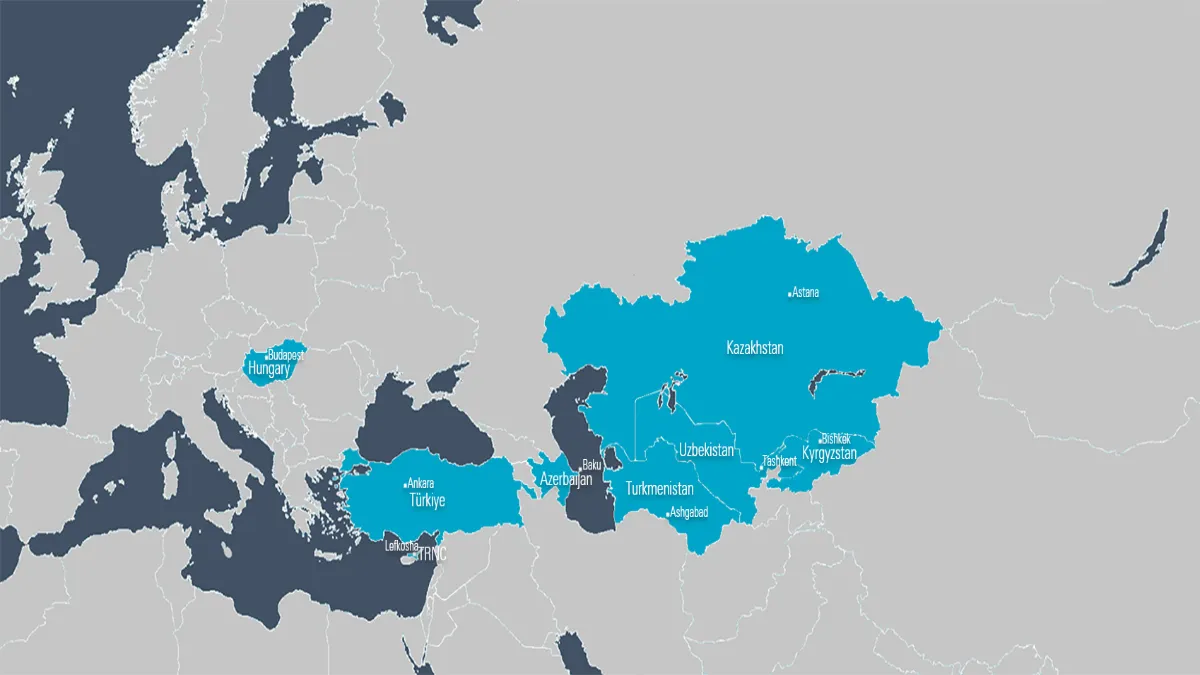
That sentence carries more weight than the usual corridor rhetoric. Türkiye is now presenting the Trans-Caspian East-West Middle Corridor as a route that can carry trade, rail freight and energy politics at the same time, connecting Kazakh crude, Caspian transport, the South Caucasus and Ankara's long-running ambition to serve as a westbound transit platform.
The agreement package reinforced that direction. Reporting from the visit pointed to cooperation between KazMunayGas and the Turkish Petroleum Corporation on oil and gas projects, alongside a wider energy and natural resources framework. The same package also included defence industry cooperation, including plans linked to ANKA unmanned aerial systems, while the broader economic message placed energy, transport, defence industry and technology under one Türkiye-Kazakhstan agenda.
That wider agenda was already visible before the Astana talks. Bosphorus News reported ahead of the Turkic AI summit that Türkiye and Kazakhstan were placing trade, defence industry, energy, transport and artificial intelligence inside the same Central Asian frame, a pattern that became more explicit once Erdoğan's Astana meetings moved into the Turkistan summit track.
Tokayev pushed the corridor discussion beyond diplomacy and into logistics. Kazakh statements have placed new emphasis on scaling up the Trans-Caspian International Transport Route, with Astana pointing to freight growth, port capacity, digital management systems and electronic permits as parts of the same modernization effort.
The Middle Corridor now faces the harder test of capacity. The route from China through Kazakhstan, the Caspian Sea, Azerbaijan, Georgia and Türkiye to Europe depends on ports, rail systems, customs coordination, ferry availability, cargo tracking and predictable cross-border procedures. Without those layers, the corridor remains attractive on maps while still fragile in commercial use.
The Turkistan summit adds the digital side of the same corridor debate. The Organization of Turkic States is holding its informal summit on May 15 under the theme "Artificial Intelligence and Digital Development," with leaders expected to discuss AI, digital innovation, emerging technologies, public services, sustainable growth and regional connectivity.
Erdoğan and Tokayev's visit to the Alem.AI Artificial Intelligence Centre in Astana gave the agenda a visible stage before the Turkistan meeting. The message was direct: the same trip that placed Kazakh oil and the Middle Corridor on the table also moved through an AI centre before arriving at a Turkic summit built around digital development.
AI should not be treated here as decorative summit language. Digital customs, electronic consignment systems, e-permits, cargo platforms and AI-supported logistics are becoming part of the same corridor debate as railways, ports and pipelines. A physical route that wants to compete across Eurasia needs a digital layer capable of reducing delays, standardising procedures and giving traders the predictability that older routes still provide.
The oil file remains more difficult than the diplomatic language suggests. Kazakhstan has already exported crude through the Baku-Tbilisi-Ceyhan route, yet larger volumes face practical limits, including Caspian crossing capacity, port infrastructure, tanker availability and oil quality requirements on the BTC system. Much of Kazakhstan's export architecture also remains tied to routes through Russia, especially the Caspian Pipeline Consortium.
This is the restraint behind Erdoğan's Astana message. Türkiye can offer a westbound route, and Kazakhstan has clear reasons to diversify access to global markets, while larger crude volumes across the Caspian and through the South Caucasus will still require investment, technical alignment and capacity that summit declarations cannot create on their own.
Türkiye is using the Turkic platform to pull energy transit, digital connectivity and strategic technology into one conversation, with Astana supplying the oil and corridor language while Turkistan gives the same agenda its AI and digital governance frame. That combination gives Ankara a stronger story than cultural solidarity alone, because it places barrels, cargo, permits, data systems and industrial cooperation inside one regional architecture.
The diplomatic tension remains visible. Türkiye wants the Turkic world to operate as a strategic community with practical economic weight, while Central Asian governments continue to protect their own routes, markets and foreign policy balances. That tension does not weaken the Astana message; it makes the operational test more serious, because the success of the corridor depends on whether national priorities can be made compatible across ports, rail lines, energy companies, customs systems and digital platforms.
The Kazakhstan visit exposes the scale of the work ahead. Türkiye is trying to turn the Turkic track into something measurable: more oil through Turkish territory, more freight through the Middle Corridor, more digital infrastructure across borders and more political weight inside a region that follows its own timetable as much as Ankara's.
Astana and Turkistan now leave Ankara with a practical test rather than a slogan. The corridor will be judged by crude flows, rail cargo, port capacity, customs data and the ability of Turkic states to make their technology policy serve real movement across borders; without that operational layer, the language of oil, AI and connectivity will remain impressive at summit level and limited on the ground.