
By Bosphorus News Staff
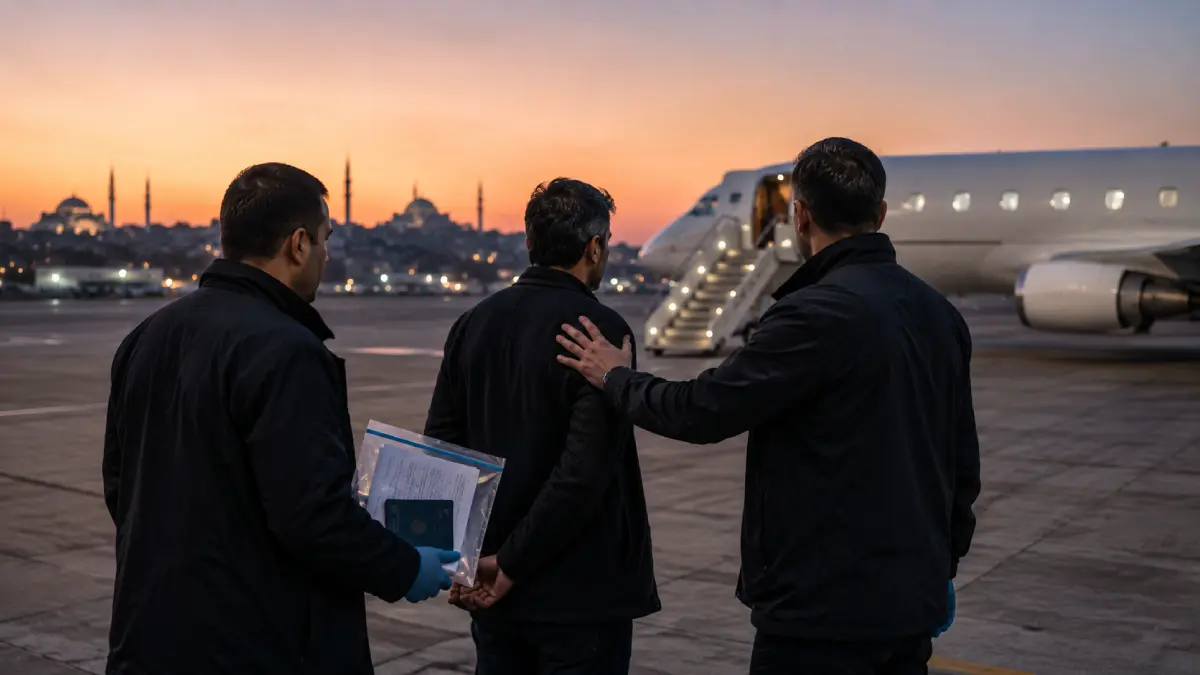
Türkiye has handed over Mohammed Salim Dola, an alleged Dawood Ibrahim-linked drug trafficker wanted in India, after his arrest in Istanbul, bringing a transnational narcotics case into a rare visible channel of Ankara-New Delhi security cooperation.
India's Press Information Bureau said on April 28 that the Narcotics Control Bureau secured Dola's return from Türkiye under "Operation Global-Hunt," working with international and Indian intelligence agencies. Dola was taken into custody after arriving at Indira Gandhi International Airport in New Delhi, the statement said.
Indian authorities describe Dola, 59, as a Mumbai-origin fugitive wanted in multiple narcotics trafficking cases. The Indian government said he had been the subject of an Interpol Red Notice issued at India's request in March 2024 and had been absconding from Indian law enforcement.
The Ministry of Home Affairs said Dola had built a transnational drug trafficking network across the Middle East, Africa and Europe. It listed heroin, charas, mephedrone, mandrax and methamphetamine among the substances linked to cases in Maharashtra and Gujarat, and described him as a bulk supplier to downstream distribution networks inside India.
Union Home Minister Amit Shah presented the case as part of India's wider anti-narcotics campaign.
"Now no matter where they hide, no place is safe for drug kingpins," Shah said, according to the Press Information Bureau.
Indian media reported that Dola had been detained in Istanbul after coordination between Indian agencies and Turkish authorities. The Times of India said he had been operating under a false identity in Istanbul's Beylikdüzü district and had used a Bulgarian passport under the name "Hamza," a detail that widens the case beyond a single deportation file.
The Indian government statement also credited cooperation between authorities in Türkiye, Interpol and Indian agencies. That point gives the case its political weight. Türkiye-India relations have remained difficult on several files, including Ankara's Pakistan ties and New Delhi's closer engagement with Greece, Cyprus and Armenia.
The Dola transfer should not be inflated into a diplomatic reset. Ankara and New Delhi issued no joint political declaration, and Turkish authorities have not publicly framed the case as a broader bilateral opening. The practical meaning is narrower, but still significant: security channels moved when both sides had a direct operational interest.
India uses the return to reinforce its campaign against fugitives accused of running drug networks from abroad. Türkiye's role places Istanbul again inside the map of international organised crime investigations, where narcotics, false documents, Gulf links and Balkan routes increasingly overlap.
Dola's transfer remains limited in diplomatic terms, but operationally it is not minor. Ankara and New Delhi still diverge on several strategic files. In this case, however, police, intelligence and narcotics coordination moved through the political noise because both governments were dealing with the same criminal network.
***Sources: Press Information Bureau of India, Ministry of Home Affairs; Times of India; Indian Express; DD News.