
By Bosphorus News Defense Desk
The Ministry of National Defence used its weekly press briefing on 12 March to deliver a pointed statement on the status of İncirlik Air Base, outline military reinforcements to northern Cyprus, confirm the deployment of a NATO Patriot system to Malatya, and accuse Greece of violating the demilitarised status of eastern Aegean islands.
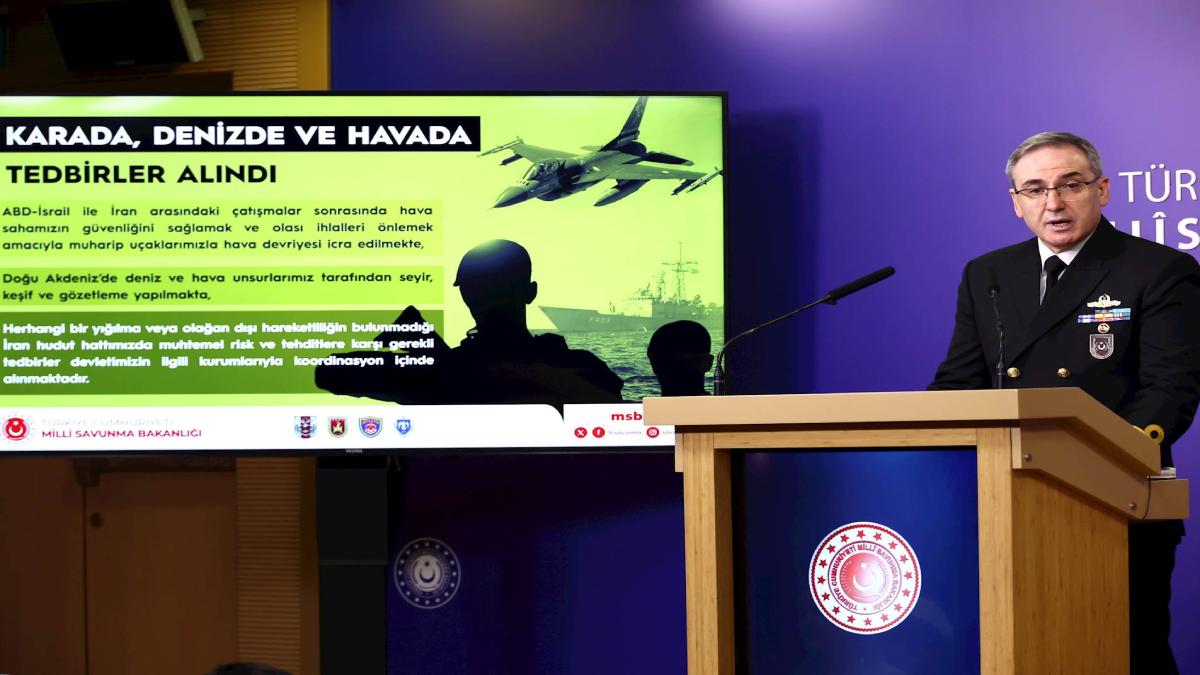
Ministry spokesperson Rear Admiral Zeki Aktürk addressed reporters at the briefing. The ministry then issued formal responses to press questions on several subjects.
"The presence of American soldiers does not make it an American base"
On İncirlik, the ministry's statement was direct:
"İncirlik is a Turkish base. Our 10th Main Jet Base Command, operating under our Combat Air Force Command in Eskişehir, is stationed at İncirlik, Adana. Our 10th Main Jet Base Command houses our F-16 squadron, our Tanker squadron and our UAVs. The ownership of the base, including all facilities on it, belongs to the Republic of Türkiye. The base commander is a Turkish Brigadier General. The presence of American soldiers there does not mean it is an American base. Spanish, Polish and Qatari military personnel are also stationed there."
The statement did not specify what prompted the clarification. But it came against the backdrop of heightened activity at the base linked to the ongoing conflict between the United States, Israel and Iran, and continued public debate over the base's function and command authority.
Six F-16s and air defence systems deployed to northern Cyprus
The ministry confirmed that six F-16 fighter jets and air defence systems have been deployed to the Turkish Republic of Northern Cyprus (TRNC) as part of a phased response to the missile and drone threat generated by the US/Israel and Iran conflict.
The ministry framed the deployment through Türkiye's legal standing as a guarantor power on the island under the 1960 Treaty of Guarantee. It stated that the reinforcements are designed to strengthen deterrence, support airspace security and improve rapid reaction capability.
"The additional measures we have taken will contribute not only to the security of the Turkish Republic of Northern Cyprus but to the security of the entire island," the ministry said. It added: "In an environment where some countries that are not guarantors are dispatching military assets to Cyprus and the Eastern Mediterranean, the measures taken by Türkiye reflect an entirely legitimate, appropriate and balanced security approach."
The ministry's closing formulation on Cyprus was unequivocal: "We are enough for the Turkish Republic of Northern Cyprus." It warned that Ankara would not tolerate any hostile posture or fait accompli targeting the rights and interests of Turkish Cypriots and would not hesitate to exercise the rights and powers conferred by its guarantor status.
NATO Patriot system deployed to Malatya
On the air defence front, the ministry confirmed that a Patriot system assigned by NATO's Allied Air Command at Ramstein, Germany, is being deployed to Malatya as a complementary element in Türkiye's air defence architecture.
The deployment follows the interception of two ballistic projectiles fired from Iran into Turkish airspace at separate times. Both were neutralised by NATO air and missile defence assets stationed in the Eastern Mediterranean. Debris from one of the projectiles, intercepted on 9 March, fell on open terrain in Gaziantep and Diyarbakır. No casualties were reported.
The ministry said combat aircraft are conducting air patrols to secure Turkish airspace and prevent violations. Naval and air units are carrying out surveillance and reconnaissance in the Eastern Mediterranean. Along the Iranian border, where no buildup or unusual movement has been detected, precautionary measures are being coordinated with other state institutions.
Aegean islands: Ankara accuses Athens of treaty violations
The ministry issued a detailed legal and political response to Greece's recent military activities on eastern Aegean islands, naming Lemnos and Karpathos specifically.
The statement recalled that the eastern Aegean islands were transferred to Greece under two conditions of demilitarisation. Lemnos falls under the 1923 Treaty of Lausanne. Karpathos, part of the Dodecanese, falls under the 1947 Treaty of Paris. The ministry characterised the demilitarised status as an essential condition of both treaties, not a secondary obligation.
"The violation of the demilitarised status constitutes a fundamental breach," the ministry said. "These fait accompli efforts do not legally produce the conclusion that the demilitarised status has been unilaterally terminated. This point has also been raised at the highest level of our state."
The statement accused Greece of acting in violation of properly concluded treaties and warned that Athens's actions "both create a breach of law and damage our relations of neighbourliness and alliance." It called the situation unacceptable among NATO allies at a time of ongoing security crises in the region.
The ministry concluded with a broader accusation: "We state that we do not accept Greece's initiatives that do not serve the real purpose and that seek to turn crises in our region into opportunities, and that we have taken all necessary measures in this regard."
The statement did not name the specific Greek deployment it was responding to. But the reference to Karpathos aligns with Greece's deployment of a Patriot missile battery to the island in early March, alongside the dispatch of frigates and F-16s to the Greek Cypriot administration's territory as part of an activated joint defence doctrine between Athens and Nicosia.
S-400 addressed briefly
Asked why Türkiye did not use its Russian-made S-400 system to intercept the Iranian ballistic projectile, the ministry said the country's air and missile defence operates as a multi-layered structure. The most suitable defence asset is determined by engagement rules and the operational picture at the time. When a ballistic missile is detected, the system automatically selects and fires the fastest and most appropriate interceptor due to the extremely short response window. The ministry confirmed the incoming projectile was successfully destroyed by the most effective available asset, without naming the specific system used.