
By Bosphorus News Defense Desk
First Dive in the Marmara
Istanbul Technical University based defense company DATUM Submarine Technologies completed the first unmanned dive of Türkiye's first domestically designed and classified mini-submarine on 14 April 2026 in the Sea of Marmara off Karamürsel. Officials from the Presidency of Defence Industries (SSB) and surveyors from Türk Loydu, Türkiye's maritime classification society, witnessed the test. Assembly was completed at Şefine Shipyard. TRT Haber later broadcast footage of the platform in May.
The platform, formally designated the Çok Amaçlı Mini Denizaltı (ÇAMD), is a manned 12-metre vessel with a beam of 2.3 metres and a displacement of 36 tonnes. Its first dive was conducted without personnel on board, allowing the system to perform assigned commands before moving toward crewed testing. The vessel is rated for depths exceeding 300 metres and a maximum speed of 10 knots. The propulsion system is fully electric, based on a 22-kilowatt motor powered by a lead-acid gel battery. Domestic content exceeds 80 percent: the pressure hull was built by Yakut Kazan, the motor by Femsan DC Motor Fabrikası, and the propeller by Eriş Pervane. ÇAMD is the first submarine to receive Türk Loydu classification.
DATUM's founder, Dr. Zafer Özden, told TRT Haber that the platform was designed, manufactured and certified in Türkiye, and that it would be followed by configurations shaped around operational requirements defined by the Turkish Naval Forces.
A Test Platform for the National Submarine Programme
ÇAMD's role extends beyond its own operational profile. The platform is planned as a dedicated testbed for subsystems being developed under MİLDEN, Türkiye's Milli Denizaltı (National Submarine) programme, allowing evaluation of sensors, weapons and propulsion components in a live underwater environment without pulling fleet submarines from operational duties. Future integration of ASELSAN sonars and Roketsan's Orka lightweight torpedo is planned.
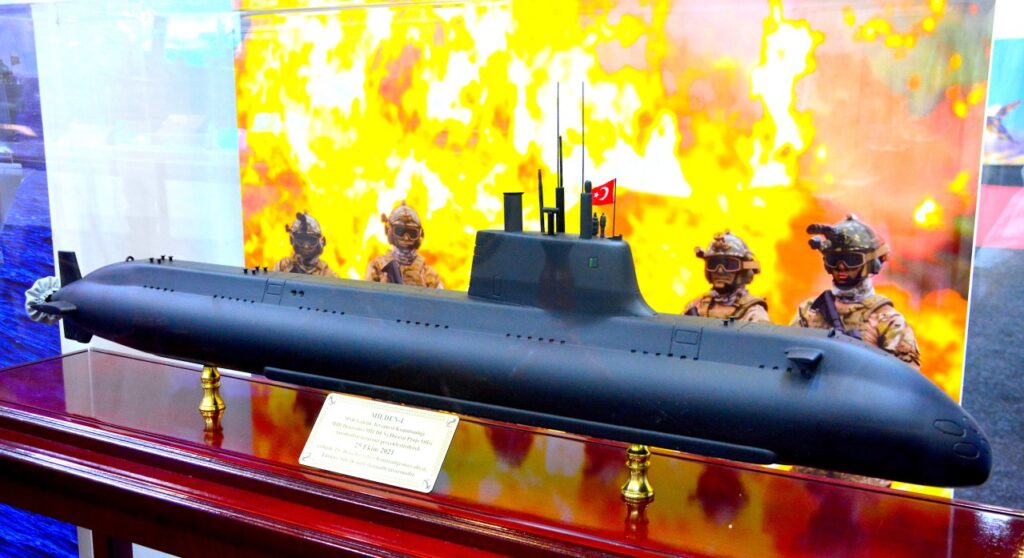
Construction of the first MİLDEN submarine, designated the Atılay class, began at Gölcük Naval Shipyard in January 2025. As Bosphorus News reported at the time, the programme represents Türkiye's most ambitious naval undertaking, targeting delivery in the early 2030s. The Atılay class will displace approximately 2,700 tonnes, exceed 80 metres in length, carry an air-independent propulsion (AIP) system and an armament package including Roketsan Akya torpedoes, Atmaca anti-ship missiles and Gezgin land-attack cruise missiles. ÇAMD provides the industrial and technical bridge between what the navy operates today and what MİLDEN will require.
The DATUM Platform Family
ÇAMD is the base from which DATUM has developed four additional platforms, each targeting a distinct operational requirement.
The Sinarit is a modular extra-large unmanned underwater vehicle (XLUUV) derived from ÇAMD by replacing the crew section with 3.8-metre modular payload bays. It fits inside a standard truck container and can be airlifted by an Airbus A400M military transport aircraft. The platform is capable of 12 defined mission types, including coordinated swarm attacks with Baykar unmanned aerial vehicles, Malaman mine deployment, and the firing of Roketsan Atmaca or Çakır missiles from submerged positions.
The Trança is a combat mini-submarine designed for Türkiye's Special Underwater Assault Command, known as SAT. It can transport six operators and their diver propulsion devices over a range of 400 nautical miles from a submerged launch point, carries two heavy torpedo tubes capable of firing the Akya torpedo and Akata missile, and can deploy up to 10 Malaman mines.
The Mezgit is a seabed warfare vessel designed for the protection of critical underwater infrastructure and offensive operations against adversary assets. At nine metres and 12 tonnes displacement, it can reach depths exceeding 1,000 metres, is fitted with side-scan and forward-looking sonar, carries a three-degree-of-freedom manipulator capable of cutting an underwater cable, and can be transported in a 40-foot container.
The Submarine Rescue Vehicle (SRV) is 12.5 metres long, rated to 650 metres depth, and can accommodate 17 rescued submariners. Seven steerable electric thrusters allow precision positioning over a submarine hatch for docking. The SRV is in the testing phase and is expected to be delivered to the Turkish Navy's Rescue and Underwater Command.
DATUM presented the full platform family at SAHA Expo 2026 in Istanbul in May. Of the five platforms, ÇAMD is the only one to have completed dive testing. The others remain in varying stages of development.
Where ÇAMD Sits in a Wider Portfolio
ÇAMD should not be confused with STM500, the 49-metre shallow-water attack submarine design developed by STM, Türkiye's defense consultancy. STM500 carries a crew of 22 plus an eight-person special forces team, four heavy torpedo tubes and a mission endurance of 30 days at depths exceeding 200 metres. It sits in a different category, closer to a small conventional attack submarine. The two programmes together show how Türkiye's underwater portfolio is widening beyond mainline submarine projects into more specialised and mission-specific platforms.
As Bosphorus News analysed in January, Türkiye's armed unmanned surface vessel ULAQ, developed by ARES Shipyard and Meteksan Defence, already brought strike-capable unmanned systems to the water's surface following the doctrinal sequence established in the air domain. ÇAMD and the Sinarit extend that sequence below the surface, positioning Türkiye as one of a small number of states developing armed unmanned systems across both surface and subsurface maritime domains simultaneously.
Defense industry analyst Kozan Selçuk Erkan, cited in a second TRT Haber report on the programme, said Türkiye is moving beyond models and prototypes in some underwater systems, with manned and unmanned mini submarines, underwater loitering munitions and deep-water swarm concepts entering the next development phase. The status of each system differs, and not all are at the same maturity level.
Türkiye's underwater expansion is taking shape across three simultaneous tracks: the Atılay-class national submarine in construction at Gölcük, the DATUM mini-submarine family in testing and development, and the ULAQ armed unmanned surface vessel already exported. Each track covers a different layer of the maritime domain.
***Sources: DATUM Submarine Technologies; Defence Blog; EDR Magazine; C4Defence; Army Recognition; Interesting Engineering; Bosphorus News reporting.