
By Bosphorus News Staff
Türkiye's footprint in the Balkans is often reduced to religion. That shortcut obscures how influence actually operates. What Ankara projects in the region is neither a Gulf style campaign of ideological export nor the version of political Islam common in European debates. It is a quieter form of power, anchored in institutions, local accommodation, and sustained state presence.
Evidence from Kosovo highlights the gap between perception and practice. Recent field research shows that even foreign funded religious infrastructure, often treated as a vehicle for ideological penetration, is locally perceived as community oriented. In the Pristina neighborhoods surveyed, residents described newly built mosques as improving social cohesion, with no observed extremist rhetoric or political mobilization. The assumed link between religious infrastructure and ideological capture does not hold.
Türkiye's role is better understood through institutional embedment. Influence here is not measured by visibility or conversion, but by how deeply state linked structures become part of everyday social, cultural, and administrative life.
A Network Built on Institutions
Türkiye's soft power in the Balkans is carried through a network of state institutions spanning development, education, culture, religion, and heritage. The effect is incremental rather than disruptive.
This engagement is not limited to Muslim majority settings. While visibility is higher in Muslim contexts, core institutions, most notably TİKA, also operate in non Muslim Balkan countries such as Serbia. These projects focus on development cooperation, infrastructure, and heritage restoration. The broader footprint weakens claims that Türkiye's approach is identity driven. It reflects a regional and pragmatic logic.
No Link Between Official Mosques and Radicalization
Critics often argue that Türkiye's religious footprint in the Balkans inevitably produces ideological influence or political Islam. That assumption rests more on perception than evidence. Field research from Kosovo finds no link between officially operating mosques and radicalization. Instead, extremist mobilization is traced to informal and unregulated networks operating outside institutional religious structures.
The study draws a clear distinction between religion and ideology. Newly built mosques were associated with rising levels of religiosity and religious visibility, particularly among younger cohorts, without a corresponding increase in extremist attitudes or behavior. Greater religious presence did not translate into radicalization.
This outcome is closely tied to Kosovo's regulatory framework. Religious discourse is formally monitored, and foreign donors are required to cooperate with the Islamic Community of Kosovo, which retains authority over mosque administration and religious appointments. This structure limits ideological drift by anchoring external engagement within locally accountable institutions.
Where religious activity is embedded in formal institutions with oversight, local language, and community accountability, it functions as a stabilizing force. Framing Türkiye's institutional presence as inherently radicalizing conflates visibility with influence and misreads how radicalization has occurred on the ground.
This distinction is central. Türkiye's engagement relies overwhelmingly on state linked structures that emphasize regulation, continuity, and local adaptation rather than ideological messaging.
Religion That Remains Local
Survey respondents in Kosovo consistently reported that mosque personnel respected local religious traditions and practices. Islam was perceived as locally grounded rather than externally imposed.
This pattern mirrors Türkiye's broader model in the Balkans. Language, ritual practice, and social norms remain local. Influence is exercised through familiarity, not rupture.
Architecture as Friction
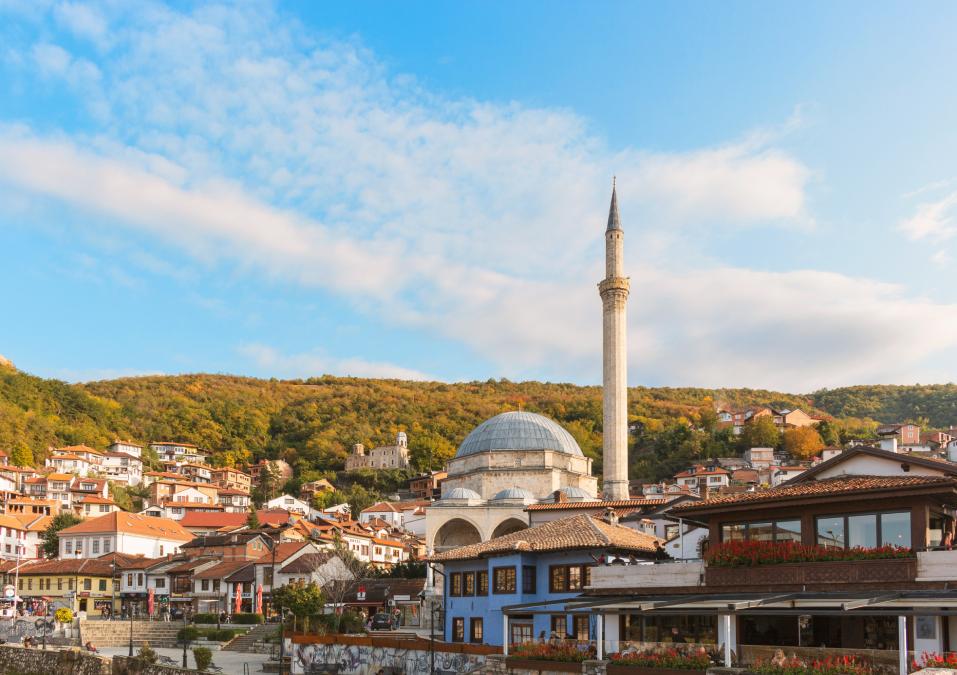
Soft power also operates through symbols. Survey findings from Kosovo show that criticism directed at Gulf funded mosques focused less on religious function and more on imported architectural designs perceived as clashing with local traditions and urban landscapes. Respondents associated these designs with foreignness rather than continuity.
By contrast, Türkiye linked projects more often prioritize Ottoman heritage or architectural styles compatible with local urban contexts. This emphasis on aesthetic continuity reduces symbolic friction and reinforces perceptions of historical and cultural familiarity rather than external imposition.
The Limits of Religious Spending
Survey data from Kosovo reveals a clear hierarchy of foreign actors. The United States remains the most positively viewed external presence, reaching approval levels of up to 95 percent in some neighborhoods. Türkiye, however, is consistently rated more favorably than Saudi Arabia and Qatar across surveyed communities. This positioning matters. Türkiye emerges as a bridge power in the local perception landscape. It is more culturally familiar than Western actors, yet more institutionally trusted than Gulf donors whose presence is often viewed as distant or episodic.
Despite sustained investment by Gulf actors, perceptions of Saudi Arabia and Qatar remained well below those of Western countries and Türkiye. Religious spending alone did not translate into influence. Without local embeddedness and governance, its returns proved limited.
This gap is reinforced by development assistance data. Türkiye's official development assistance in Kosovo significantly exceeds that of Gulf states, placing it in a tier comparable to the United States and the European Union rather than project based donors. Unlike episodic or narrowly framed contributions, Türkiye's aid profile reflects sustained institutional engagement embedded in public administration, infrastructure, and social services.
Stability Through Institutions
Türkiye's institutional model in the Balkans functions as a stabilizing force rather than an ideological project. By integrating religious activity into formal, state linked structures with local accountability, it narrows the space in which informal and unregulated networks operate. In a regional context where radicalization has emerged primarily outside official institutions, this form of embedded governance matters more than visibility, rhetoric, or religious spending.