
By Bosphorus News Geopolitics Desk
Turkish Commander Visits Nakhchivan
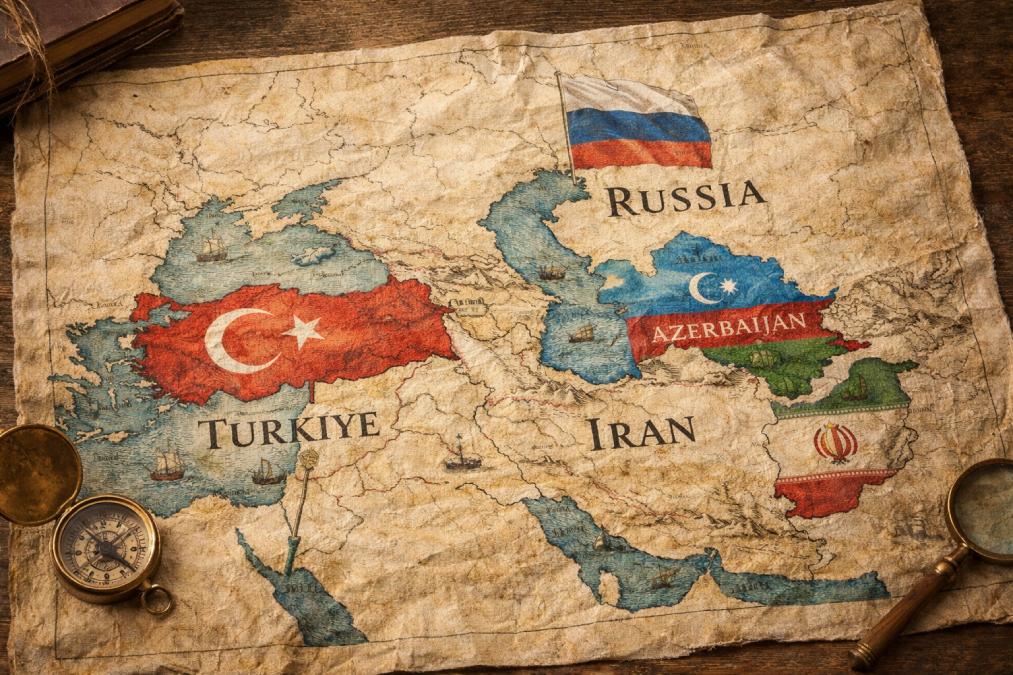
On 11 March, General Metin Tokel, Commander of Türkiye's Land Forces, travelled to the Nakhchivan Autonomous Republic for a visit that carried unmistakable strategic weight. Meeting with Azerbaijani Commander of the Combined Arms Army Kanan Seyidov, Tokel stated that Türkiye was ready "to provide any military assistance in accordance with the provisions of the Shusha Declaration," the mutual defence pact signed between Ankara and Baku in June 2021. He added that Türkiye "always stands by Azerbaijan's side" and that bilateral relations "are based on a strong foundation of strategic and military partnership."
The visit came six days after Iranian drones struck Nakhchivan on 5 March, hitting the region's international airport and landing near a school in the village of Şekerabad, injuring four civilians.
Baku's Calibrated Response
Azerbaijan's reaction to the drone strikes has been carefully layered. Baku sealed its land border with Iran immediately after the incident, evacuated its diplomats from Tehran, and mobilised reservists. Yet within days, President Aliyev was also extending an olive branch. Following a phone call with Iranian President Pezeshkian on 8 March, Azerbaijan dispatched a humanitarian convoy to Iran carrying 10 tonnes of flour, 6 tonnes of rice, 2.4 tonnes of sugar, more than 4 tonnes of drinking water, approximately 600 kilograms of tea, and around 2 tonnes of medicines and medical supplies, all delivered by road to the Iranian border city of Astara.
The Culfa and Dilucu border crossings, both critical transit points for Türkiye's trade routes to Central Asia via Nakhchivan, have since reopened after a brief closure, easing a buildup of freight traffic that had formed along the frontier.
Azerbaijan also served as a transit corridor for Russia's humanitarian effort. On 12 March, an Il-76 aircraft of Russia's Emergency Situations Ministry landed at Lankaran International Airport carrying more than 13 tonnes of medicines, dispatched on the direct orders of President Putin and subsequently handed over to Iranian authorities by road through the Astara crossing. Russian Ambassador to Azerbaijan Mikhail Evdokimov told journalists in Lankaran that Putin had personally raised the transit request with Aliyev in a phone call, and that Aliyev had approved it within an hour. "We are very grateful to the Azerbaijani side," Evdokimov said.
The dual aid flows, Baku's own convoy and Moscow's medical shipment transiting through Azerbaijani territory, reflect the complex position Azerbaijan occupies: a close Israeli partner that supplies more than 40 percent of Israel's crude imports, yet also a neighbour with deep economic and geographic ties to Iran it cannot simply sever.
Iran's Ambassador: Third Parties May Be Behind the Missiles
The question of who fired the missiles intercepted over Turkish airspace, the third such incident since 4 March, took a new turn with remarks from Iran's Ambassador to Ankara, Mohammad Hassan Habibollahzadeh. Speaking to Turkish media, the Ambassador proposed the formation of a joint technical commission to investigate.
On Türkiye's role, Habibollahzadeh confirmed that Iranian President Pezeshkian had held phone calls with President Erdoğan, Azerbaijani President Aliyev, the Pakistani Prime Minister, the Omani King and the Iraqi President, describing the outreach as part of coordinated regional diplomacy aimed at containing the conflict.
Baku Widens Its Diplomatic Circle
Azerbaijan is also broadening its own regional contacts. On 12 March, Foreign Minister Jeyhun Bayramov held a phone call with Pakistani Deputy Prime Minister and Foreign Minister Muhammad Ishaq Dar. The two sides discussed the regional security situation, the escalating military tensions in the Middle East, and bilateral cooperation, with both ministers reviewing plans for future contacts.
The call follows an earlier conversation between Bayramov and his Armenian counterpart Ararat Mirzoyan on the night of 5 March, in which both sides stressed the importance of protecting the Trump Route for International Peace and Prosperity, the centrepiece trade corridor whose vulnerability to Iranian interference the drone strikes had sharply underscored.
Ankara at the Centre
Türkiye finds itself at the intersection of multiple overlapping pressures: Iranian missiles intercepted in its airspace, a close ally mobilising on its eastern flank, and a critical trade artery through Nakhchivan only recently reopened. Ankara has not publicly retaliated against Iran and continues to pursue a mediating posture, with President Erdoğan maintaining active contact with all parties. Iran's ambassador, for his part, has been careful to frame Türkiye not as an adversary but as a neighbour whose mediation role Tehran values, explicitly noting that the last round of nuclear negotiations was launched in Istanbul.