
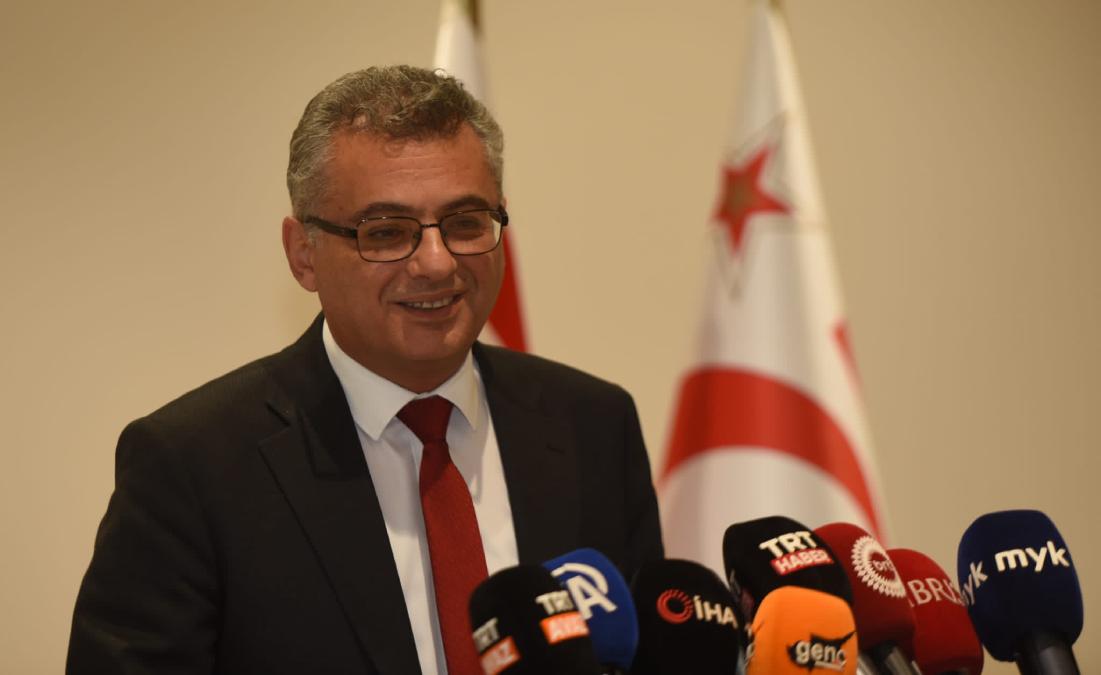
Tufan Erhürman locates the core failure of the Cyprus process not in the absence of dialogue, but in the repetition of negotiations that do not produce binding outcomes. His position is explicit and consistently stated.
"We do not want negotiations merely for the sake of negotiating; we want negotiations aimed at reaching a solution."
For Erhürman, dialogue has value only if it is structured to conclude. A process that exists to sustain itself, he argues, does not move the parties closer to settlement. It normalises deadlock and entrenches imbalance.
From the outset, Erhürman stresses that the Turkish Cypriot side has never withdrawn from the negotiating table. He presents this as a matter of record rather than rhetoric.
"The Turkish Cypriot people, together with the Republic of Türkiye, have repeatedly shown their commitment to a solution, in full view of the international community. They have never shunned a settlement, negotiations, or talks."
In his reading, the absence of a settlement cannot credibly be attributed to a lack of willingness on the Turkish Cypriot side. Engagement has been continuous, public, and coordinated with Türkiye as guarantor.
At the centre of Erhürman's position lies political equality. He treats it not as a future objective or confidence-building concept, but as a starting point.
"On this island, Turkish Cypriot children have the same rights as Greek Cypriot children. The Turkish Cypriot people are as sovereign on this island as the Greek Cypriot people."
Any framework that postpones equality to later stages, he argues, reproduces the structural asymmetry that caused previous negotiations to fail. Effective participation, including rotating presidency, is therefore not a concession but a requirement.
Erhürman also draws a clear distinction between remaining at the table and accepting stagnation. He rejects withdrawal, but he equally rejects the idea that presence alone constitutes progress.
"Our priority is to remain at the table and to turn the meeting table back into a negotiation table. We will not walk away from it. At the same time, there is a world beyond the table, and we will continue to fulfil our responsibilities to our people."
This dual logic defines his approach. Engagement continues, but it does not suspend political responsibility or silence criticism of an unproductive process.
Alongside these principles, Erhürman advances concrete proposals aimed at easing daily life and preserving minimal functionality across the divide. These include facilitating crossings, addressing barriers under the Green Line Regulation, mitigating the impact of property-related legal actions, enabling hellim exports through technical authorisation, and expanding youth contact, including through sports. He is explicit that these steps are not substitutes for a comprehensive settlement.
On the role of international actors, Erhürman issues a clear warning. If a renewed process collapses without fault on the Turkish Cypriot side, the continuation of the status quo cannot be justified.
"If the process fails again through no fault of our own, the Turkish Cypriots will not be condoned to their current status."
For Erhürman, open-ended process without consequence is not neutrality. It is avoidance. Negotiations must be time-framed, result-oriented, and anchored in political equality from the outset.
The position, taken as a whole, rejects two paths. It rejects abandonment of dialogue. It also rejects endless process management. What Erhürman calls for is a negotiation architecture that ends.
The claim is consistent throughout his statements. Turkish Cypriots have demonstrated willingness. What they refuse is a process that manages the problem rather than resolves it.