
By Bosphorus News Geopolitics Desk
Iran Was Supposed to Be the Stable Obstacle
TRIPP was built around a straightforward idea. Iran would remain a strong transit state, and anything that went around it would carry strategic value. The war that began on 28 February has not erased Iran from the regional map, but it has made its role unpredictable in ways that affect every assumption the corridor was built on, because the project was never just about geography, and a variable that shifts mid-construction is harder to absorb than one that never moved.
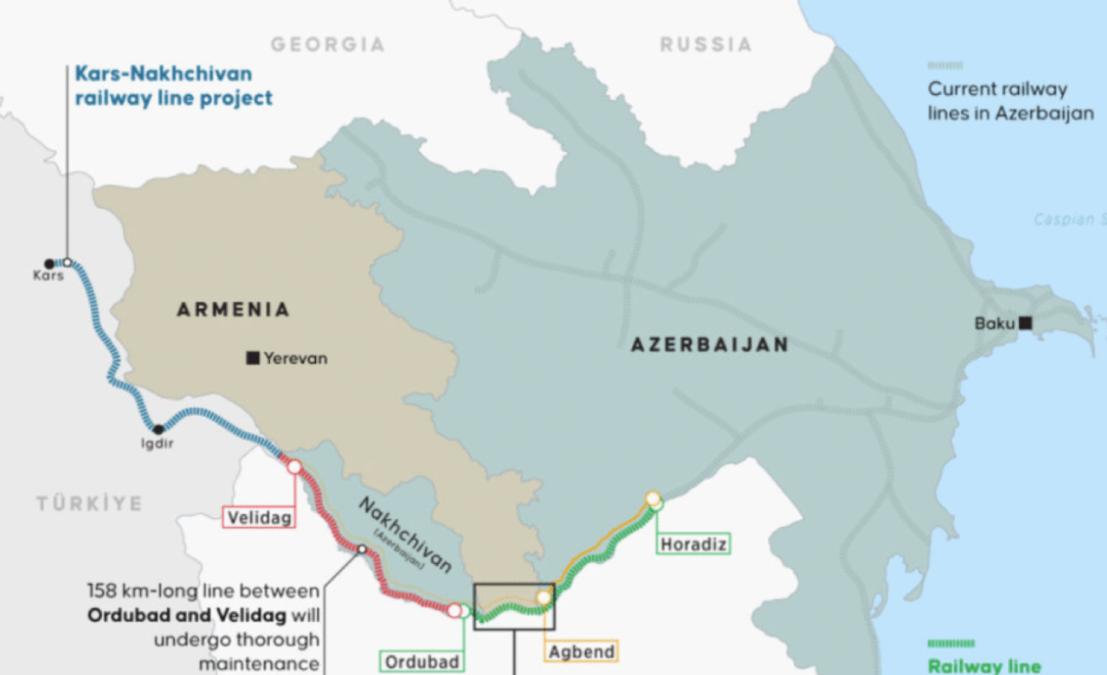
The Trump Route for International Peace and Prosperity, announced formally in January 2026 when US Secretary of State Marco Rubio and Armenian Foreign Minister Ararat Mirzoyan published a joint implementation framework, runs a 43-kilometre corridor through Armenia's Syunik province. It connects mainland Azerbaijan to its Nakhchivan exclave and then onward to Türkiye, giving Baku a direct route that does not pass through Iranian territory for the first time. A US-majority company holds 74 percent of the development entity, with Armenia holding 26, under a 49-year concession extendable by another 50.
The Kars-Iğdır Railway Was Already Under Construction
Türkiye's interest in TRIPP was never ambiguous. A direct land link to Azerbaijan and further east into Central Asia, without touching Iranian territory, has been part of Ankara's planning for years, and the moment the TRIPP framework was published in January 2026, Türkiye announced construction on the Kars-Iğdır-Aralık-Dilucu railway, a 224-kilometre line to the Nakhchivan border at a projected cost of 2.4 billion euros.
That railway, once complete, integrates with the Baku-Tbilisi-Kars line and the broader Middle Corridor, potentially creating a continuous rail connection between the South Caucasus and Türkiye that bypasses both Russian and Iranian territory entirely. The corridor also displaces a function Iran has held for decades: the Aras route, the only existing direct link between Azerbaijan proper and Nakhchivan, runs through Iranian territory for 107 kilometres, and Tehran has always treated that passage as a political instrument rather than neutral infrastructure.
Iran's senior leadership said so explicitly before the war began. Former Foreign Minister and current supreme leader adviser Ali Akbar Velayati publicly opposed the corridor, and in Tehran's reading the project was always a combined US-Turkish-Azerbaijani move to reduce Iranian influence along its northern border, where losing any single transit function carries consequences that extend into Baku, Ankara, and beyond.
Four Iranian Missiles Have Entered Turkish Airspace Since 4 March
Iran's diminished military capacity has reduced the diplomatic cost of building TRIPP. What it has not reduced is the security risk along the corridor's eastern approach.
Four Iranian ballistic missiles have entered Turkish airspace since 4 March, PJAK activity along Türkiye's eastern border has increased, and Iran has conditioned any ceasefire on a halt to Israeli operations in Lebanon, signalling that Tehran intends to keep every pressure point active regardless of its own losses. A fragile or disintegrating Iran along Türkiye's eastern and southeastern frontier generates uncertainty that does not stay within the borders that produced it, and infrastructure of the scale TRIPP requires demands a security environment that the next twelve to eighteen months cannot credibly offer.
Cargo Is Already Shifting in the Direction TRIPP Was Designed to Serve
As Hormuz shipping has ground to a halt since 28 February, companies are redirecting freight through overland alternatives, and the Middle Corridor, running through Azerbaijan and Georgia to Türkiye, is absorbing a significant share of that redirected demand. Container traffic along the route was already rising before the war and has accelerated sharply since, according to Caspian Post reporting from mid-March 2026.
Türkiye sits at the western anchor of both routes. If TRIPP moves forward, Ankara gains a direct eastern corridor through Armenia that connects without any Iranian or Russian intermediary. If it stalls, the existing Middle Corridor through Georgia continues to carry the load, and Türkiye remains the route's western terminus. The railway construction already under way in eastern Anatolia positions Ankara to benefit from whichever track consolidates first.
A 99-Year Concession Does Not Land as a Purely Technical Arrangement in Yerevan
In Armenia, the discussion still circles around what kind of arrangement a small landlocked country is actually agreeing to when it signs a 99-year concession tied to American and Azerbaijani interests. Parliamentary elections in 2026 give Prime Minister Nikol Pashinyan reason to show progress on the corridor, and equal reason to be careful about how much he concedes in order to get it.
Russia reads TRIPP as further confirmation that its position in the South Caucasus is narrowing, a process that accelerated after Azerbaijan's 2023 military takeover of Nagorno-Karabakh and Russia's deepening preoccupation with Ukraine. Tehran, even weakened by the current war, stands to lose a transit function that shaped its regional presence for decades and gave it a degree of influence over both Baku and Ankara that the corridor, once built, would substantially reduce.
The infrastructure is not ready. Financing is not fully locked. The political agreement between Baku and Yerevan is holding, but it has not gone through a serious test.
The Distance Between a Signed Framework and a Functioning Corridor Remains Considerable
The project now sits inside a region shifting faster than its own construction schedule allows. The assumptions TRIPP was built on, a contained Iran, a stable South Caucasus, a predictable security environment along Türkiye's eastern border, are all under pressure.
Whether TRIPP advances, stalls, or is revised under new regional conditions, the underlying geography works in Türkiye's direction. The Kars-Iğdır line is already under construction, and the war has already generated the demand the corridor was designed to serve. Whether the region stabilises fast enough for the infrastructure to catch up is a question the corridor's backers have not been able to answer since January, and the war has made it harder.