
Türkiye is preparing to strengthen oversight of its rapidly expanding drone ecosystem with the development of a nationwide UAV tracking system, a move that reflects both growing civil aviation needs and longer-term ambitions in autonomous air mobility.
The system is being developed by TITRA Teknoloji, an Ankara-based firm operating under Pasifik Holding, and is currently undergoing testing in coordination with the Directorate General of Civil Aviation (SHGM). According to company officials, the software is designed to monitor commercial drones operating in Turkish airspace, supporting flight safety, regulatory compliance, and situational awareness for authorities.
If implemented at scale, the initiative would place Türkiye among a growing group of countries seeking to bring drone traffic under structured national management frameworks. Similar efforts are underway globally, as aviation regulators respond to the increasing density of unmanned aircraft over urban areas, transport corridors, and critical infrastructure.
From Monitoring to Integrated Air Mobility
TITRA Teknoloji frames the UAV tracking system as a foundational layer rather than a standalone product. Company representatives describe it as part of a broader, long-term approach focused on end-to-end unmanned logistics and air mobility, an area attracting rising attention worldwide.
This vision includes the gradual development of drone-enabled logistics centers, autonomous transfers between hubs, and eventually direct delivery to end users, all integrated into smart city concepts. Such models mirror international discussions around advanced air mobility (AAM), where unmanned and semi-autonomous aerial platforms are increasingly viewed as tools to improve efficiency, resilience, and access.
TITRA's work in autonomy also extends beyond drones. Speaking about the company's involvement in helicopter unmanned conversion efforts, General Manager Ekrem Ünlü has noted that "we are part of a program aimed at converting conventionally piloted helicopters into unmanned platforms that could remain usable once autonomous systems are integrated." The statement underscores a broader technological direction that seeks to adapt existing aviation assets to future autonomous requirements, rather than replacing them outright.
Engineering Capacity and Domestic Development
The company reports a workforce of nearly 250 employees, with engineers and technical staff accounting for approximately 75 percent. Executives emphasize that sustained in-house development—particularly in avionics, software, and autonomous systems—has expanded domestic engineering capabilities over time, reducing external dependency in key technological areas.
This focus is most evident in TITRA's unmanned rotary-wing platforms, a segment that remains relatively specialized even within the global UAV market.
Unmanned Helicopters and Modular UAV Systems
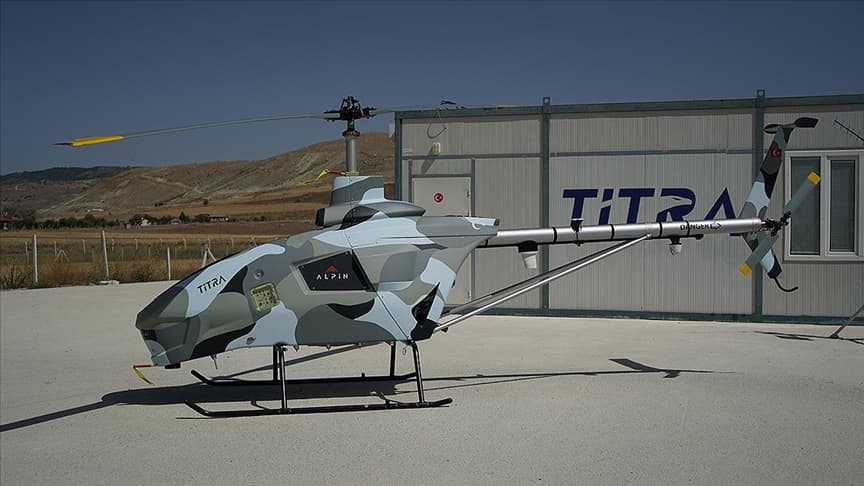
Among the company's better-known platforms is ALPİN, Türkiye's first unmanned helicopter. Despite being introduced several years ago, ALPİN continues to stand out due to its payload capacity, vertical take-off and landing capability, and ability to hover—features that differentiate rotary-wing UAVs from fixed-wing alternatives.
Its successor, ALPİN 2, incorporates avionics, electronics, and software largely developed by TITRA itself, reaching an estimated 85 percent domestic content. Initial deliveries of the new platform are expected before the end of the year.
Other systems include DUMRUL, a compact armed unmanned helicopter developed in response to operational requirements, and the DELİ family of loitering munitions. These range from GPS-guided variants equipped with anti-jamming features to smaller, manually deployable FPV-enabled systems.
TITRA has also introduced MERKÜT, a UAV platform developed in thermal-camera and tethered configurations, as well as PARS VTOL, a vertical take-off and landing reconnaissance UAV designed with modular payloads and extended endurance in mind. Test flights for PARS VTOL are planned for the first quarter of 2026.
Automation, AI, and Navigation Resilience
Beyond airframes, the company is working on supporting systems aimed at reducing operational workload and increasing autonomy. KORGAN, an automated drone docking and charging solution, is designed to allow drones to deploy, return, and recharge without direct operator intervention—an increasingly important capability for persistent surveillance and infrastructure monitoring.
Another area of focus is SEYYAH, a vision-based navigation system that uses onboard imagery, map data, and artificial intelligence to determine position and speed. Such systems are gaining importance globally, particularly in scenarios where GPS signals may be disrupted or unreliable.
Competing Beyond the Domestic Market
Company leadership notes that future competitiveness will depend not only on technological sophistication but also on scalability, reliability, and regulatory compatibility across different geographies. As demand grows for higher payload capacities and longer endurance—especially in large or densely populated regions—unmanned rotary-wing platforms are expected to attract increased attention.
Türkiye's investment in UAV tracking and autonomous aerial systems reflects a broader shift toward structured drone governance and advanced air mobility. With TITRA Teknoloji's tracking system under regulatory testing and a diverse portfolio of unmanned platforms under development, the country appears to be positioning itself not only as a user of emerging technologies, but as an active contributor to the evolving global unmanned aviation landscape.