
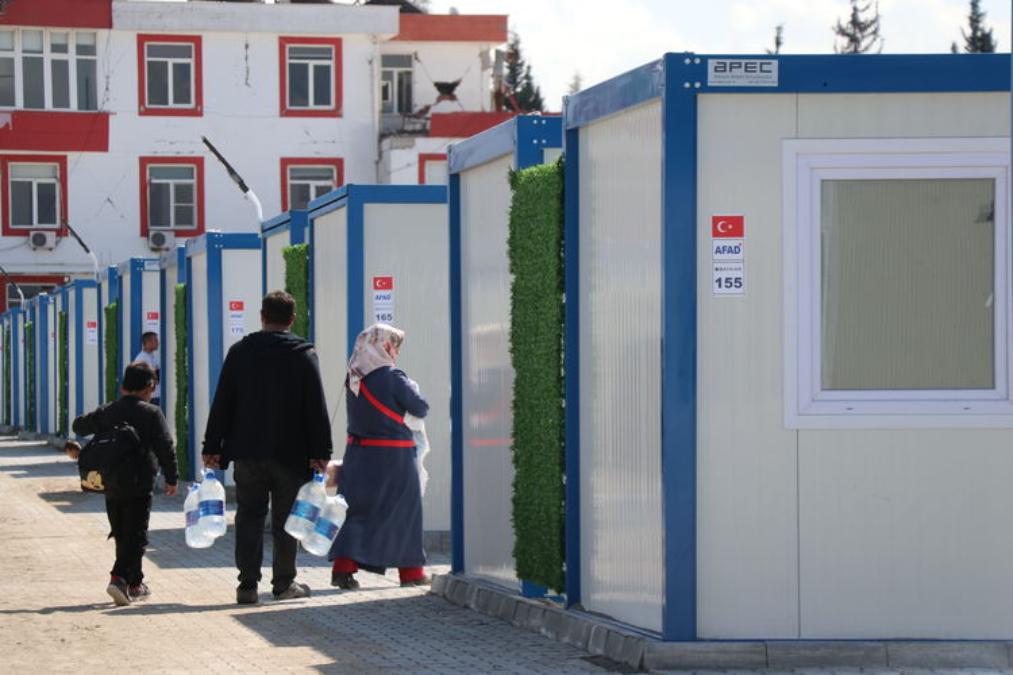
Three years after the 6 February 2023 earthquakes, reconstruction in Türkiye has advanced at scale. Public investment has surged, housing lotteries have been completed, and macroeconomic indicators show recovery across the affected provinces. One figure, however, defines the present phase: roughly 360,000 people are still living in container housing.
This is not a residual emergency issue. It is a structural condition shaping daily life for hundreds of thousands of citizens.
According to the Kahramanmaraş and Hatay Earthquakes Reconstruction and Development Report published in 2026 by the Presidency of the Republic of Türkiye Strategy and Budget Directorate, progress is visible across housing, infrastructure, and public services. By early 2026, housing lotteries had been completed for more than 433,000 housing units and 21,690 workplaces, with delivery and settlement ongoing. The same report confirms that a large container population remains active, concentrated in provinces such as Hatay, Kahramanmaraş, and Malatya.
The persistence of container living marks a shift from emergency response to prolonged temporariness. What began as a short-term solution has hardened into a semi-permanent settlement pattern, with social and economic effects that extend beyond housing.
Employment Has Recovered. Stability Has Not.
Official labour data point to a rebound. Employment losses triggered by the earthquakes have been statistically offset. Total employment in the affected provinces reached 4.3 million in 2024, exceeding pre-disaster levels. Reconstruction activity and sustained public spending have driven this outcome.
Yet underlying indicators remain weak. Labour force participation in the region stands at 49.2 percent, well below the national average. Unemployment remains elevated in several provinces. Informal employment reaches 37 percent, signalling persistent vulnerability rather than short-term disruption.
Container living and employment insecurity reinforce each other. Unstable housing limits access to regular work. Informal or intermittent employment undermines the transition to permanent housing. The result is a recovery that functions statistically but not socially.
Macro Recovery, Micro Stagnation
At the macro level, the affected provinces now account for 10.4 percent of Türkiye's GDP, up from 9.8 percent in 2023. Construction and public investment dominate the recovery profile, and the region's contribution to national growth has increased.
Aggregate gains do not equal social normalization. The report documents continued weakness in labour participation, sustained demographic pressure, and the persistence of temporary housing at scale. Growth has resumed. Normal life has not fully returned.
The Policy Language Gap
Official assessments increasingly frame the recovery as largely completed. Infrastructure has been rebuilt, public services restored, and investment pipelines secured. These claims are supported by data.
The same datasets, however, show that temporary housing endures, labour insecurity remains widespread, and social stabilization lags behind physical reconstruction. This is not a dispute between politics and statistics. It is a tension within the statistics themselves.
A Shift in Phase, Not a Failure
This is not an argument of failure. It is an argument of phase change.
Türkiye's earthquake response has moved beyond emergency management and large-scale reconstruction. It has entered a stage defined by extended temporariness. Container housing, informal work, and delayed social normalization are no longer anomalies. They are features of the current recovery model.
Recognizing this shift is essential. Rebuilding cities is not the same as restoring stability. Growth figures alone cannot resolve a crisis that has become structural in everyday life.