
Tariffs are often sold as an external pressure tool, a way to force concessions from trading partners while raising revenue at home. The latest evidence from the Kiel Institute for the World Economy suggests the opposite. In practice, tariffs function as a domestic tax, paid overwhelmingly by importers and consumers in the country that imposes them.
A January 2026 policy brief by the Kiel Institute examines the United States' 2025 tariff wave using shipment-level trade data covering more than 25 million transactions worth nearly $4 trillion. The conclusion is unambiguous. Foreign exporters absorb roughly 4 percent of the tariff burden, while 96 percent is passed through to US buyers via higher import prices.
Price rigidity, volume collapse
The core finding is not simply that prices rise. It is how adjustment occurs. Export prices remain largely unchanged, while trade volumes contract sharply. Event studies around discrete tariff shocks, Brazil at 50 percent and India at 25 to 50 percent, show no meaningful decline in exporter prices. Instead, shipments fall. Exporters respond by selling less, not cheaper.
This pattern is reinforced by Indian export customs data, which captures prices at the port of departure. Even when facing steep US tariffs, Indian exporters maintained their prices and redirected sales rather than conceding margins for the US market. The implication is structural. Tariffs do not transfer income from foreign producers to domestic consumers. They reallocate costs internally.
Revenue without relief
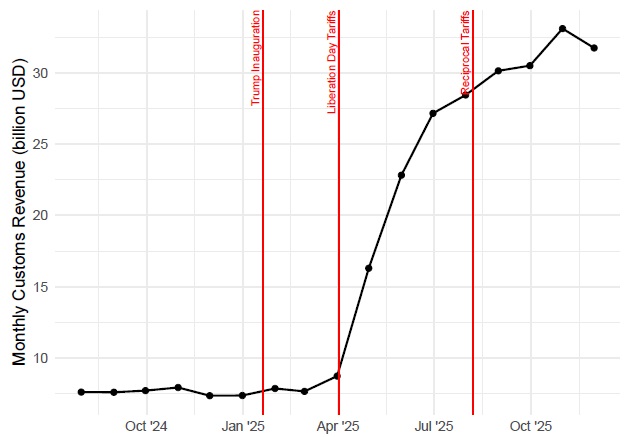
Source: Kiel Institute (2026)
US customs revenues surged by roughly $200 billion in 2025. Politically, this is often framed as a gain extracted from abroad. Economically, it is a transfer from American firms and households to the US Treasury. Every dollar of tariff revenue corresponds to a dollar paid domestically, either through higher prices, reduced choice, or disrupted supply chains.
The broader cost exceeds the revenue collected. Higher tariffs distort consumption, force costly supplier substitutions, and reduce product variety. These losses do not appear on budget lines, but they shape competitiveness and household welfare.
Why exporters do not "eat" the tariff
The brief identifies several reasons exporters rarely absorb tariffs. Alternative markets exist, making price cuts for one destination unattractive. High tariffs are difficult to offset through discounts without erasing margins. Global supply chains are sticky, and buyers cannot easily switch suppliers in the short term, giving exporters pricing power. Expectations also matter. If tariffs are seen as temporary or negotiable, exporters have little incentive to reset prices.
The strategic misread
The lesson is not that tariffs never change behavior. They do, but mainly by reducing trade, not by shifting costs abroad. The 2025 tariffs repeat the dynamics observed in the 2018 to 2019 trade war, despite being broader and more severe. There is no evidence that incidence has changed.
For countries trading with the United States, including Türkiye, the implication is clear. Tariff shocks primarily compress volumes and disrupt supply chains. They do not reliably force exporters into price concessions. For policymakers, the conclusion is starker still. Tariffs are a blunt instrument whose costs land at home, even when their rhetoric points outward.