

By the end of 2025, Türkiye's foreign policy had neither reset nor collapsed. Instead, the year clarified a governing method that Ankara has increasingly relied on: maximising flexibility by resisting fixed alignment. In this framework, diplomatic access is treated as a variable rather than a constant. Across different theatres, this approach produced uneven results. Where channels were preserved, even narrowly and conditionally, Türkiye retained relevance and room to act. Where they were allowed to close, flexibility proved a poor substitute for access, sharply narrowing Ankara's ability to convert position into influence.
Power Without Alignment
Türkiye's handling of the war in Ukraine offered the clearest expression of this method. Despite mounting pressure from allies, Ankara succeeded in keeping diplomatic channels open to both Kyiv and Moscow, treating communication itself as a strategic asset. By separating moral positioning from operational diplomacy, Türkiye preserved access at a time when alignment increasingly came at the cost of mediation capacity.
This willingness to sustain engagement across divides extended beyond the Black Sea. Ankara's continued political closeness with Venezuela—and the personal rapport cultivated between President Recep Tayyip Erdoğan and Nicolás Maduro—reinforced the perception of a foreign policy comfortable engaging regimes largely isolated by the West. As with references to non-Western multilateral platforms, these relationships functioned less as endorsements than as assertions of autonomy.
At the same time, this autonomy appeared less the product of a clearly articulated long-term foreign policy doctrine than of short-term political and diplomatic calculations. Rather than being anchored in a stable set of external principles, Türkiye's engagements in 2025 were often shaped by immediate tactical needs, domestic considerations, and situational opportunity—a pattern that produced flexibility, but also strategic volatility.
Greece and the Cyprus Problem
The same logic of managed ambiguity was visible in Türkiye's approach to Greece and the Cyprus proble one of the oldest and most structurally embedded files in its foreign policy. In 2025, Ankara prioritised stability over resolution, deliberately avoiding dramatic escalation while stopping short of meaningful de-escalation. Diplomatic contacts and confidence-building measures reduced the risk of immediate crisis, yet failed to generate a renewed political horizon.
This cautious equilibrium reflected a preference for containment rather than settlement. Long-standing disputes in the Aegean remained managed but effectively frozen, signalling mutual restraint without progress. On the Cyprus problem, Türkiye's continued emphasis on a two-state framework further narrowed the scope for substantive engagement beyond crisis prevention. Channels stayed open and tensions remained below the threshold of confrontation, but the underlying deadlock became increasingly normalise a condition that, in different ways, also aligned with Greek interests by preserving predictability and avoiding politically costly compromises.
In this sense, the Greece–Cyprus file mirrored a broader characteristic of Türkiye's foreign policy in 2025: the ability to prevent deterioration without generating momentum. It was a diplomacy focused on managing risk rather than resolving disputes—consistent with Ankara's wider reliance on manoeuvre, flexibility, and short-term stability over long-term settlement.
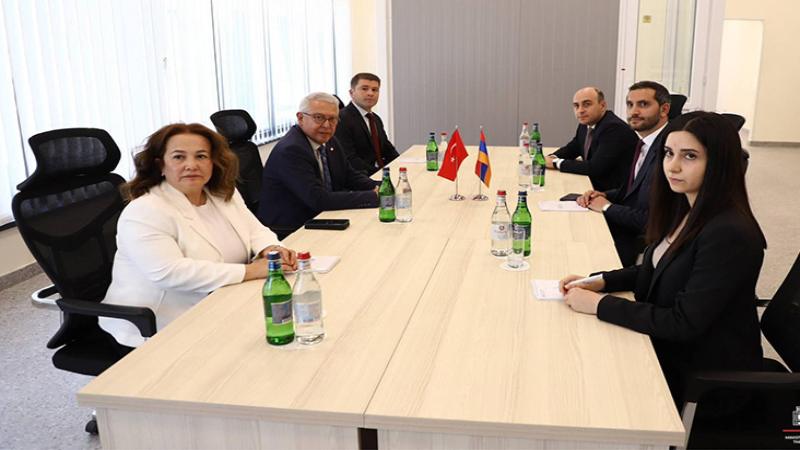
Türkiye–Armenia technical border meeting
Armenia: Doctrine, Constraint, and Conditional Openings
For decades, the bilateral track between Türkiye and Armenia remained effectively frozen at times even non-existent at the interstate level, despite geographic proximity and deep historical entanglement. Diplomatic, commercial, and institutional ties were largely absent, leaving relations confined to the margins of regional geopolitics. Yet this prolonged stagnation never translated into a complete rupture at the societal level. Ankara has consistently framed tensions with Armenia as a dispute between governments rather than peoples, a distinction that shaped its approach even during periods of heightened tension. This framing translated into a measured tolerance toward Armenian citizens residing and working in Türkiye, including those without regular legal status, combining humanitarian considerations with strategic calculation rather than outright disengagement.
At the core of this long-standing freeze lies a structural constraint that Ankara has treated not as a policy option but as a binding principle: the primacy of Armenia–Azerbaijan relations in shaping Türkiye's own engagement with Yerevan. Across successive governments, normalisation with Armenia has been explicitly conditioned on progress between Baku and Yerevan, elevating this linkage from a tactical preference to a de facto doctrine of state policy. This position is anchored in the ideological framework that defines Türkiye–Azerbaijan relations, commonly articulated as "one nation, two states." In practice, this doctrine has imposed a firm strategic ceiling on Ankara's Armenia policy, clearly delineating the political and diplomatic boundaries within which any engagement must operate.
Within these rigid constraints, Ankara has nonetheless sought to preserve a narrow space for manoeuvre by distinguishing between interstate disputes and societal interaction. Even as formal relations remained at zero, Türkiye deliberately avoided steps that would further harden the environment, refraining from measures that could escalate tensions irreversibly or deepen hostility. This restraint reflected a calculated effort to maintain limited leverage while keeping channels below the diplomatic threshold from closing entirely—a posture shaped as much by regional realities as by domestic political considerations.
The 2025 peace agreement between Armenia and Azerbaijan introduced a cautious but consequential shift in this equation. While it did not transform Türkiye–Armenia relations overnight, it eased a long-standing structural blockage by reshaping the regional context in which Ankara's policy operates. For the first time in years, the absence of active conflict between Baku and Yerevan created diplomatic space for Türkiye and Armenia to move beyond purely symbolic engagement and test limited, good-faith steps. Rather than signalling a breakthrough, this shift began to loosen entrenched constraints, turning what had long been a static—at times even non-existent—relationship into one marked by tentative yet observable movement.
This opening translated into a small but tangible package of practical steps, closely tied to the momentum generated by improving Armenia–Azerbaijan relations. Türkiye and Armenia engaged in both overt and discreet technical contacts aimed at lowering barriers without prejudging broader political outcomes. Preparatory work at the Alican border crossing, including on-site technical assessments of infrastructure and customs arrangements, marked the first concrete movement toward reopening a land link closed for more than three decades. Alongside this, targeted efforts to ease visa procedures for specific categories of travellers signalled a parallel intent to facilitate official and institutional interaction, even as the overall framework of relations remained deliberately constrained.
Taken together, the Armenia file illustrates both the possibilities and the limits of Türkiye's foreign policy approach in 2025. Where channels remained open—however narrow, technical, or conditional. Ankara retained relevance and tested cooperation without overstepping established red lines. This progress did not emerge from a comprehensive strategic doctrine, but from the careful management of access within clearly defined political and ideological constraints. In this respect, the Armenia case reinforces a broader pattern evident across Türkiye's diplomacy that year: flexibility can generate movement, but only within the boundaries set by structural commitments and preserved dialogue.
When Channels Close: Gaza
Türkiye's approach to the war in Gaza marked a sharp contrast with the channel-preserving logic evident elsewhere in 2025. In files where Ankara prioritised access and sustained dialogue under tight constraints, influence was maintained through continued engagement. In Gaza, by contrast, diplomatic contact with Israel narrowed rapidly, while public positioning moved to the forefront. Moral clarity assumed greater prominence, but at the expense of operational diplomacy. The result was a shift from access to visibility an approach that increased visibility while constraining Türkiye's ability to influence outcomes, underscoring how influence diminishes when critical channels fall silent, regardless of regional exposure or rhetorical reach.
The practical consequences of this narrowing became visible in the diplomatic margins rather than at the negotiating table. As discussions emerged around potential international arrangements for Gaza, Türkiye remained in contact with a range of actors, maintaining dialogue across multiple channels. Yet the absence of direct engagement with the actor at the centre of the issue proved decisive. Without an operational line to that channel, Ankara's room to test proposals, shape parameters, or contest exclusion was sharply constrained. The episode illustrated a familiar but often overlooked reality of crisis diplomacy: access, not alignment or visibility, determines whether a position can be translated into influence.
Viewed alongside other files in 2025, Gaza highlighted the outer limits of Türkiye's flexibility-driven diplomacy. Where dialogue was sustained, even under strain, Ankara retained room to manoeuvre and shape processes with a degree of operational leverage. Where channels closed, however, flexibility alone proved insufficient. In Gaza, the absence of sustained operational contact narrowed options, reduced leverage, and slowed Ankara's ability to translate political positioning into tangible outcomes. The case underscored a central lesson of the year: flexibility can broaden diplomatic presence, but without access, it cannot substitute for influence.