
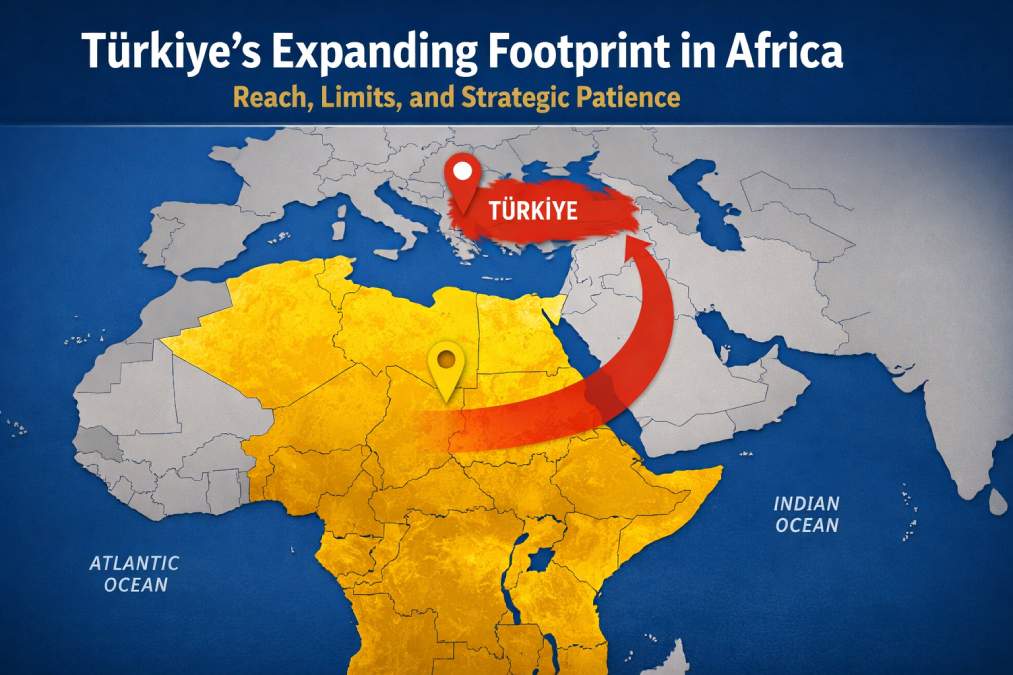
Türkiye's growing presence in Africa is no longer a tactical outreach or a short-lived diplomatic push. It has matured into a structured foreign policy track, one that blends diplomacy, commerce, security cooperation, and soft power. A 2024 report by the Rome-based think tank CESPI traces this trajectory in detail, presenting Africa as one of the clearest arenas where Ankara's multidirectional approach is tested at scale.
This is not a story of sudden ambition. It is a story of cumulative positioning. Türkiye's Africa engagement has expanded steadily over two decades, and its visibility now reflects planning more than spontaneity. The harder question is what that visibility converts into: durable influence, or presence that outpaces capacity.
Africa as a proving ground for Ankara's multidirectional policy
For Ankara, Africa has become a practical extension of a broader strategy. Not a replacement for Euro-Atlantic ties, but a complementary theatre where Türkiye can diversify partnerships, widen diplomatic room for manoeuvre, and engage on terms that are often less constrained by legacy structures.
CESPI notes the appeal of Türkiye's framing as a partner without a colonial past. That narrative does not eliminate rivalry, but it can lower initial political resistance and create openings for engagement, particularly in parts of Sub-Saharan Africa where historical baggage weighs heavily on Western actors.
A long build-up, not a sudden turn
A core point in the report is institutional continuity. Türkiye's Africa policy did not begin in the 2010s, and it is not built only on leader-level optics. The foundations were laid in the late 1990s, accelerated after 2005, and were reinforced through an expanded diplomatic network, regular Türkiye–Africa summits, and sustained engagement with continental institutions.
The result is a footprint that, in diplomatic terms, compares with several mid-sized European states. That matters less as a metric of prestige than as a signal of intent. It suggests Africa is treated as a long-term portfolio, not an episodic opportunity.
Trade is growing, leverage is harder to claim
Economic ties have expanded quickly, driven by industrial goods, construction, textiles, and machinery. Turkish firms are visible across infrastructure and contracting, and commercial diplomacy has been one of Ankara's most consistent tools.
CESPI's reading remains measured. Visibility does not automatically translate into structural influence. China and the European Union continue to dominate African markets in scale, finance, and institutional embeddedness. Türkiye's position is dynamic, but it operates under constraints. Sustaining momentum will require deeper financial capacity, more diversified investment instruments, and a clearer pathway from transactions to long-term economic anchoring.
Security cooperation as a quiet multiplier
Security engagement forms a less public but increasingly consequential layer. Training missions, defence exports, and long-term presence in strategic locations such as Somalia extend Ankara's reach beyond diplomacy and trade. In a number of contexts, this has positioned Türkiye as a partner that can deliver capabilities rather than statements.
The report also flags a familiar risk profile. Security commitments generate exposure. If military cooperation expands faster than economic and political depth, it can create liabilities as easily as leverage. The challenge is not whether Türkiye can be present, but whether it can remain present without strategic overhang.
Soft power travels well, until credibility erodes
Humanitarian assistance, development projects, education initiatives, and cultural outreach remain among Türkiye's most distinctive assets in Africa. They have helped build goodwill and reinforce a practical image: accessible, responsive, and able to operate outside the slow rhythms of larger bureaucracies.
CESPI adds an important caution. Soft power works because it is perceived as non-coercive. When these instruments are seen as politicised, credibility weakens and the advantage narrows. For Ankara, the task is not simply to expand soft power. It is to preserve legitimacy and avoid turning social and educational channels into contested terrain.
How Europe, and Italy in particular, interpret Türkiye's role
One of the report's useful contributions is its European framing. Italy and several EU states approach Africa primarily through energy security, migration management, and stabilisation agendas. Türkiye's approach is broader and often more flexible, combining commercial presence with political and security engagement.
CESPI does not present this only as competition. It points to selective areas where interests could converge, including infrastructure, energy-related projects, training, and capacity-building. Whether these complementarities materialise depends heavily on political context between Ankara and European capitals. The scope for pragmatic overlap exists, but it is not automatic.
Influence without shortcuts
CESPI's conclusion is cautious but clear. Türkiye has emerged as a visible, agile, and multidimensional actor in Africa, able to combine diplomacy, commerce, security cooperation, and soft power with notable coherence. Africa, however, remains a proving ground. The durability of Türkiye's influence will be shaped by economic sustainability, regional competition, and institutional discipline at home and in partner states.
For Ankara, the continent is no longer peripheral. It is a strategic arena where ambition meets constraint, and where patience matters as much as presence.
***Editorial note: This analysis draws on CESPI's 2024 report, L'influenza turca in Africa, and reflects an independent editorial reading in line with Bosphorus News' analytical framework.
***Full report (CESPI PDF): https://www.cespi.it/sites/default/files/documenti/cespi_-_linfluenza_turca_in_africa_-_maeci_uap_2024.pdf