
A new policy analysis by the Clingendael Institute, published in late 2025, offers a detailed geopolitical mapping of Eastern Europe and places Türkiye in a distinct category among regional and global actors navigating the fallout from Russia's war in Ukraine and intensifying great-power competition.
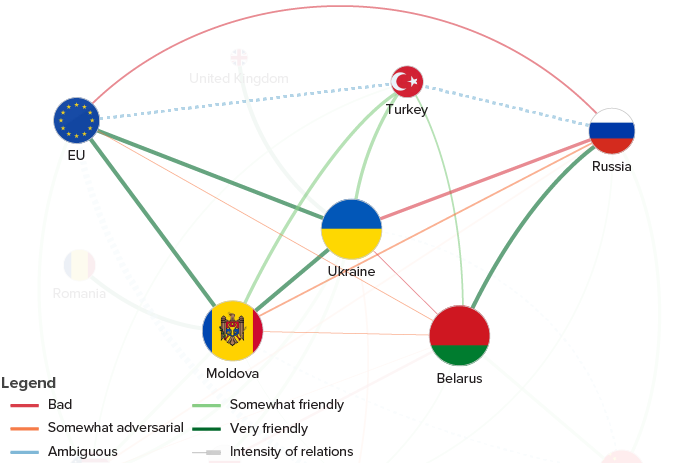
Using a structured geopolitical mapping methodology, the report measures political, economic, and strategic ties between core Eastern European states — particularly Ukraine, Belarus, and Moldova — and a wider circle of regional and international players. By scoring bilateral relationships across multiple indicators, the study illustrates how alliances have largely solidified since 2022, while a small number of actors have retained greater diplomatic flexibility.
Türkiye's Distinct Position
One of the report's most notable findings concerns Türkiye's strategic posture. Unlike many countries that have gravitated toward clear bloc alignment, Ankara is described as pursuing a deliberately pragmatic and balanced foreign policy, maintaining working relations across competing camps despite deepening polarization.
Clingendael characterizes this approach as strategic balancing, rather than indecision. Türkiye is grouped with actors that consciously avoid rigid "either/or" choices, opting instead to preserve diplomatic channels, protect national interests, and sustain influence in an increasingly fragmented regional order.
The report situates this stance within a broader historical arc of Turkish foreign policy: from the early 2000s emphasis on reducing tensions with neighbors, through more assertive regional phases, to a recalibration in the 2020s focused on restoring dialogue, managing disputes, and expanding cooperation where possible.
Leverage and Mediation Potential
According to the analysis, Türkiye's position in the geopolitical mapping framework gives it potential leverage as a diplomatic intermediary, particularly in settings where entrenched alignments leave limited space for engagement. While not neutral, Ankara's ability to sustain functional relations across divides distinguishes it from many regional actors whose ties have hardened into zero-sum positions.
The report also highlights Türkiye's Black Sea connections, including political, economic, and security links with Ukraine and neighboring states, as factors reinforcing its relevance. In an environment shaped by confrontation and sanctions, countries capable of maintaining dialogue across fault lines may acquire influence disproportionate to their formal alliance roles.
A Region Recast by War
More broadly, the Clingendael study underscores how Russia's invasion of Ukraine has crystallized geopolitical choices across Europe, accelerating security realignments, energy diversification, and political polarization. Within this context, Türkiye's calibrated diplomacy stands out as an example of how middle powers seek to navigate between competing pressures without fully committing to a single strategic camp.
For policymakers and analysts, the report offers a nuanced framework to understand power shifts in Eastern Europe and the strategic value of flexibility at a time when rigid alignment has become the dominant trend.
The full Clingendael report is available here: