
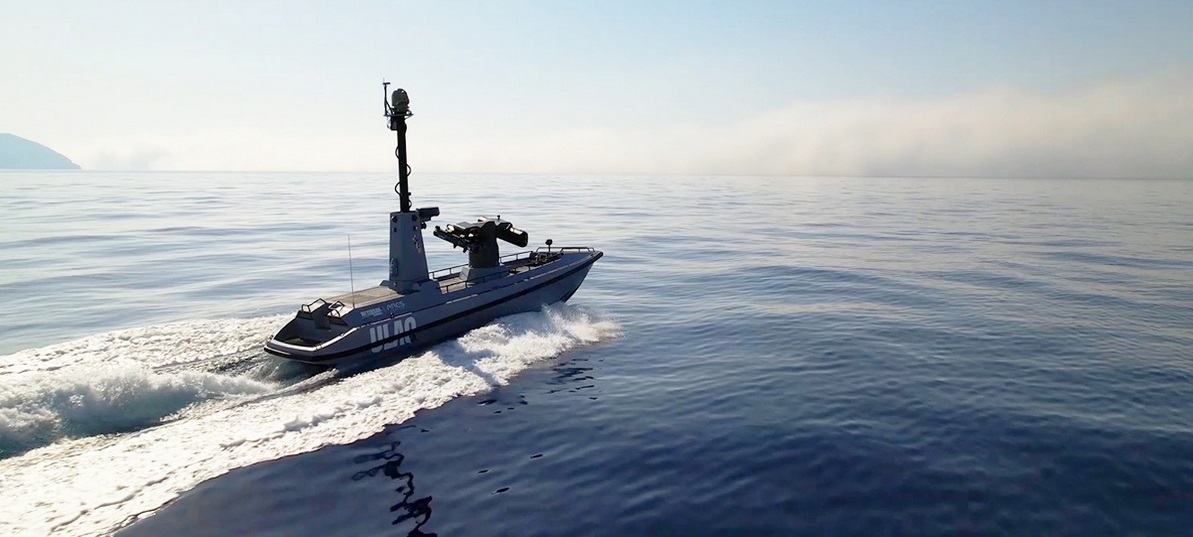
What Is ULAQ? And Why It Matters
For more than a decade, Türkiye's defence story was told through the air. Unmanned aircraft reshaped battlefields, altered procurement habits, and shifted how deterrence is calculated. That story is no longer confined to the skies.
With ULAQ, Türkiye is carrying its unmanned logic into the maritime domain.
Developed jointly by ARES Shipyard and Meteksan Defence, ULAQ is the country's first armed unmanned surface vessel (USV). It is not a prototype built to signal intent, but a weaponised platform designed for real-world naval tasks.
More than a "sea drone"
Calling ULAQ a sea drone misses the point. The platform was conceived as part of naval force structure, not as a peripheral sensor.
ULAQ can operate autonomously or under remote control, carry ISR and electronic warfare payloads, and deploy guided munitions directly from an unmanned hull. In a first for its category, it successfully fired a guided missile at sea, marking a shift from surveillance-focused USVs to strike-capable unmanned naval systems.
That distinction matters. Naval environments impose constraints that air systems do not: sea state, endurance, command resilience, and survivability. ULAQ was built to operate within those limits, not around them.
How ULAQ differs from Western USVs
Set against Western unmanned surface vessel programmes, ULAQ's logic becomes clearer.
Most US and European USVs have prioritised support roles: intelligence collection, mine countermeasures, logistics, and maritime patrol. Armed variants exist, but many remain experimental, tightly regulated, or limited by export controls and rules of engagement.
ULAQ follows a different path. It was designed from the outset as a strike-capable platform, with weapons integration treated as a core function rather than an optional module. This gives it a clearer operational identity and reduces the distance between testing and deployment.
There is also a political dimension. Western armed USVs are typically embedded within alliance frameworks that restrict transfer and use. ULAQ enters the market with fewer regulatory and political frictions, making it attractive to navies seeking capability without deep dependency.
ULAQ does not compete with Western systems on scale or budget. It competes on clarity of purpose, speed to deployment, and exportability.
From Blue Homeland to the export map
ULAQ has been tested and demonstrated within Türkiye's Blue Homeland (Mavi Vatan) framework, which emphasises layered maritime defence and persistent situational awareness across surrounding seas.
But the platform is not limited to domestic doctrine. Türkiye has already completed its first export of an armed unmanned surface vessel, extending its UAV export model into the naval domain.
The export itself matters less for volume than for signal. It confirms that ULAQ is viewed as operationally credible, not merely experimental, and places Türkiye among a small group of states offering armed, deployable unmanned naval platforms internationally.
Why navies are paying attention
Foreign defence reporting increasingly treats Türkiye's unmanned push as systemic rather than sector-specific. The emphasis is no longer on drones alone, but on an ecosystem that spans air and sea.
ULAQ fits this pattern as a force multiplier for smaller navies, a risk-absorbing asset in contested littorals, and a cost-effective complement to manned patrol or fast-attack craft. Armed USVs offer persistence without exposure and deterrence without constant escalation.
A doctrinal shift, not an add-on
ULAQ should be read as part of a broader transformation in how Türkiye thinks about naval power.
The sequence is familiar from the air domain: surveillance first, autonomy next, precision strike integration, and finally export. What is changing is the environment. In the maritime domain, unmanned systems are not replacing ships, but reshaping fleet composition at the margins—where speed, risk tolerance, and persistence matter most.
Why it matters beyond Türkiye
As maritime competition intensifies from the Eastern Mediterranean to the Red Sea, navies are looking to expand presence without expanding vulnerability.
ULAQ offers one answer. A platform shaped by combat drone experience, adapted to naval realities, and offered with fewer political constraints than many Western equivalents.
It also underlines a broader point. Türkiye's unmanned ambition was never limited to the skies. The sea was always the next domain.