
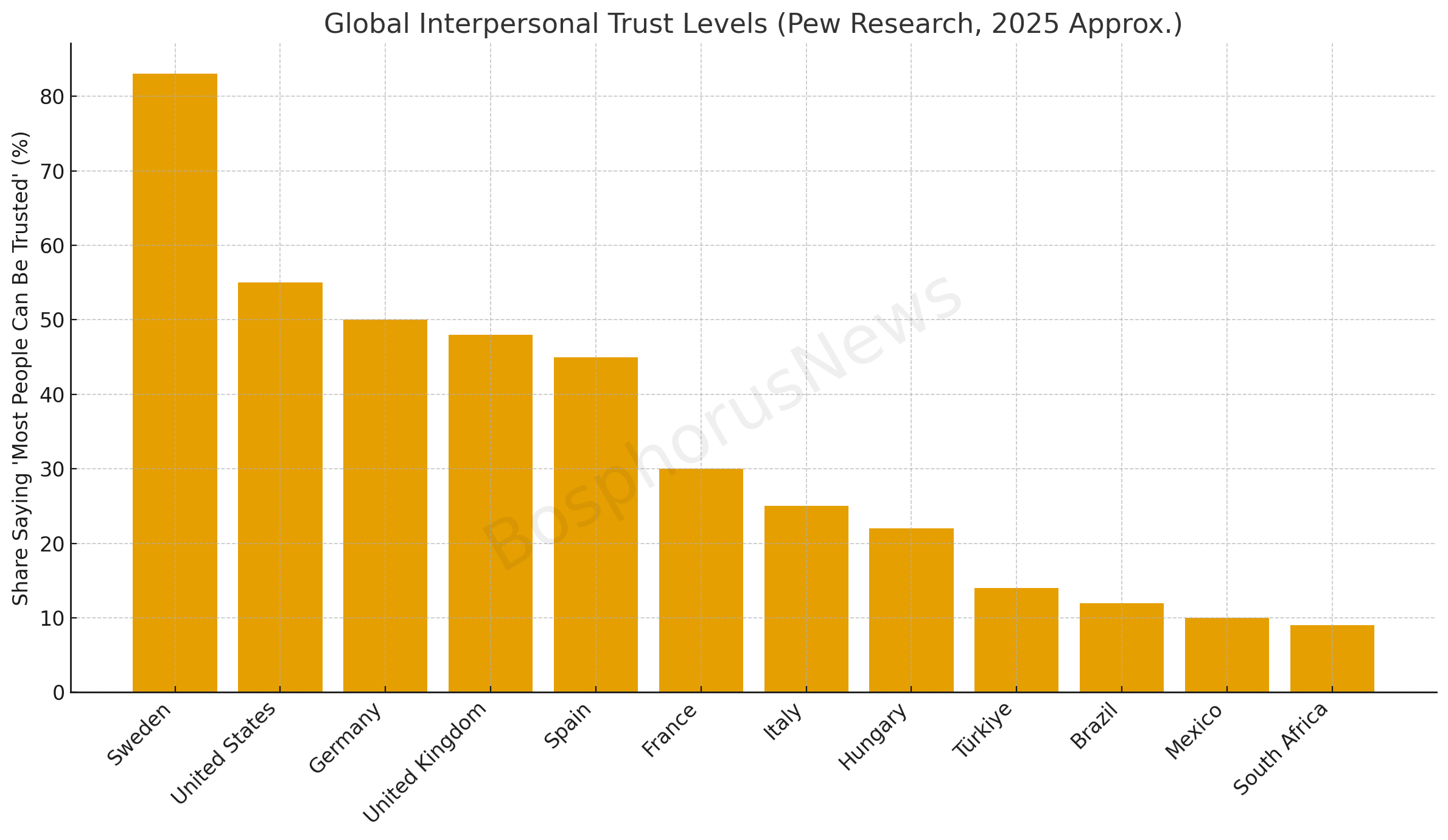
A recent global survey by the Pew Research Center — one of the world's most respected independent research organisations — reveals that levels of interpersonal trust in Türkiye are significantly below the global average, reflecting broader social and economic dynamics.
The Pew report, based on surveys in more than two dozen countries in early 2025, asked respondents whether "most people can be trusted" or whether "you can't be too careful in dealing with others." While countries such as Sweden and the Netherlands recorded some of the highest levels of trust, Türkiye's figures were notably lower, positioning it closer to nations with more cautious public attitudes toward social trust.
Türkiye's Trust Metrics in Context
- Only a small minority of respondents in Türkiye said they believe most people can be trusted.
- A clear majority expressed caution about interpersonal trust, a pattern similar to several other middle-income and transitional economies included in the survey.
- In contrast, many Northern European societies were far more confident in general trust, with majorities asserting that people can be trusted.
While the exact percentages vary slightly between countries, Türkiye's placement aligns with long-standing trends observed in comparative surveys, where economic uncertainty, political polarization, and rapid social change have tended to correlate with lower reported trust levels.
Why Trust Matters
Social scientists emphasise that interpersonal trust — the belief that strangers or fellow citizens will act fairly and cooperatively — is more than an abstract measure. It is often linked to:
- Economic performance and investment: Higher trust can reduce transaction costs and support entrepreneurship.
- Civic cooperation: Communities with higher trust tend to have stronger volunteerism and civic engagement.
- Institutional confidence: Trust in people often correlates with trust in government, media, and public institutions.
In Türkiye's case, recent economic fluctuations, debates over governance, and broader regional uncertainties may influence how people perceive social relations and security. However, trust is not static; positive policy developments, civic programmes, and inclusive economic growth can help strengthen confidence in others over time.
Comparing with Neighbours and Global Averages
While Türkiye's trust levels are lower than those in many Western European countries, the Pew survey also shows that Türkiye is not alone in this pattern. Several countries with complex socio-economic transitions and mixed governance outcomes show similar levels of trust responses — suggesting that cultural, historical, and structural factors all play roles.
For example:
- In Northern Europe, majorities often say "most people can be trusted," sometimes by margins of 60–70 percent or more.
- In Türkiye, the proportion is significantly lower, with a majority expressing caution in their dealings with others.
- Across all 25+ countries surveyed, the average share of people expressing trust tends to hover around one-third to one-half, placing Türkiye below comparable global mean levels.
Balanced Interpretation and Future Outlook
It is important to interpret these findings carefully. Survey responses reflect how people feel at a particular moment — influenced by personal experience, media narratives, and broader societal conditions. They do not necessarily predict future behaviour or inherent cultural values.
Experts caution against simplistic explanations: low trust does not mean a society is dysfunctional. Rather, it highlights areas where public dialogue, transparency, and shared social experiences may be deepened to build mutual confidence.
For policymakers and civic leaders in Türkiye, the findings present both a challenge and an opportunity: to strengthen trust through economic stabilisation, community engagement, and policies that reinforce fairness, inclusion and predictable governance.