
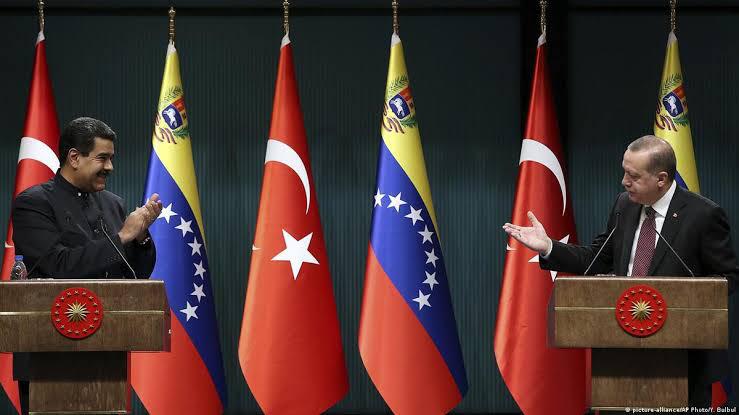
The December 6, 2025, phone call between Presidents Erdoğan and Maduro was a highly strategic diplomatic maneuver that placed Türkiye at the center of a major international crisis. By simultaneously advocating for de-escalation while reinforcing a strategic partnership, Ankara is managing geopolitical risk, but this engagement brings the explosive asylum question and its deep financial foundations into sharp focus.
I. The Immediate Message: Erdoğan's Push for Open Channels
President Erdoğan's primary directive to President Maduro—to maintain open dialogue with the United States—serves as the linchpin of Ankara's self-styled mediation role.
- De-Escalation as Strategy: The Turkish Directorate of Communications confirmed Erdoğan "stressed the vital importance of maintaining dialogue between Venezuela and the United States," expressing hope that the "tension will ease as soon as possible." This positions Türkiye, a NATO member with robust ties to Caracas, as a pragmatic actor attempting to avert a potential military flashpoint (the U.S.'s Operation Southern Spear).
- The Shared Grievance: Despite this call for conciliation, the leaders found common ground in challenging the U.S. deployment. Venezuelan Foreign Minister Yván Gil stated that Erdoğan voiced "deep concern" over the threats, suggesting Ankara validates Caracas's perception that the intensified U.S. naval presence (including the USS Gerald R. Ford) is "illegal, disproportionate, unnecessary, and even extravagant," rather than a simple counter-narcotics campaign.
- Balancing Act: This duality is critical: Türkiye appears to the West as a responsible actor promoting dialogue while simultaneously consolidating its non-Western alliance by lending political support to Maduro's claim of national sovereignty under threat.
II. The Strategic Risk: The Implied Asylum Question
Behind the public statements on trade and dialogue, the single most profound risk and unspoken subtext of the Caracas–Ankara Axis is the growing speculation that Türkiye would offer President Maduro asylum should he be forced from power.
- A Plausible Refuge: International reports, citing U.S. officials and regional experts, identify Türkiye as the most probable refuge for Maduro. This is a direct consequence of the deep personal trust between the two leaders and the established financial and logistical infrastructure of their alliance.
As reported by The Washington Post, "US officials and regional experts increasingly view Turkey as the destination that best matches Maduro's political needs and personal preferences." One expert noted that Turkey "provides Maduro with safety and [the U.S.] with a politically palatable outcome" compared to exile in Moscow or Tehran.
- The Price of Protection: Nicolás Maduro is currently indicted in the U.S. on charges of drug trafficking, corruption, and terrorism, with the U.S. offering a massive $50 million reward for information leading to his arrest. An asylum arrangement in Türkiye would necessitate assurances against extradition, thereby placing Ankara in direct, irreconcilable conflict with U.S. law enforcement and foreign policy objectives.
- Economic Anchor & Security: The strategic importance of the $3 billion trade goal and the re-established Caracas–Istanbul air route is cemented by this exile possibility. These links serve as a ready-made channel for security coordination and financial support (including the long-running Venezuelan gold trade) that would be essential to maintaining Maduro's status in exile.
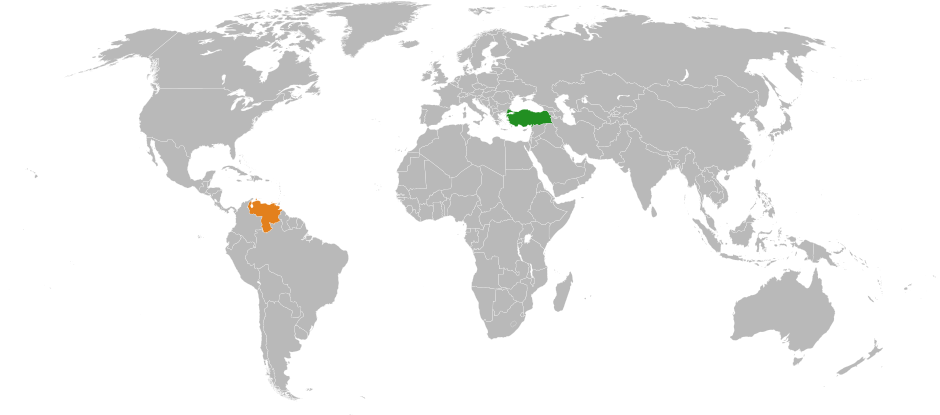
III. The Sanctions-Busting Gold Trade: The Financial Lifeblood
The foundation of the strong bilateral trade goal is the proven track record of using gold exports as a key mechanism to bypass international sanctions, directly supporting the Maduro regime's financial stability and providing the necessary infrastructure for any future exile.
- Gold as a Counter-Sanction Mechanism: Since 2018, Türkiye has become the linchpin of the Venezuelan gold trade, allowing Caracas to monetize its vast gold reserves after Western financial institutions cut off access to traditional banking. In 2018 alone, Turkey imported approximately $900 million in Venezuelan gold, a massive jump from virtually zero the year before. This move was widely seen as mirroring Ankara's previous "gas-for-gold" scheme with Iran.
- The "Gold-for-Food" System: This arrangement evolved into a "gold-for-food" system, where unrefined Venezuelan gold was reportedly shipped to Turkey for refining, with the revenues or goods (like basic food supplies for the government's CLAP program) being sent back. This creates a sanctions-resistant barter system that allows the regime to fund key operations without relying on the U.S. dollar, effectively ensuring its financial endurance.
IV. The Caracas-Ankara Axis: A Strategic Partnership (Erdoğan & Maduro)
The relationship between President Recep Tayyip Erdoğan of Türkiye and President Nicolás Maduro of Venezuela has matured from an opportunistic trade relationship into a strategic, geopolitical partnership designed to provide both leaders with mutual resilience against Western-led pressure.
- Deep Personal Trust: The core of the alliance is the strong personal tie between Erdoğan and Maduro. This trust has been demonstrated by Erdoğan's unwavering diplomatic support for Maduro during the Venezuelan presidential crisis (2019). This promise of political sanctuary is the most critical element, providing the Venezuelan leader with a layer of personal security against the $50 million U.S. indictment.
- Economic Counter-Sanction Firewall: On a financial level, the partnership is cemented by the gold trade. This mechanism provides Caracas with an essential, non-dollar-based revenue stream crucial for funding government operations and maintaining the regime's solvency. The current $3 billion trade goal serves to further formalize this resilient, counter-sanction economic architecture.
- Geopolitical Alignment: For Türkiye, the alliance with Venezuela is a clear expression of its multi-vectored foreign policy, allowing Ankara to project influence into the Caribbean and Latin America while positioning itself as a leader among nations seeking to challenge or mitigate U.S. unilateralism.
V. The US Response: Military Pressure and Diplomatic Warnings
The intensifying relationship between Ankara and Caracas—particularly the financial ties and the asylum risk—is seen by Washington as a direct challenge to its hemispheric policy and a breach of NATO solidarity.
- Operation Southern Spear Context: The diplomatic advice from Erdoğan to Maduro occurs against the backdrop of Operation Southern Spear—the largest U.S. military buildup in the Caribbean since the Cuban Missile Crisis. This operation is explicitly framed by the Pentagon as a counter-narco-terrorism campaign targeting networks linked to the Maduro regime.
- The Asylum Warning: U.S. officials and lawmakers have publicly warned against the asylum scenario. Republican Senator Lindsey Graham, for instance, has used social media to publicly track possible exile destinations, aiming to complicate Ankara's political calculation by highlighting the geopolitical cost of harboring a U.S.-indicted target.
- Targeting the Financial Network: U.S. sanctions policy has already focused heavily on the economic links, with the Treasury Department sanctioning Turkish entities for their involvement in the Venezuelan gold trade, explicitly calling it an effort to "circumvent international sanctions."
The Strategic Conclusion: Prioritizing Autonomy
The phone call between President Erdoğan and President Maduro on December 6, 2025, was not an act of mediation, but a strategic validation.
Türkiye's engagement with Venezuela is a calculated, high-stakes gamble that provides immediate strategic benefits: it reinforces Ankara's preferred posture as a nation pursuing "strategic autonomy," allows it to project influence into a critical Latin American theatre, and solidifies its role as an economic counterweight to Western financial dominance.
However, this strategy carries an unavoidable geopolitical cost. The Caracas-Ankara Axis is now fundamentally defined by the unspoken promise of asylum. Should the U.S. pressure (through Operation Southern Spear) force Maduro from power, and should Erdoğan provide sanctuary to an indicted U.S. target, Türkiye will have made an irreversible choice: prioritizing its non-Western strategic autonomy over the core obligations and political cohesion of the NATO alliance. The $3 billion trade goal and the established gold trade are the tools of resilience; the asylum risk is the ultimate strategic trigger that defines the new trajectory of Turkish foreign policy.