
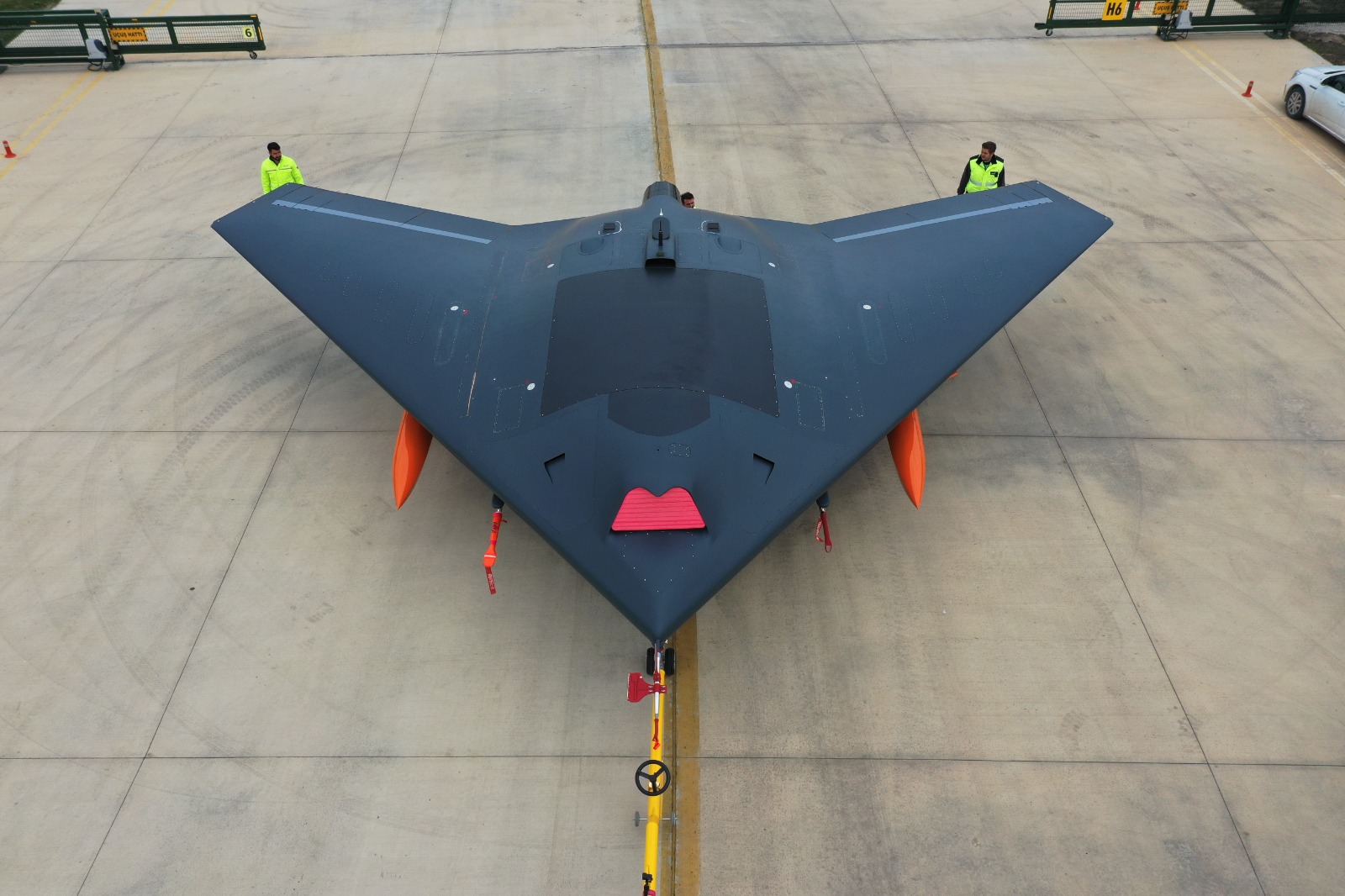
Türkiye's next-generation unmanned combat aircraft, the ANKA-III, has successfully completed a new series of autopilot and autonomous-flight tests, moving the program into a more mature phase of development. The latest sortie — the 46th flight since the platform's debut — was conducted by Turkish Aerospace Industries (TUSAŞ) as part of broader system verification and performance evaluation efforts. According to program officials, the vehicle met all predefined criteria for stability, response accuracy, and automated flight control.
The ANKA-III, designed in a flying-wing configuration to reduce radar visibility, represents one of Türkiye's most ambitious aerospace projects to date. Its ability to integrate a large payload, operate at high subsonic speeds, and conduct missions with reduced detectability places it in a small class of advanced unmanned combat platforms currently under development worldwide.
Growing Capabilities and Technical Profile
Early performance data places the aircraft at a maximum takeoff weight of roughly seven tons, a useful payload capacity of around 1,200 kilograms, and an operational ceiling near 40,000 feet. The system is expected to cruise at high subsonic speeds close to 0.7 Mach and maintain an endurance of up to ten hours, depending on payload configuration.
These characteristics position ANKA-III for a wide spectrum of missions: long-range ISR (intelligence, surveillance, reconnaissance), electronic warfare, stand-off strike roles, suppression of enemy air defenses, and cooperative missions alongside crewed fighter aircraft. The platform's internal weapons bay and external hardpoints enable it to carry guided munitions without compromising its low-observable profile.
In earlier test phases, the UAV successfully executed weapon-release trials, including the deployment of precision-guided munitions from its internal bay. Engineers have also tested satellite-based datalinks and sensor suites, both integral to autonomous or semi-autonomous mission profiles.
Why the Autopilot Test Matters
Successful completion of advanced autopilot trials is a critical requirement for Türkiye's goal of fielding a reliable, high-autonomy unmanned combat air vehicle. These tests evaluate the aircraft's ability to manage flight dynamics without pilot input, respond to mission-control directives, stabilize under changing atmospheric conditions, and adapt to system failures by rerouting or returning safely.
Such capabilities are considered central to future airpower concepts where unmanned aircraft operate in teams — either with each other or alongside crewed fighters — to distribute risk, extend reach, and deliver precision effects without exposing pilots to danger.
For Türkiye, which has spent over a decade building a comprehensive UAV ecosystem, ANKA-III is a logical next step after the Bayraktar series, the ANKA family, and the entry of the jet-powered Kızılelma prototype. Together, these platforms indicate a shift toward more complex, multi-layered unmanned operations.
A Balanced Outlook: Achievements and Remaining Challenges
While the progress is notable, the aircraft must still undergo extensive stress testing, electronic warfare resilience assessments, and operational evaluation in realistic field environments. Low-observable designs perform differently depending on adversary radar characteristics, atmospheric conditions, and mission altitude; therefore, long-term assessments will determine how well ANKA-III's stealth profile holds in modern threat environments.
In addition, Türkiye will need to finalize production infrastructure, training frameworks for operators and mission planners, and integration protocols with existing command-and-control networks. Autonomous systems, particularly those intended for high-risk missions, require careful doctrinal development to ensure reliability and human oversight.
Conclusion: A New Phase for Türkiye's UAV Ambitions
The ANKA-III's successful autopilot campaign marks a major step toward operational readiness and places Türkiye among a small group of nations capable of designing and testing low-observable unmanned combat aircraft. As development continues, the aircraft is set to become a central component of Türkiye's future airpower structure — complementing crewed platforms, expanding ISR and strike capacity, and contributing to a more resilient national defense posture.
If forthcoming phases proceed as planned, ANKA-III may evolve from a promising prototype into a platform that reshapes Türkiye's role in next-generation unmanned aviation.