
By Bosphorus News Geopolitics Desk
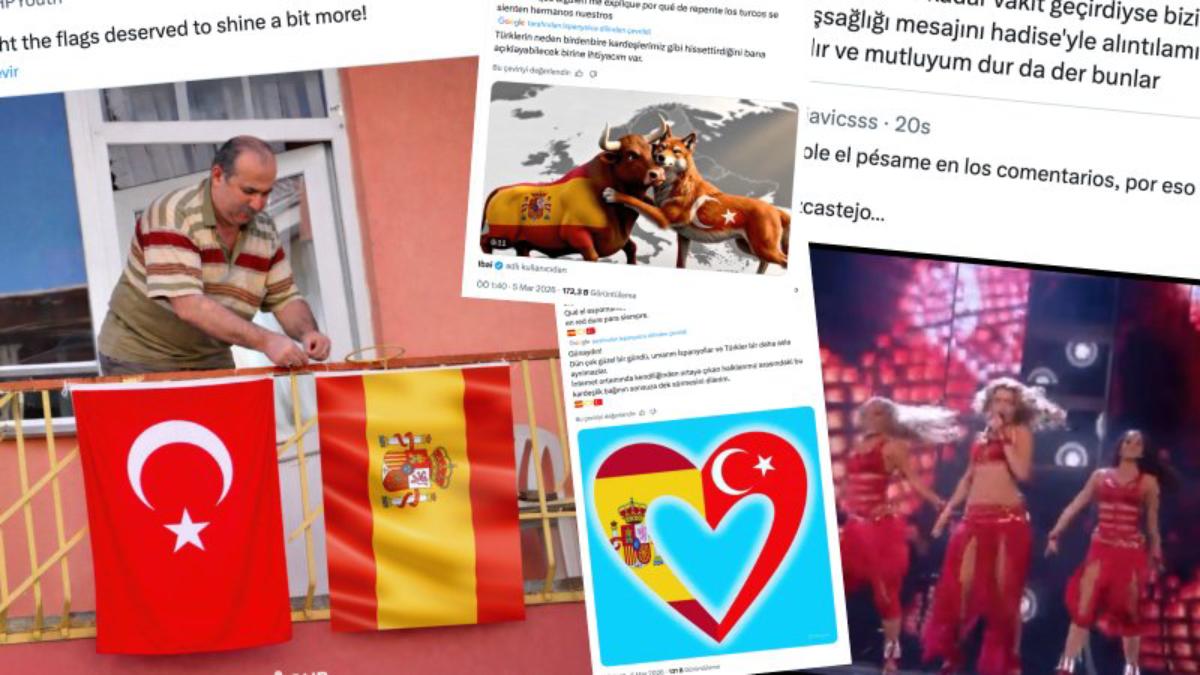
When Spanish Prime Minister Pedro Sánchez declared the US-Israeli strikes on Iran "unjustifiable and dangerous," the approval in Türkiye was immediate. The clips went viral. Memes circulated. On TikTok and X, Spanish-Turkish friendship briefly became a trending topic across both countries. The question worth asking is what sits underneath it.
Spain has indeed become an outlier. While Berlin told reporters this was "not the time to lecture our partners and allies," and most European capitals fell into line, Sánchez held firm. Madrid did not authorise the use of the jointly operated bases at Rota and Morón for US operations against Iran, a decision that prompted Trump to threaten trade measures against Spain. Sánchez absorbed the threat and kept his position. The Spanish warship Cristóbal Colón was deployed to the Mediterranean, with Madrid avoiding any linkage to offensive operations. Spain also formally condemned the escalation after NATO intercepted a missile launched from Iran approaching Turkish airspace, and after Iranian drones struck Azerbaijan. (Spanish Ministry of Foreign Affairs, March 5, 2026)
The values story holds, but it does not explain why Madrid's line is so consistent.
The Investment Nobody Talks About
Look past the diplomatic language and the numbers tell a different story. Spain is not merely a trading partner of Türkiye. It is, by one critical measure, the most committed European investor in the Turkish economy among major EU nations.
The total stock of Spanish direct investment in Türkiye stands at approximately $10.68 billion, placed by 775 Spanish companies operating across banking, insurance, rail, cement, and manufacturing. (Spanish Ministry of Economy and La Moncloa, June 2024) Germany and the Netherlands hold larger shares on raw stock figures, at roughly 12.8 percent and 12.2 percent respectively, but raw stocks can be misleading because they mix operating exposure with holding structures. Dutch stocks often reflect holding structures and special purpose vehicles as much as operating exposure. (OECD / Presidency of the Republic of Türkiye Investment Office)
Look past that, and the picture changes. Adjusted for GDP per capita, Spain's exposure stands at approximately 0.66 percent of the measure, against Germany's 0.44 percent and France's estimated 0.22-0.28 percent. A Spanish citizen has, in proportion to their own income, invested roughly fifty percent more in Türkiye than a German citizen, and between two and three times more than a French citizen, yielding a per-capita investment ratio no other major EU economy comes close to matching. (Bosphorus News calculation based on OECD FDI stock data and World Bank GDP per capita figures, 2023)
Spain was the largest foreign investor in Türkiye in 2022, driven by BBVA's consolidation of its position in Garanti Bank. (Spanish Ministry of Economy, June 2024) Mapfre entered the Turkish insurance market in 2007. CAF has held rolling stock and rail contracts in Türkiye. (Real Instituto Elcano, 2009; Spanish Ministry of Economy, 2024) The pattern is not opportunistic. It is structural.
What Structural Means
Structural investment produces structural interests. A bank with a major Turkish subsidiary needs Turkish political stability. It needs the Turkish economy to function. It needs access to Turkish markets, and it needs the regulatory and trade framework governing that access to remain as open as possible.
That framework has a name. The Customs Union between the EU and Türkiye, in force since 1996, governs the movement of goods that underpin much of this investment. Bilateral trade reached $19.2 billion in 2023, and both governments have set a $25 billion target within five years. Spain ranks among Türkiye's top EU trading partners. (Turkish Ministry of Foreign Affairs; Spanish Ministry of Economy, 2024) If the upgrade talks stall or EU and Türkiye relations deteriorate, Spanish corporate interests take the hit. For Madrid, this is not an abstract Brussels agenda. It is a balance sheet item.
The political record reflects the economic one. Spain has been among the most consistent EU supporters of Türkiye's membership prospects. When Sánchez and President Erdoğan held their eighth bilateral summit in June 2024, they signed thirteen memoranda of understanding covering infrastructure, green transition, digital transformation, export financing, and investment protection. (La Moncloa, June 13, 2024) BBVA and Limak, Türkiye's largest conglomerate, were named co-chairs of the bilateral business council. The summit was not a diplomatic courtesy. It was a business meeting with heads of government attached.
The War Positions Converge
None of this makes the convergence on Iran automatic, but it makes it legible. Türkiye condemned the US-Israeli strikes as illegal, called for a ceasefire, and refused to allow its bases to be used for offensive operations. Spain took a comparable line on escalation control and base access. The positions converge on legal framing, even if the operational context differs.
Erdoğan described the strikes as part of Israel's "bid for regional hegemony." Sánchez described them as "an escalation that contributes to a more uncertain and hostile international order." Neither formulation is identical, but both point in the same direction.
Both countries are also exposed to the economic consequences of escalation in ways that the loudest supporters of the offensive are not. Spain's $19 billion trade relationship with Türkiye runs through shipping lanes that an expanded conflict could disrupt. Türkiye's own trade relationships with its Middle Eastern neighbours, its role as a transit hub, and the fragility of its current account position all make a wider war directly costly for Ankara. A full closure of the Strait of Hormuz would likely drive oil prices and shipping insurance costs sharply higher. Both economies would feel it quickly.
The Principled Position and the Profitable One
None of this is to say that Sánchez's anti-war stance is insincere. Polling has shown broad public scepticism in Spain toward Washington's Iran policy. (Eurobazuka, February 2026) Spain has a consistent record on Gaza, on Venezuela, on Greenland, on every point where Washington has pressed European governments to fall in line. Sánchez has been willing to absorb real political cost for these positions, including a direct presidential threat of trade measures.
But sincerity and self-interest are not mutually exclusive. The most durable foreign policy positions are usually the ones where values and interests run in the same direction. Sánchez's anti-war stance happens to align with his domestic base, with his ideological convictions, and with a bilateral economic relationship worth billions that depends on regional stability, Turkish institutional continuity, and the preservation of a trade framework that keeps Spanish capital productive in Istanbul, Ankara and beyond.
What began as a viral moment of solidarity has a less romantic explanation underneath. Spain has more economic skin in the Turkish game than many other EU powers. Should the conflict spread and Türkiye's economy contract, or the EU and Türkiye trade framework fracture under geopolitical pressure, Spain's exposure is not theoretical. It is $10.68 billion, spread across banking, insurance, rail and cement, with no easy exit. Among major EU economies, Spain would be among the most exposed, and exposed early.
Spain and Türkiye are not just aligned on values. They are aligned on exposure. For Spain, with $10.68 billion tied to Turkish stability, the friendship has a price tag.