
By Bosphorus News Energy Desk
With Qatar's LNG offline and the Strait of Hormuz closed to Western-linked shipping, the Azerbaijan-Türkiye pipeline corridor is the only major overland route carrying non-Russian, non-Gulf gas into the EU. Infrastructure is expanding, but Azerbaijan's upstream output is not yet keeping pace.
The closure of the Strait of Hormuz since 28 February has removed roughly a fifth of global LNG trade from the market. Qatar halted production at its Ras Laffan and Mesaieed facilities on 2 March and declared force majeure on gas contracts two days later. European natural gas futures jumped approximately 30 percent in the first week of the war.
In this environment, the Southern Gas Corridor, the pipeline system carrying Azerbaijani gas through Georgia and Türkiye to southern Europe, is the only major overland corridor delivering non-Russian, non-Gulf gas into EU territory.
The corridor
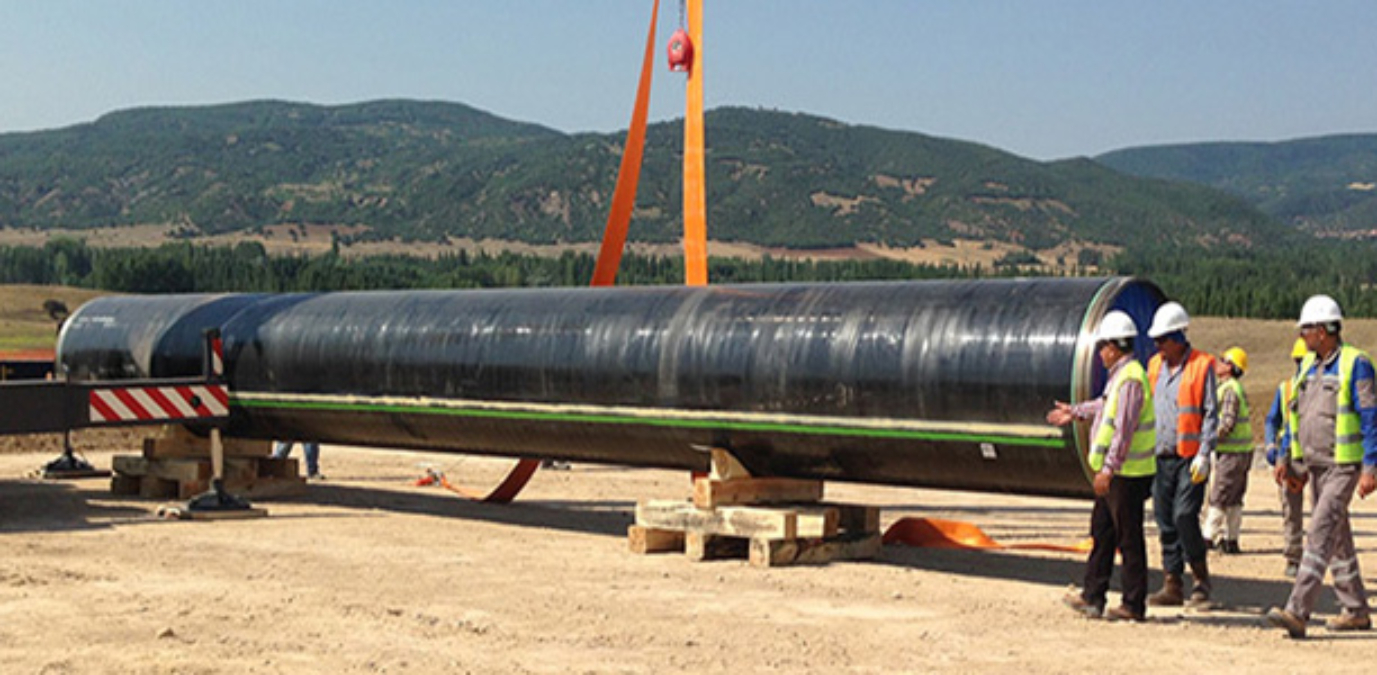
The Southern Gas Corridor links three pipelines end to end. The South Caucasus Pipeline carries gas from Azerbaijan's Shah Deniz field through Georgia to the Turkish border. TANAP runs 1,841 kilometres across Türkiye to the Greek border, with an offtake for Turkish buyers at Eskişehir. TAP continues through Greece and Albania and under the Adriatic to southern Italy. TANAP is operated by SOCAR. Türkiye's pipeline operator BOTAŞ holds 30 percent. BP holds 12 percent.
Export snapshot
Azerbaijan's gas exports reached 25.2 billion cubic metres in 2024, up 5.8 percent year on year. Exports to Europe rose 8.6 percent to 12.9 bcm.
Azerbaijan began exporting gas to Syria via Türkiye on 2 August 2025. The route runs through existing Turkish infrastructure. It is the first tangible sign that Ankara's post-Assad political influence in Syria is acquiring an energy dimension.
Pipes ready, gas lagging
TANAP was designed as a modular system. Planned expansion phases target 31 bcm per year by 2026 and 60 bcm at full build-out, achievable by adding compressor stations and parallel loops. At the European end, TAP added 1.2 bcm of annual capacity in January 2026, with 1 bcm for Italy. TAP's operator plans to double throughput to 20 bcm by 2027. President Ilham Aliyev said in January 2026 that deliveries to two new European countries would begin this year, bringing the total to 16. Germany and Austria joined the network under new agreements, including a 10-year contract with Germany's SEFE for up to 1.5 bcm per year.
The infrastructure is expanding. The gas behind it is not keeping pace.
Most of Azerbaijan's export gas comes from a single field, Shah Deniz, operated by BP. BP has not confirmed the expanded production rate for Shah Deniz Phase Two or disclosed expected volumes from deep gas reserves beneath its ACG oil field. TotalEnergies' Absheron field produced 1.6 bcm in 2025. A second phase that could raise output to 6 bcm per year has not received a final investment decision.
An analysis published by OilPrice.com in January 2026 argued that recent production data and stalled upstream investment cast doubt on Azerbaijan's ability to reach its pledged 20 bcm annual exports to the EU in the near term. Neither SOCAR nor TAP has confirmed whether the new German and Austrian deliveries represent incremental volumes or redirected gas from existing flows. Pipes can be expanded. Supply cannot be assumed.
Türkiye's position
Every cubic metre of Azerbaijani gas destined for Europe crosses Turkish territory. Ceyhan, on the Mediterranean coast, is the terminal for the Baku-Tbilisi-Ceyhan oil pipeline, which carried approximately 1.2 million barrels per day in 2024. With the Strait of Hormuz closed, Ceyhan is one of the few Eastern Mediterranean oil export points not dependent on Gulf shipping lanes.
That same geography is now acquiring a harder security dimension. Ankara has deployed F-16s and air defence assets to the TRNC, completed vessel traffic surveillance stations under the Eastern Mediterranean GTH project, and is negotiating passage for stranded Turkish ships through the Strait of Hormuz. The energy corridor and the military footprint now occupy the same map.
What the data does not show
SOCAR and BOTAŞ have not disclosed whether TANAP throughput has increased since the Hormuz closure on 28 February. Q1 2026 flow data has not been released. Pipeline gas cannot be ramped up as quickly as LNG cargoes can be redirected. Capacity expansion requires physical compressor station installation, on a timeline of months. Whether the compressor work needed to reach the 31 bcm target is on track has not been disclosed.
The Southern Gas Corridor is more important to European energy security today than at any point since its commissioning in 2018. It is the only pipeline delivering non-Russian gas to the EU that does not depend on a maritime chokepoint under threat. TAP is adding capacity. Azerbaijan is adding customers.
The immediate constraint is no longer pipeline architecture. It is whether Azerbaijan can produce enough gas to fill a corridor Europe suddenly needs more than before.
SOURCES:
Market and crisis context: U.S. Energy Information Administration, UNCTAD (March 2026), TIME, CNBC, Windward Maritime Intelligence (10 March 2026).
Pipeline and export data: Caspian News (December 2025), Interfax Ukraine (January 2026), Azerbaijani Energy Ministry, TAP AG, SOCAR.
Production analysis: OilPrice.com / Eurasianet (January 2026), Azernews (January 2026).
European supply context: Intereconomics / ZBW (2025), Enerdata.