
What Equity Means, and What It Does Not
The recent study published by SAIS Review of International Affairs revisits a core assumption in the Türkiye–Greece maritime dispute: that legal certainty can be achieved through technical formulas alone. At the centre of this debate lies equidistance (the method of drawing maritime boundaries by placing a median line at equal distance from opposing coasts), a technique commonly associated with the United Nations Convention on the Law of the Sea (UNCLOS), the principal legal framework governing maritime zones. The paper treats equidistance not as a rule in itself, but as a conditional tool whose relevance depends on geography and proportionality.
Rather than proposing a fixed outcome, the study questions the routine use of equidistance as a default method. Its argument is not that equidistance is unlawful, but that it becomes inadequate when applied without regard to coastal realities, relative shoreline lengths, and regional setting. In this reading, equity is not an afterthought invoked when rules fail. It is a starting point embedded in the logic of maritime delimitation.
One of the article's more consequential contributions is its reading of UNCLOS as a deliberately open framework. By stressing that the Convention leaves boundaries to be defined through agreement, the authors reject the idea that legal text alone can predetermine outcomes. Law does not draw lines by itself. It defines the parameters within which negotiation takes place.
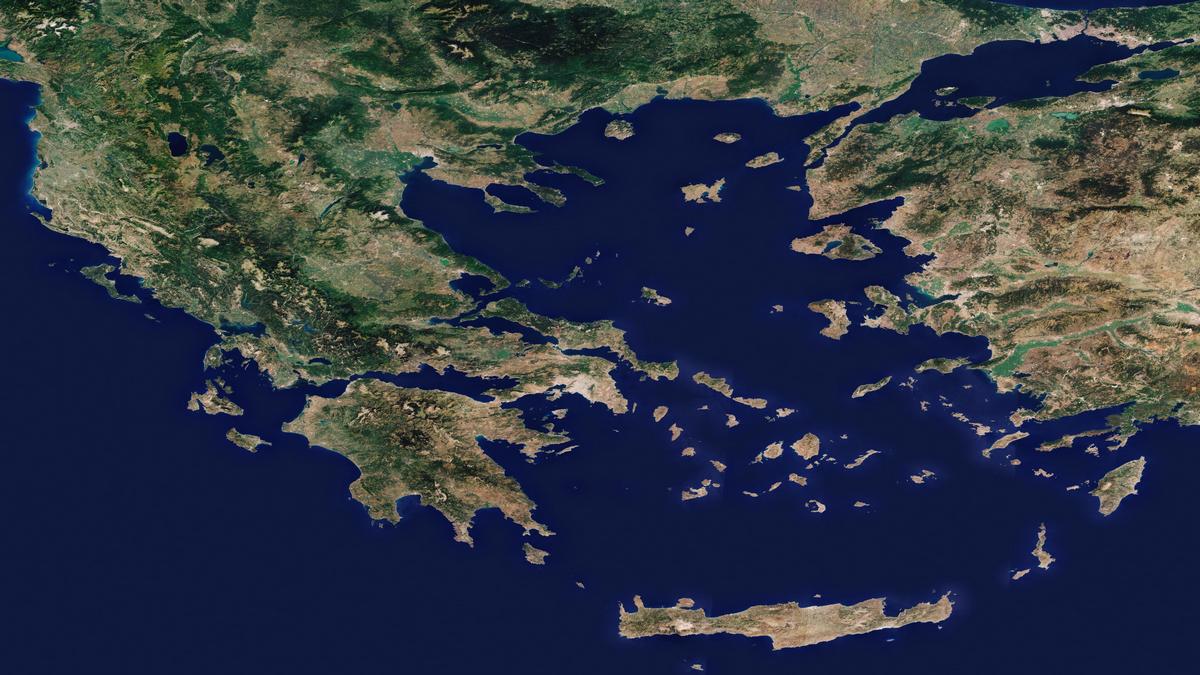
This distinction matters most in maritime settings where geography resists simplification. Dense island formations, sharply uneven coastlines, and semi-enclosed seas complicate any attempt to apply uniform solutions. In the Aegean, high island density combined with pronounced coastline asymmetry produces effects that cannot be resolved through abstract formulas. The article treats these features not as anomalies, but as the very reason equity must guide technique. Maritime delimitation, in this sense, is less about geometry than about managing disproportional outcomes.
The discussion of islands follows the same logic. Rather than assuming that islands generate full maritime effect in all circumstances, the study places their impact within a broader assessment of proportionality. It recalls that international jurisprudence has repeatedly adjusted island effects where strict application would distort access to maritime space. The point is not that islands lack rights, but that those rights operate within a relational geographic context.
Equally important is what the paper avoids. It does not present the Türkiye–Greece dispute as a legal anomaly requiring correction, nor does it elevate one interpretation as inherently superior. Instead, it treats the dispute as a case shaped by its own geographic and legal particularities, where law operates in constant tension with island configurations and coastline asymmetries. Courts, precedents, and conventions are referenced as guides, not as shortcuts to predetermined conclusions.
Seen from this angle, a recurring limitation in the Greek position becomes clearer. By treating UNCLOS and equidistance as near-automatic solutions, Athens narrows the space for negotiation. Yet the study's core argument points elsewhere. Where geography is atypical, as in the Aegean, insisting on general rules without regard to disproportional effects does not clarify the dispute. It entrenches it. The difficulty lies not in the absence of law, but in applying a general framework to a setting that resists generalisation.
The article is similarly cautious about judicial shortcuts. While courts and tribunals remain relevant reference points, the study implicitly questions whether judicialisation alone can substitute for negotiated balance. In disputes shaped as much by geography as by law, litigation risks freezing positions rather than addressing underlying asymmetries.
What ultimately emerges is a restrained but clear argument. The Türkiye–Greece maritime dispute remains unresolved not because law is missing, but because law cannot operate in isolation from geography and proportionality. Equity, as presented in the study, is not a concession to either side. It is the condition under which the law of the sea remains workable in a uniquely complex maritime setting.