
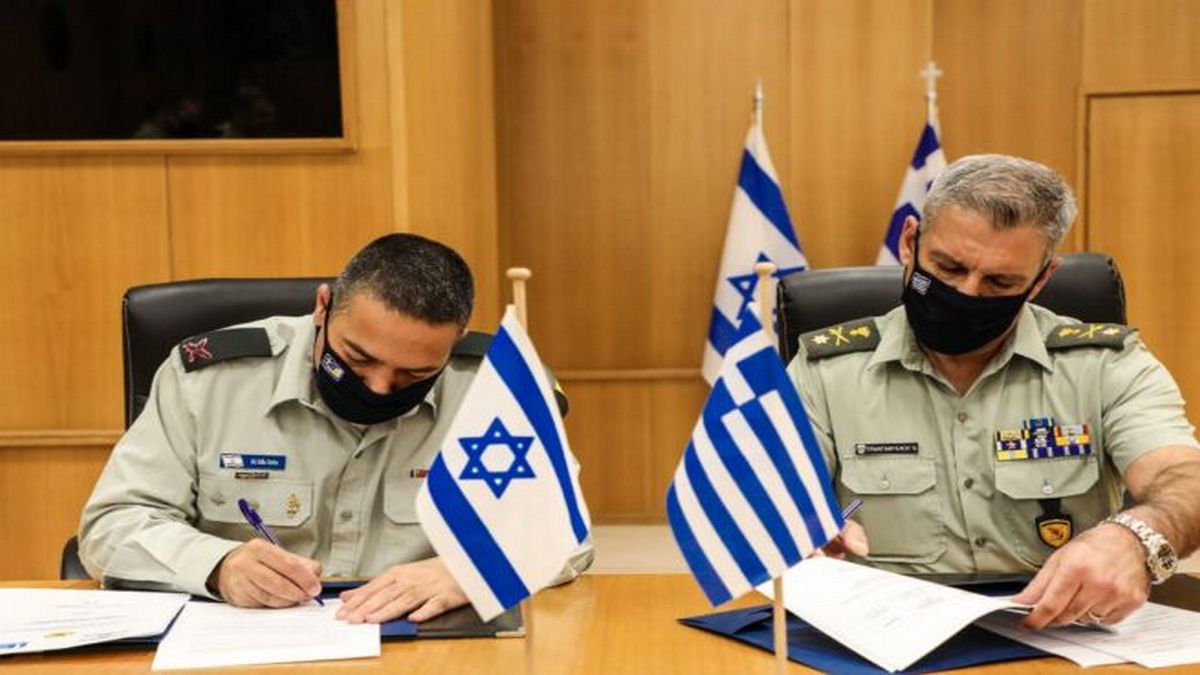
The announcement is being presented as dramatic. Greece and Israel, according to today's headlines, have reached a deal on counter-drone systems and cybersecurity. The language suggests urgency, surprise, and a response to fast-changing regional threats.
That framing is misleading.
This week's announcement in Athens, highlighted by Greek and Israeli officials as a deal on anti-drone strategy and cybersecurity, provides the immediate news hook. References to drone swarms, cyber threats, and maritime security frame the cooperation as a response to present risks. Yet these statements do not mark the start of a new partnership. They mark the moment when an existing security track is being described in operational language and placed openly on the public agenda.
What is new is not the cooperation itself, but the moment chosen to present it publicly and the language now used to describe it.
What is being described now is not a newly formed partnership, nor a sudden strategic alignment. It is the latest public articulation of a dialogue and security vision that has been evolving for years, largely away from the spotlight.
Greek Defence Minister Nikos Dendias has framed the cooperation in explicitly operational terms, focusing on drone swarms, maritime surveillance, and cyber risks. Israeli officials have placed the same cooperation within a wider regional security narrative, linking it to instability across multiple theatres. Turkish officials, meanwhile, have interpreted the development as part of a broader pattern of exclusionary alignments in the Eastern Mediterranean.
Each side, from its own perspective, presents the cooperation as carrying implications for Türkiye. This matters because it turns what is presented as technical cooperation into a political signal.
The underlying process that produced this announcement is neither sudden nor reactive.
The cooperation now being discussed did not begin with drones, and it did not begin in 2026.
Publicly as early as 2024, Greece and Israel were already engaged in discussions on layered air and missile defence concepts drawing on Israeli systems. Counter-unmanned capabilities were embedded in those talks from the outset, alongside radar integration, command and control, and cyber resilience. These were not isolated conversations but part of a broader effort to reshape air defence and security architecture.
Throughout 2025, this dialogue continued and deepened. Procurement options, system integration, and operational coordination were discussed in parallel with expanded military-to-military interaction. Joint exercises and training arrangements created the routines and interoperability required to move from concept to application.
Seen in this context, the current announcement is not a turning point. It is a continuation.
What has changed is not the direction of travel, but the openness of the language used to describe it. The cooperation is no longer presented as limited, technical, or provisional. It is now framed as necessary and enduring.
This is where the Türkiye dimension becomes unavoidable, even if it is not always named directly.
For Greece, the cooperation is presented as strengthening national defence and regional stability. For Israel, the value lies less in technology transfer than in embedding security cooperation within a wider eastern Mediterranean network. For Türkiye, the issue is not the existence of cooperation, but the cumulative strategic effect of security formats consolidating without its participation.
All three readings coexist. None of them emerged overnight.
Treating the announcement as something new obscures the continuity that gives it strategic meaning. It suggests a sudden shift where there is, in fact, a long-running process reaching a more visible phase.
For Türkiye, the question is not whether Greece and Israel cooperate. That has been evident for years. The question is how incremental steps, each defensible on their own terms, gradually reshape the security environment and narrow strategic options.
This is why the current headlines miss the point. The story is not about drones or cybersecurity. It is about the normalisation of a security vision that has been in the making for a long time and is now being framed as news.