
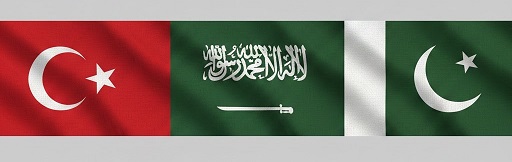
When Bloomberg reported that Türkiye was in talks to join a Saudi Arabia–Pakistan defence pact described as "mirroring NATO's Article 5," the story did not need amplification. It needed repetition. And repetition is exactly what it got. Within hours, global outlets converged on a single shorthand. "Islamic NATO."
What did not travel with the headline was scrutiny. The analogy was circulated as if it were self-explanatory, even though the question that actually defines collective defence was barely addressed: can an Article 5–style mechanism function when one of its core participants sits inside an active, high-risk conflict environment? Once that question is asked, the comparison stops being persuasive.
Why this surfaced now matters as much as what it claims
The timing is not incidental. The report emerged as regional security arrangements are being reworked, Western guarantees are debated more openly, and defence procurement and industrial cooperation have become central tools of diplomacy. In such moments, signalling often precedes structure. Headlines move faster than institutions, and language is used to test reactions before commitments are drafted.
Seen this way, the story's circulation tells us less about a finished alliance and more about a moment of strategic probing.
Automatic defence is not branding
The defining feature of NATO is not symbolism. It is automation. Collective defence removes discretion at the moment of crisis. An armed attack on one member is treated as an attack on all, triggering obligations designed to be hard to delay, reinterpret, or dilute.
This is why NATO does not admit states facing active wars or unresolved high-risk conflicts. Ukraine and Georgia are not political outliers. They reflect a structural rule. An alliance built around automatic defence cannot absorb ongoing wars without importing them.
Any framework that ignores this constraint may borrow NATO's language. It cannot borrow NATO's mechanics.
Pakistan is not a dormant variable
That is where the analogy fails first. Pakistan operates in a security environment shaped by a persistent and unstable rivalry with India. Nuclear deterrence lowers the probability of total war, but it does not neutralise crisis dynamics or escalation risk. This is not a frozen file. It is an active one.
A defence arrangement that genuinely mirrored Article 5 would therefore place Türkiye, at least in theory, on the edge of a South Asian contingency. That outcome runs directly against Ankara's long-standing objective: avoiding entrapment in conflicts beyond its immediate theatres while preserving strategic optionality.
The question is not ideological. It is operational. What does Türkiye gain by binding itself to a conflict geometry involving one of the world's largest and most consequential states, when the security return is marginal and the downside risk is structural?
Consultation is not obligation
Here, a technical distinction matters. Collective defence can be built around consultation or around obligation. NATO chose the latter. Many contemporary security frameworks choose the former. Consultation preserves discretion. Obligation removes it.
What is being discussed fits the logic of consultation far more than obligation. That distinction explains both the ambition of the language and the absence of institutional detail. It also explains why the Article 5 comparison resonates politically while remaining implausible operationally.
The attraction, and the imbalance
The attraction is easy to explain. Even without nuclear weapons, proximity to a nuclear-armed partner can shape perceptions. Deterrence often works through uncertainty, and uncertainty can be useful.
But deterrence by association is imbalanced. It deters only if commitments are believed, and belief raises the risk of entrapment. For Türkiye, the trade-off is unfavourable. The incremental deterrent gain is limited. The cost of automatic association with a high-risk rivalry is not.
That imbalance alone rules out a NATO-style design.
India's Mediterranean turn widens the field
The picture becomes more crowded once India's evolving posture is added. New Delhi's deepening ties with Greece and the Greek Cypriot administration, alongside recurring reports of maritime access and defence cooperation in the Aegean, reflect a broader maritime and great-power calculus rather than a single-issue stance toward Türkiye.
For India, the eastern Mediterranean is part of a wider network linking sea lines of communication, Western security ecosystems, and long-term positioning vis-à-vis China. For Türkiye, India's growing visibility alongside Greece and the Greek Cypriot administration adds another layer to an already dense pressure environment in the Aegean and the eastern Mediterranean.
Here, a common misreading becomes clear. The idea that Türkiye would respond to Greek Cypriot–Greek–Israeli defence arrangements by entangling itself in rigid and high-risk security adventures rests on a fundamental misunderstanding of Ankara. In its mildest interpretation, it is naïve. More accurately, it reflects a failure to grasp how Türkiye calibrates power under pressure. Ankara does not exchange strategic autonomy for symbolic alignment, nor does it accept commitments that automatically import external conflicts into its security calculus. Expectations to the contrary underestimate not only Türkiye's risk sensitivity, but also its long-established capacity to absorb pressure without surrendering control over escalation.
Ambiguity is leverage
Seen from this angle, the report becomes easier to place. The NATO reference is a signal, not a blueprint. What is being explored is far more likely a deliberately ambiguous framework that gestures toward mutual defence without hardwiring automatic escalation.
Such arrangements prioritise defence industrial cooperation, financing, access, and political alignment. They use the language of collective defence to project seriousness while preserving discretion. The trigger is not automatic. The commitment is not symmetric. For Türkiye, that ambiguity is not a defect. It is leverage.
The statement
If this were truly an Article 5–style arrangement, it would already be unworkable. Pakistan's conflict exposure, Saudi Arabia's regional entanglements, and Türkiye's multi-theatre posture would lock the mechanism before it ever operated. That it is being discussed at all tells us what it is not.
This is not an "Islamic NATO." It is alignment without obligation, deterrence without automation, and cooperation designed to expand options rather than foreclose them. The headlines repeat the analogy. The mechanics quietly reject it.