
By Bosphorus News Türkiye Desk
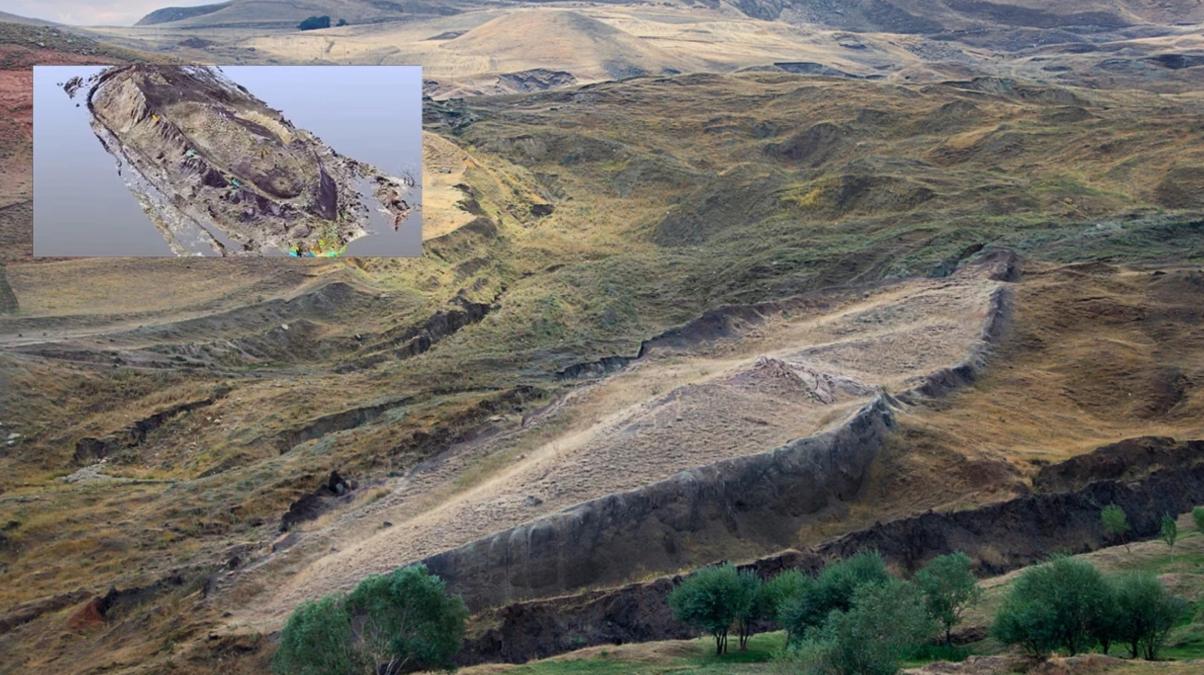
New underground scans have reignited one of the world's most contested biblical archaeology debates, after researchers reported tunnel-like structures, angular subsurface features and unusual soil chemistry beneath the Durupınar formation in eastern Türkiye.
The boat-shaped site, located in Ağrı province about 29 kilometers south of Mount Ararat and roughly 1,980 meters above sea level, was first identified in 1959 by Turkish Air Force Captain İlhan Durupınar during an aerial survey. The formation measures about 157 meters in length, a figure often cited by researchers who argue that it corresponds to 300 Egyptian cubits, the dimensions given for Noah's Ark in the Book of Genesis.
The latest findings come from Noah's Ark Scans, a California-based research group led by Andrew Jones. The team has been using ground-penetrating radar, electrical resistivity tomography, LiDAR scanning and chemical analysis at the site since 2019.
On April 9, 2026, the group released results from a new soil study conducted with Australian soil scientist Bill Crabtree and Dr. Mehmet Salih Bayraktutan, a geologist at Atatürk University. The study collected 88 soil samples from 22 locations inside and outside the formation boundary. Laboratory analysis at Atatürk University found that soil inside the formation contained about three times more organic matter and 38 percent higher potassium levels than soil immediately outside it.
Ground-penetrating radar data, reviewed alongside the new soil results, also showed what the team describes as tunnels about four meters below the surface and roughly two meters high. Researchers said the features run along the center and inner edges of the formation, including a central corridor extending about 71 meters and angular structures reaching depths of up to six meters.
Jones told Fox News that the layout may point to "possible support beams and walls" and suggested that the features could indicate a man-made object rather than a natural formation. The team has also cited yellowish vegetation inside the formation boundary during autumn months, which it links to differences in the soil beneath the surface.
The next phase of research, planned for 2026, is expected to involve a remote-controlled device that would enter the detected tunnel-like structures to film and collect samples.
The claim remains heavily disputed. Durupınar entered global attention in the late 1970s after amateur explorer Ron Wyatt promoted the site as a possible Ark location, but the theory never gained broad scientific acceptance. In 1996, Wyatt co-authored a paper with geologist Lorence Collins that concluded the formation was a natural rock structure resembling a boat, with supposed anchor stones and metal fittings identified as local volcanic material.
A 2025 paper titled "Durupınar Debunked" also challenged the Ark interpretation, arguing that the evidence for a man-made structure does not meet scientific standards. The paper reviewed claims related to the site's geology, archaeology and geophysics, and also questioned whether a boat-shaped formation fits the biblical description of the Ark as a box-like structure.
Most geologists continue to classify Durupınar as a natural geological formation. The 2026 soil results have not yet been independently verified by outside laboratories, and no confirmed samples of wood, metal fittings or other man-made structural material have been extracted from the site.
Turkish authorities have continued to support research and visitor activity around Durupınar, where a visitor center in Ağrı province has helped keep the formation inside Türkiye's cultural heritage and faith tourism landscape.
The new scans do not prove that Noah's Ark has been found. They do, however, add fresh technical data to a claim that has endured for decades because of the site's shape, location and religious significance. Durupınar now moves into another research cycle, with the central question still resting on whether future sampling can produce direct, independently verified material evidence.