
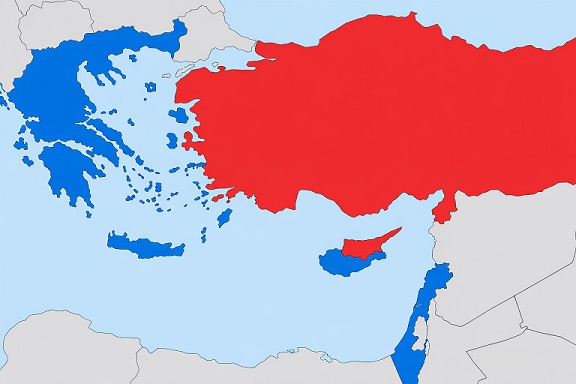
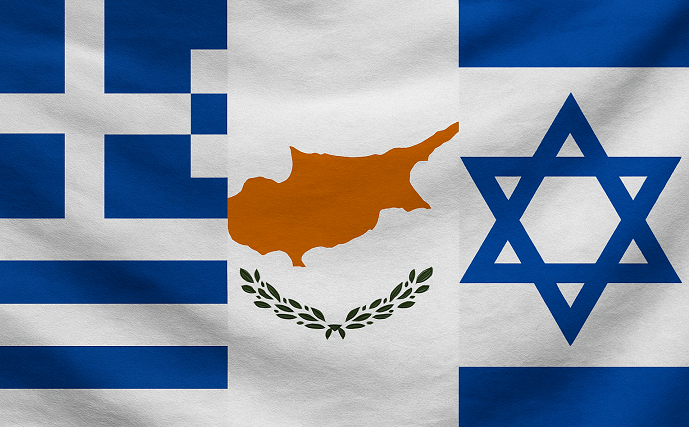
Israeli Prime Minister Benjamin Netanyahu adopted a notably uncompromising tone toward Türkiye, framing Israel's partnership with Greece and Cyprus as a deliberate strategic response to Ankara's expanding influence in the Eastern Mediterranean.
Addressing the trilateral framework, Netanyahu declared that the alliance would "prevail over chaos," a phrase widely read as a pointed message to regional actors he believes are seeking to reshape the balance of power. His remarks underscored a clear preference for tightly aligned blocs over inclusive regional engagement.
A Sharpened Message Toward Ankara
Netanyahu's warning that those attempting to "re-establish their rule" in the region would fail marked one of his most direct rhetorical signals toward Türkiye in recent months. Rather than acknowledging Ankara as a necessary regional interlocutor, he implicitly cast it as a destabilizing factor whose ambitions must be checked.
The language reflected a shift from ambiguity to confrontation, suggesting that Israel's current leadership views Türkiye not as a partner for dialogue but as a strategic rival to be contained through coordinated alliances.
Energy as Geopolitics
Energy cooperation occupied a central place in Netanyahu's remarks. Joint initiatives involving natural gas development, electricity interconnection, and infrastructure were presented as pillars of the Israel–Greece–Cyprus axis.
By emphasizing exclusivity in these projects, Netanyahu reinforced the message that Türkiye would remain outside key Eastern Mediterranean energy frameworks, despite its geographic proximity and established role in regional energy transit.
Connectivity Without Ankara
Netanyahu also highlighted the India–Middle East–Europe Economic Corridor as a flagship connectivity project. While framed as an engine of prosperity and stability, the corridor was notably discussed without reference to Türkiye, even though Ankara sits at the crossroads of Europe, Asia, and the Middle East.
Analysts interpret this omission as consistent with Israel's broader approach: promoting selective integration that advances economic goals while limiting Türkiye's participation in emerging regional architectures.
Strategic Implications
The rhetoric reflects a broader recalibration in Israel's regional posture. By doubling down on trilateral cooperation and drawing sharper political lines, Netanyahu appears intent on reinforcing existing fault lines in the Eastern Mediterranean rather than bridging them.
For Ankara, the message is unmistakable: Israel's current leadership is prioritizing deterrence and bloc politics over engagement with Türkiye, a stance that could harden regional alignments and complicate future diplomatic openings.
What This Signals
Netanyahu's remarks suggest that Israel is choosing consolidation over accommodation in the Eastern Mediterranean. By framing stability through exclusionary partnerships and explicit warnings, the Israeli prime minister has clarified where his government stands — and, just as clearly, where it does not see room for Türkiye within its preferred regional order.