
By Bosphorus News Geopolitics Desk
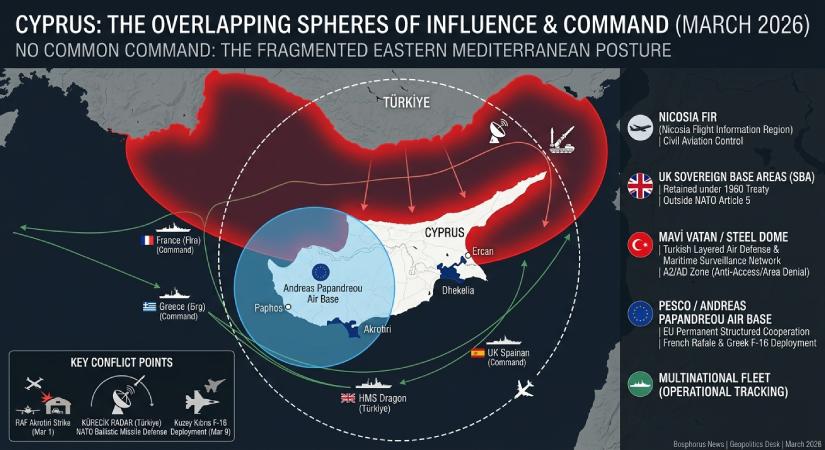
When Iranian drones hit RAF Akrotiri on 1 March, France's carrier group, Greece's newest frigate, and warships from five more European states converged on Cyprus within days, each government announcing its deployment separately, each justifying it with different language. France moved under a strategic partnership agreement with Cyprus. Greece activated its bilateral Joint Defence Doctrine. The UK reinforced its own sovereign territory, the Sovereign Base Areas at Akrotiri and Dhekelia retained under the 1960 independence treaty and outside NATO's formal Article 5 perimeter. Spain sent a frigate while blocking Washington from using its bases at Rota and Morón for strikes on Iran, and later confirmed it would not join any military mission in the Strait of Hormuz. None of these decisions ran through NATO's integrated command structure. As Euronews reported, the deployments happened "outside any formal NATO command structure."
On a map, the forces around Cyprus look coordinated. They answer to seven different capitals.
Parallel Deployments, Separate Chains of Command
The clearest illustration of the split sits not around Cyprus but further east. NATO is currently deploying additional Patriot batteries to Malatya and Adana under Allied Air Command Ramstein, intercepting Iranian ballistic missiles over Turkish territory through a formal institutional chain. The Turkish Defence Ministry has described these deployments in explicitly NATO terms. In the same crisis, the response to an Iranian drone strike on a British base produced no equivalent institutional response, only a collection of national deployments coordinated bilaterally, each anchored in a different legal and political framework.
The United States operates from Incirlik and coordinates NATO missile defence from the Kürecik radar in Malatya, both on Turkish soil. Türkiye has publicly condemned the US-Israeli strikes on Iran as "unjust and unlawful" while relying on NATO air defence to intercept missiles targeting its territory. Ankara has taken a firm political stance against the war while the alliance's infrastructure on its soil continues to operate as a regional missile shield.
The European states around Cyprus are pursuing visibly different political lines. Spain deployed a frigate to protect Cyprus while refusing Washington access to Rota and Morón, drawing a line between defensive protection and offensive participation that its government has stated explicitly. France sent the Charles de Gaulle group while Macron framed the deployment as proof that Europe could act independently of US pressure. Greece treats Cyprus as an extension of its own defence perimeter under a bilateral doctrine that predates NATO's involvement in the current crisis. These are uncoordinated national decisions held together by circumstance rather than any shared command structure.
Türkiye moved to reinforce its position in northern Cyprus, deploying F-16s and expanding what Ankara calls its Steel Dome, a layered radar and maritime surveillance network under construction across the island's north coast, built around Hisar air defence systems and designed to provide continuous monitoring of the surrounding sea and airspace. NATO intercepts Iranian missiles over Turkish airspace, while the question of whether Türkiye's F-16 deployment to northern Cyprus violates US arms agreements remains formally unresolved within the alliance.
The Corridor Nobody Controls
When Greek F-16s scrambled to intercept drones near Lebanese airspace on 4 March, they were operating under Greek national authority, coordinating with Cypriot airspace control, in a corridor where NATO maritime assets, French carrier aircraft, and Turkish surveillance drones were all active simultaneously, according to Cypriot government statements. NOTAM A0126/26, issued under the Nicosia Flight Information Region, warns of GPS spoofing and jamming across Cypriot airspace through 1 May 2026. EASA has separately flagged the broader eastern Mediterranean as a region of intensified GNSS interference since 2022. No deconfliction centre covers this corridor. The actors moving through it share no common channel, and in a degraded electronic environment, the margin for misidentification narrows for everyone regardless of flag.
No Architecture for This
Cyprus is not Alliance territory. The British Sovereign Base Areas sit outside NATO's Article 5 perimeter, which is why the response to the Akrotiri strike took the form it did. When the SHAPE spokesperson told Euronews that NATO "has what it takes to defend Alliance territory," that formulation was accurate and beside the point simultaneously. The territory that was struck does not fall within it.
What Article 42(7) of the Treaty on European Union provides, the EU's mutual assistance obligation triggered when a member state faces armed aggression, is a partial substitute: it creates a political expectation of support among EU members but carries no integrated military command structure of its own. France, Greece, Italy, Spain, the Netherlands, and Germany all responded. They did so under their own national mandates, coordinating bilaterally with Nicosia, not through Brussels or NATO.
On 17 March, Trump called NATO allies' reluctance to engage in the Iran war "a very foolish mistake." The allies he was criticising had deployed warships to protect a British base on an island outside the NATO perimeter, while refusing to support the campaign that made the base a target. The distinction between defending against Iranian retaliation and supporting the war that triggered it is real, and it has no institutional home in the current architecture.
Ankara watches all of this from Incirlik and Kürecik, hosting NATO's missile shield while positioning its own assets across northern Cyprus. The same crisis that runs through a single institutional chain on Turkish soil runs through seven separate national ones around Cyprus. Türkiye works within that asymmetry rather than waiting for others to resolve it.
***Source note: NATO Patriot deployment to Adana sourced from Turkish Defence Ministry statement, 18 March 2026. SHAPE quote sourced from Euronews, March 2026. NOTAM A0126/26 from Nicosia FIR official record. Spanish base restrictions sourced from Spanish Defence Ministry statements, March 2026. EU Article 42(7) framework sourced from Treaty on European Union.