
By Bosphorus News Geopolitics Desk
Greek Cypriot media have framed the expanding Kazakhstan-Cyprus relationship as a new diplomatic and economic opening, after direct flights, embassy diplomacy and investment channels followed Greek Cypriot leader Nikos Christodoulides' visit to Astana.
Kıbrıs Hakikat reported on 4 June that Greek Cypriot newspapers treated the Kazakhstan opening as a new phase in relations, with direct flights between Larnaca, Astana and Almaty, the opening of a Republic of Cyprus embassy in the Kazakh capital and a wider economic agenda placed at the center of the coverage.
The visit built on a programme that had already drawn attention in Türkiye and the Turkish Republic of Northern Cyprus. Bosphorus News previously reported that Christodoulides was received in Kazakhstan with presidential protocol, a state honour, an embassy opening and signed cooperation agreements, exposing the limits of Ankara's effort to turn the Turkish Cypriot presence in the Turkic world into diplomatic recognition.
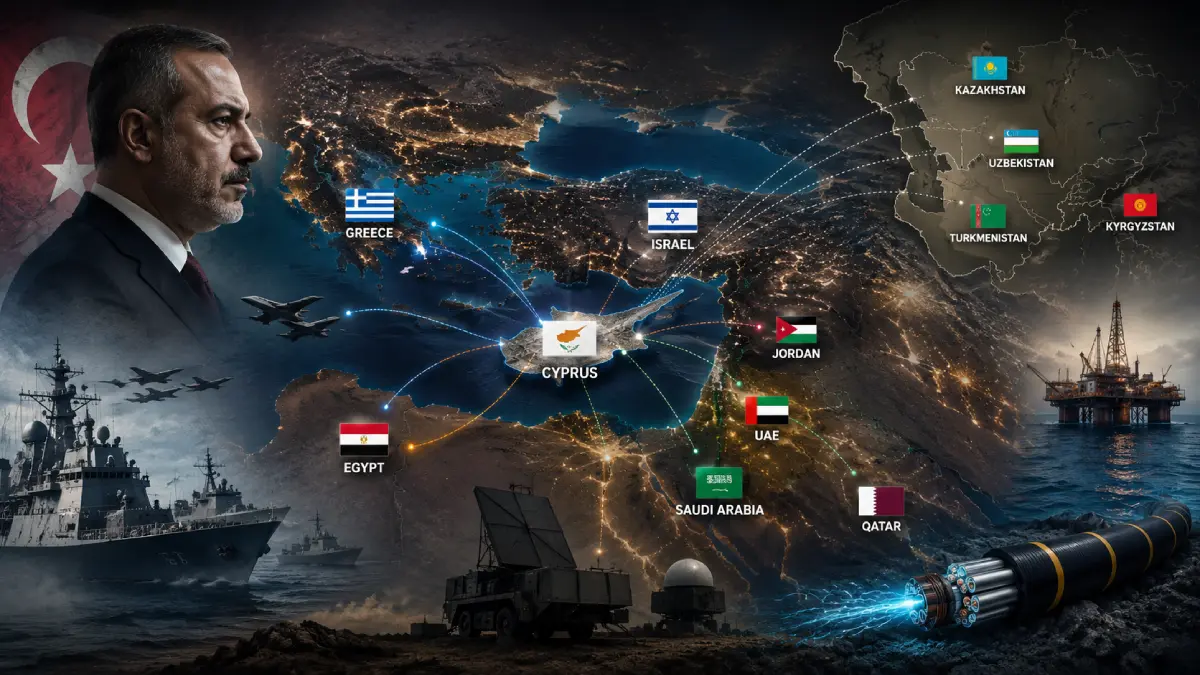
The new Greek Cypriot media coverage adds a practical layer to that debate. Kıbrıs Hakikat said the visit was linked to agreements on investment protection, the creation of a joint business council and efforts to expand trade. It also reported that Kazakhstan sees Cyprus as a logistics point in the Eastern Mediterranean, with cooperation proposals tied to the Trans-Caspian Corridor placed on the table.
That language matters because the Cyprus file is no longer moving only through diplomatic symbolism. Direct flights, embassy channels, business forums, investment tools and logistics proposals create a working relationship that can survive beyond one presidential visit. In the same report, Greek Cypriot media also highlighted Kazakh President Kassym-Jomart Tokayev's support for the sovereignty and territorial integrity of the Greek Cypriot-administered Republic of Cyprus, with references to United Nations resolutions.
The contrast remains difficult for Ankara. The TRNC gained observer status in the Organization of Turkic States in 2022, giving Turkish Cypriots more visibility in a Turkic institutional setting. Yet no Turkic state has recognized the TRNC. Kazakhstan's expanding ties with the Greek Cypriot administration show the distance between symbolic access and state diplomacy.
Astana's approach also reflects a wider Central Asian habit. Turkic states can maintain warm political language toward Türkiye and accept limited Turkish Cypriot visibility inside multilateral formats, while still preserving formal relations with the internationally recognized Greek Cypriot administration. Kazakhstan is now giving that pattern a more visible economic and logistical form.
The pattern also echoes a wider Bosphorus News analysis by Murat YILDIZ, which argued that Ankara's Cyprus language has struggled to explain why Central Asian Turkic governments can support Turkish-led platforms while maintaining formal state-to-state relations with the Greek Cypriot administration. In that reading, the issue is not that Kazakhstan is turning against Türkiye, but that Astana, like other Central Asian capitals, separates Turkic solidarity from recognition policy.
The direct flight issue sharpens the picture. Kıbrıs Hakikat reported that flights between Larnaca and Astana and Almaty will operate twice weekly, with possible expansion depending on demand. That is not recognition language, but it is connectivity. In diplomacy, connectivity often matters because it turns political contact into regular business, tourism and administrative channels.
The Trans-Caspian Corridor reference carries a similar weight. Türkiye and Azerbaijan have tried to place the Middle Corridor and Turkic connectivity at the center of a Eurasian transport agenda. Kazakhstan's willingness to discuss Cyprus as an Eastern Mediterranean logistics point does not cancel that track, but it shows that Astana is willing to connect Central Asian routes with Greek Cypriot access to European and Mediterranean networks.
That is why the Kazakhstan-Cyprus opening cuts beyond one bilateral relationship. It shows how the Greek Cypriot administration can use European Union membership, embassy diplomacy, direct air links and investment channels to build state-level relationships inside a space where Ankara has relied heavily on identity-based solidarity for the TRNC.
Türkiye's challenge is no longer to prove that Turkic solidarity exists. It is to explain why that solidarity still stops short of recognition, while the Greek Cypriot administration turns formal diplomacy into embassies, flights, business councils and corridor language.