
By Bosphorus News Geopolitics Desk
Iran has widened its operational definition of the Strait of Hormuz for the second time in less than two weeks, moving the crisis around the world's most important energy chokepoint from a narrow passage dispute into a broader military zone claim.
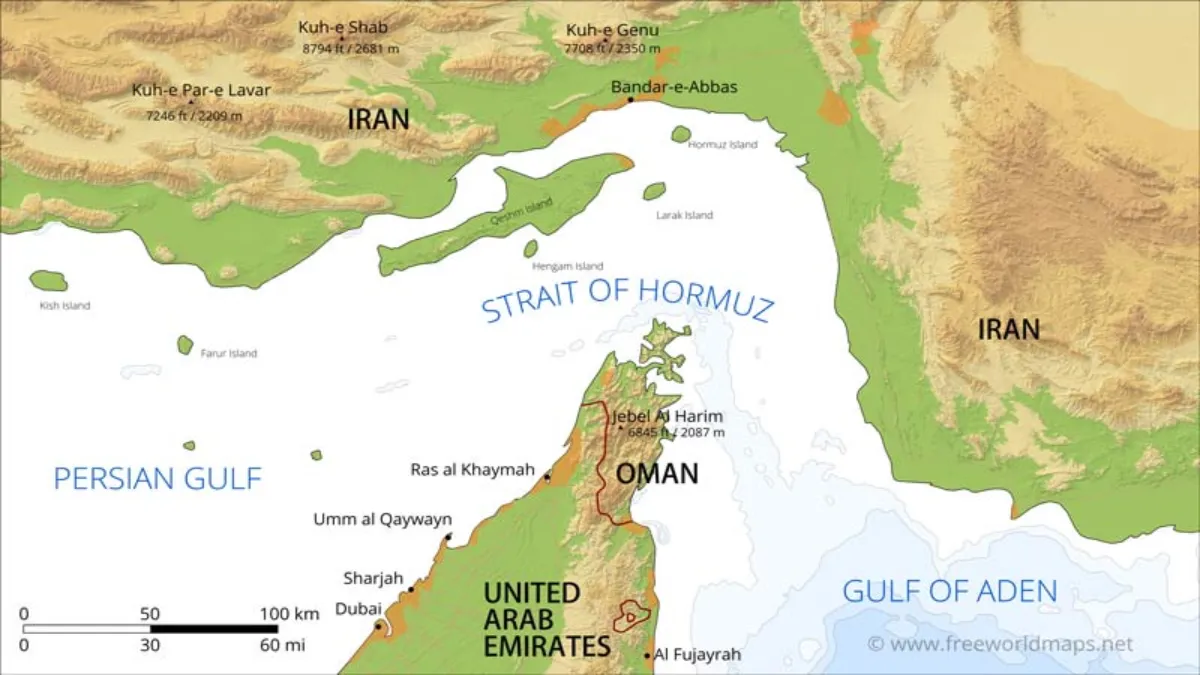
Reuters reported on May 12 that Mohammad Akbarzadeh, a senior official in the Navy of Iran's Islamic Revolutionary Guard Corps, or IRGC, said Iran no longer defines the strait only as the corridor around Hormuz and Hengam islands. Akbarzadeh described it instead as a strategic zone stretching from Jask in eastern Iran to Siri Island in the west, calling it a "vast operational area."
Iranian state-affiliated agencies Fars and Tasnim reported that the width of the area had expanded from an estimated 20 to 30 miles to between 200 and 300 miles. Tasnim described the new zone as a "complete crescent." Iranian authorities did not immediately respond to Reuters' request for comment.
The latest statement follows an earlier May 4 map published by the IRGC, which showed a new control zone running from the western tip of Qeshm Island toward Umm al-Quwain and from Kuh Mobarak toward Fujairah. The May 12 definition appears to push that logic further, placing a wider arc of Gulf and Gulf of Oman approaches inside Iran's operational language.
That matters because Fujairah is not a symbolic point on the map. It is the main outlet for the United Arab Emirates' Hormuz bypass infrastructure, including the Abu Dhabi Crude Oil Pipeline to the Gulf of Oman coast. Any credible operational risk around approaches to Fujairah would weaken one of the region's main mechanisms for keeping oil exports moving if Hormuz becomes unusable.
The move does not amount to a formal redrawing of maritime borders. It is better read as an operational assertion by the IRGC Navy during wartime conditions, one that tries to enlarge the area in which Iran can justify monitoring, warning, interception or deterrence activity.
Türkiye and Qatar answered that language from Doha on the same day. Turkish Foreign Minister Hakan Fidan, speaking after talks with Qatari Prime Minister and Foreign Minister Sheikh Mohammed bin Abdulrahman Al Thani, said the strait must not be used as a weapon.
Fidan said keeping Hormuz open was important for regional stability, security and the global economy. He also warned that the Gulf crisis should not push Gaza out of the diplomatic agenda, placing Türkiye's position between maritime security, ceasefire diplomacy and wider regional de-escalation.
Sheikh Mohammed used sharper language. "Iran should not use this strait as a weapon to pressure or to blackmail the Gulf countries," he said at the Doha press conference.
Fidan also pointed to the diplomatic knot blocking a settlement. "The expressed intention on both sides is this: to stop the war, open Hormuz and somehow resolve the nuclear file," he said, according to Türkiye Today. "The question is how to put this on paper with a prioritisation and formulation that both sides can accept."
The Doha message followed Türkiye's Doha diplomacy over Hormuz and LNG routes, where Ankara and Doha backed Pakistan-led efforts to restore freedom of navigation and prevent renewed military escalation.
The legal dimension remains contested. International straits used for global navigation are generally treated under the principle of transit passage, which limits the ability of coastal states to suspend or selectively restrict passage. Iran has signed but not ratified the United Nations Convention on the Law of the Sea, yet many navigation principles are also treated by maritime lawyers as part of customary international law.
That makes Iran's new language important less as a legal claim than as a signal of operational intent. Tehran is not merely threatening closure at the narrowest point of the strait. It is describing a larger military geography that reaches toward alternative routes Gulf producers have used to reduce dependence on Hormuz.
The United States dismissed the IRGC's language. The War Zone reported that the White House said Iran had been badly weakened by earlier US military action and was now losing heavily under economic pressure. That response downplays Tehran's capabilities, but it also underlines why Hormuz remains one of Iran's few remaining levers in negotiations.
About a fifth of the world's oil and liquefied natural gas normally passes through Hormuz, which serves as a main export route for Saudi Arabia, Iraq, Qatar and other Gulf producers. Any wider Iranian operational definition therefore affects not only shipping risk, but the insurance, routing and military escort calculations around the Gulf.
The May 12 statements drew a clear line between two competing approaches. Iran is expanding the language of maritime control. Türkiye and Qatar are pushing the language of safe passage, diplomacy and a negotiated sequence that can reopen Hormuz without turning the strait into a permanent pressure tool.