
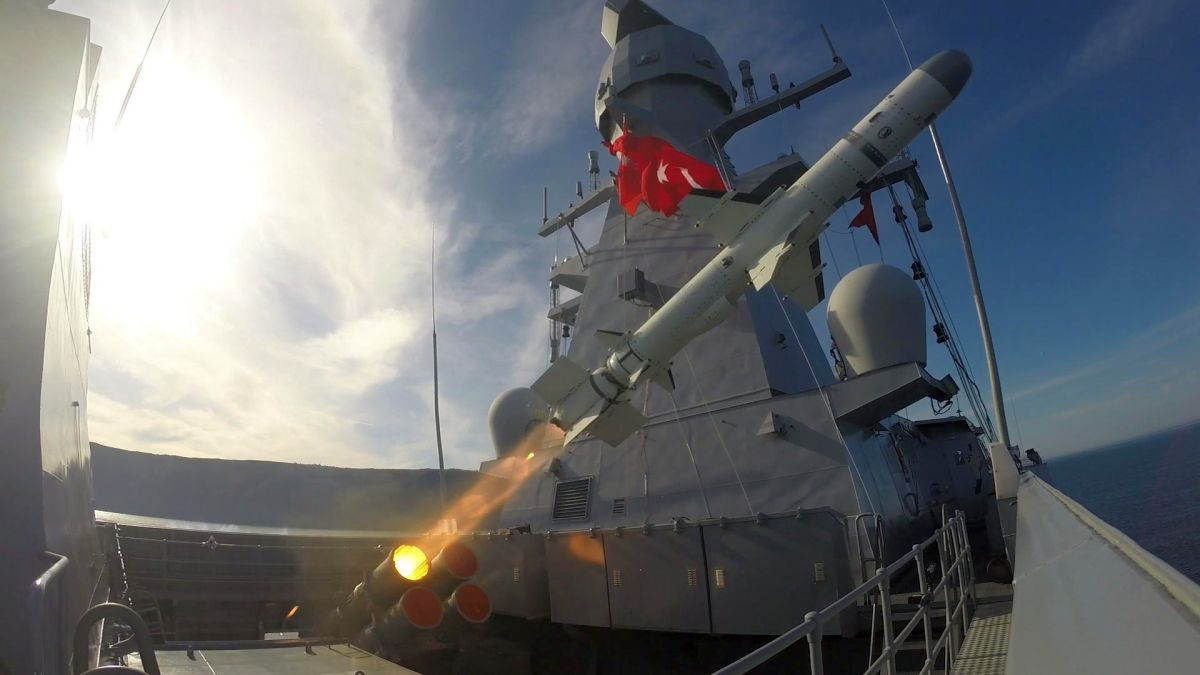
The Turkish defense industry has announced a critical milestone in its drive for complete military autonomy: the LEVENT Close-In Weapon System (CIWS) has successfully executed its first guided intercept against a real aerial target. This achievement confirms the performance capabilities of the new naval missile system, positioning it as the domestic successor to critical foreign-sourced defense components.
Developed by the Turkish defense contractor Roketsan, LEVENT is a short-range, all-weather surface-to-air missile system designed to provide the last layer of defense for surface combatants. The successful test firing, conducted at sea, demonstrated the system's ability to autonomously detect, track, and neutralize sophisticated threats.
The Strategic Shift: Replacing RAM
The primary role of LEVENT is to replace the RIM-116 Rolling Airframe Missile (RAM) system, which the Turkish Navy currently operates on its Ada-class corvettes. The transition to an indigenous system is directly linked to the need for supply chain independence and the geopolitical pressures that have historically constrained Türkiye's ability to procure foreign defense technology.
Difficulties in acquiring RAM missiles and associated launchers due to export controls and, specifically, the U.S. CAATSA sanctions, have accelerated the national initiative to develop homegrown alternatives. By successfully fielding LEVENT, Türkiye is eliminating a major point of vulnerability and ensuring the long-term readiness of its naval fleet across all platforms, from frigates to new patrol vessels.
Advanced Technology for Modern Threats
The LEVENT system is derived from Roketsan's SUNGUR portable air defense missile, but it has been heavily adapted for naval service. Its technical specifications indicate a capability built to counter modern warfare threats:
- Range: The missile has an operational range of approximately 11 kilometers, placing it squarely in the close-in defense category, suitable for intercepting incoming threats just before impact.
- Guidance: LEVENT utilizes a highly advanced dual-mode seeker. This system combines an Imaging Infrared (IIR) sensor with a Passive Radio Frequency (RF) sensor. This hybrid approach allows the missile to home in on both the heat signature of a target and the radar emissions of an attacking anti-ship missile seeker, offering superior resistance against electronic countermeasures and evasive maneuvering.
- Target Set: The system is engineered for 360-degree defense against a comprehensive array of aerial threats, including high-diving and sea-skimming anti-ship missiles, fixed-wing aircraft, helicopters, and the rapidly proliferating threat of Unmanned Aerial Vehicles (UAVs) and swarms.
- Integration: It is designed to function either as a standalone, autonomous unit or seamlessly integrated with a ship's combat management system, maximizing flexibility and reaction time.
This successful guided intercept represents a foundational achievement, paving the way for the mass production and widespread integration of LEVENT across the Turkish Navy, effectively achieving technological sovereignty in a critical layer of naval air defense.