
By Prof. Dr. Mehmet Hasgüler | Guest Commentary
Mehmet Hasgüler is a Turkish Cypriot professor of international relations, writer and politician. A former foreign policy adviser to Turkish Cypriot President Derviş Eroğlu, he ran as an independent candidate in the 2025 Turkish Cypriot presidential election.
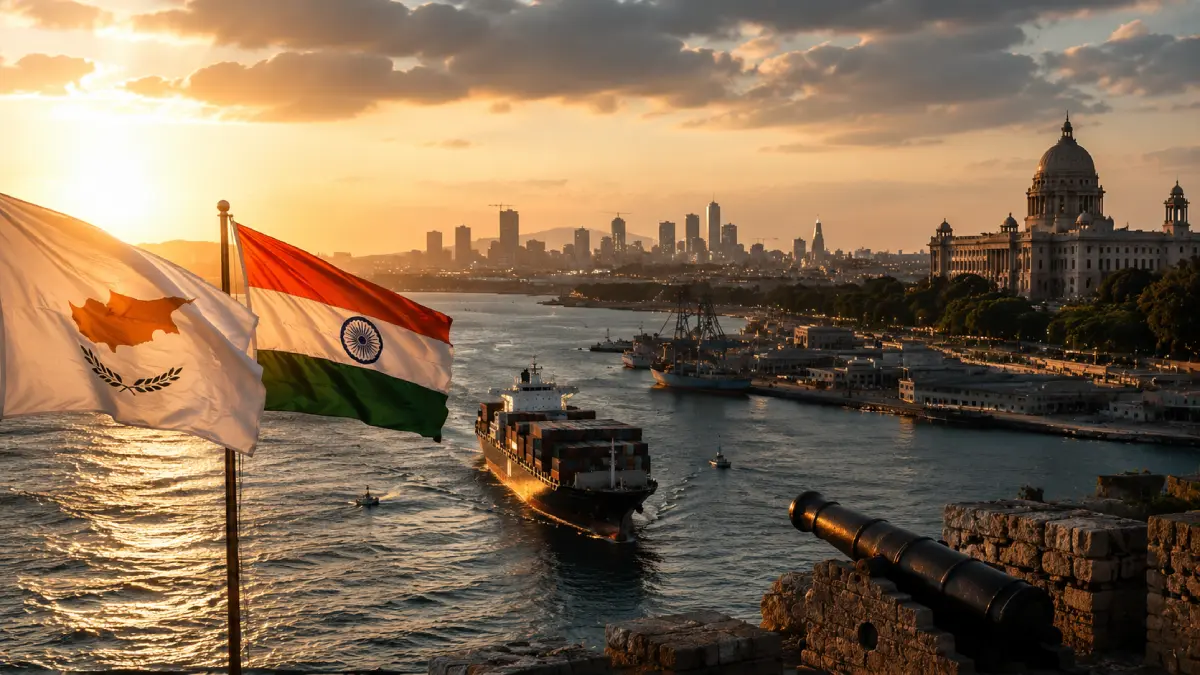
The visit of Cypriot President Nikos Christodoulides to India deserves to be assessed not only in economic terms, but also through its military and strategic dimensions.
Prime Minister Narendra Modi visited Cyprus in June 2025, becoming the first Indian prime minister to travel to the island in more than two decades. Christodoulides' visit to India now builds on that momentum at a time when Cyprus is preparing to hold the rotating Presidency of the Council of the European Union in 2026 and when India is seeking a wider role between Europe, the Middle East and South Asia.
The first President of Cyprus to visit India was Archbishop Makarios. That visit took place in 1962, when both countries were members of the Non-Aligned Movement. India, which carried considerable influence inside the movement at the time, did not withhold its support from Makarios. Of course, much water has passed under the bridge since then. Cyprus left the movement after joining the European Union, while India under Modi now follows a foreign policy very different from its earlier non-aligned posture.
Still, the relationship did not disappear. It continued at the United Nations and through a wider diplomatic familiarity between two former British colonies and Commonwealth members.
Cyprus supports India's aspiration for a permanent seat on the United Nations Security Council. Nicosia has also supported India's position in global nuclear governance debates. India, in turn, has long supported the Republic of Cyprus in international forums. This gives the relationship a historical base that should not be underestimated.
Since Modi became prime minister, India and the Republic of Cyprus have moved into a more modern phase of cooperation. Defence, cybersecurity, maritime security and counterterrorism are now part of the bilateral agenda. During the latest phase of engagement, the two sides elevated relations to a Strategic Partnership, agreed on a Defence Cooperation Roadmap for 2026-2031 and launched new cooperation channels on cybersecurity and consular affairs.
There is also a growing social and economic dimension. Around 7,000 Indian citizens live in the south of Cyprus, including professionals working in software, maritime and finance companies, students and people involved in cultural exchange programmes. The arrival of the Indian film industry on the island, including the possibility of Bollywood productions being filmed in Cyprus, is also on the agenda.
But the recent acceleration in relations cannot be explained only through historical goodwill, business ties or cultural exchange. The largest reason for this new momentum is India's need to respond to the growing cooperation between Türkiye and Pakistan.
A similar logic can be seen in India's close relationship with Israel. India is also seeking a key role in the India-Middle East-Europe Economic Corridor, a planned trade, energy and connectivity route linking India, the Gulf, the Eastern Mediterranean and Europe. That project gives Cyprus new strategic relevance as a possible European gateway in a corridor connecting South Asia to European markets.
This is where the Cyprus-India relationship becomes part of the Eastern Mediterranean equation.
It is quite clear, in my view, that India sees Christodoulides as a balancing actor against Türkiye in the Eastern Mediterranean. Christodoulides, for his part, does not miss any opportunity to widen the diplomatic front against Türkiye. The relationship he has built with Israel now has a parallel in the relationship he is developing with India. In his own calculation, this strengthens Nicosia's position.
This policy will have consequences. We will discuss them more in the years ahead.
***Editor's note: This is a guest commentary. The views expressed are those of the author.