
Football rankings are often subjective, shaped by headlines and hype. The International Federation of Football History and Statistics (IFFHS) was created to do the opposite. Founded in 1984 and now based in Zurich, the organization focuses on measurable performance: minutes played, match impact, competition level, and consistency across domestic leagues and international tournaments. Over decades, its annual lists have become a quiet benchmark for how world football is actually evolving beneath the noise.
Some lists reward visibility. Others reward durability. IFFHS has always leaned toward the latter.
Where the Numbers Lead, Not the Noise
That perspective frames the release of the 2025 IFFHS World U20 Best XI, a lineup designed to capture where the future of the game is already taking shape rather than where marketing departments hope it will go. The selection reflects sustained performance across leagues and competitions, not momentary form or viral moments.
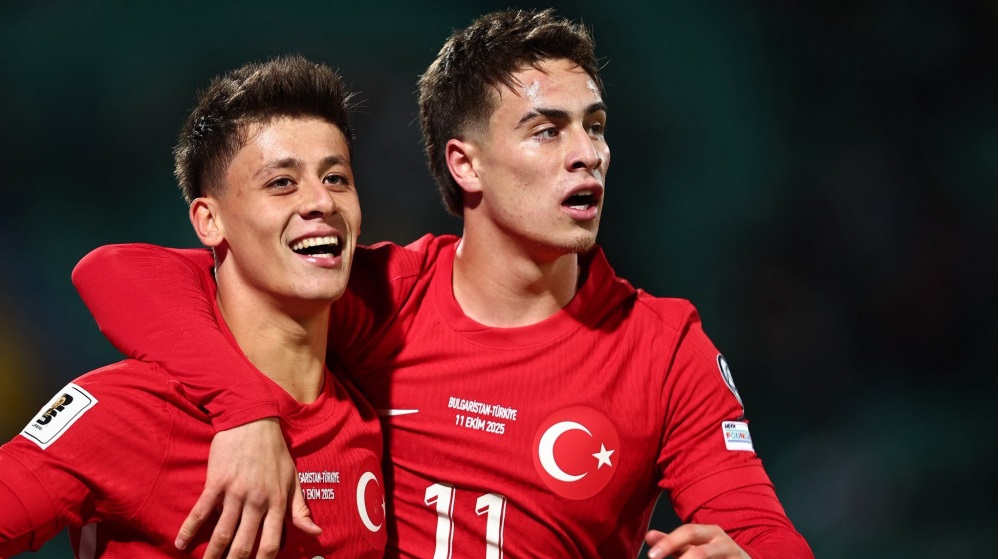
What stands out this year is the presence of two players from Türkiye in the same elite group—an outcome that speaks to consistency rather than coincidence.
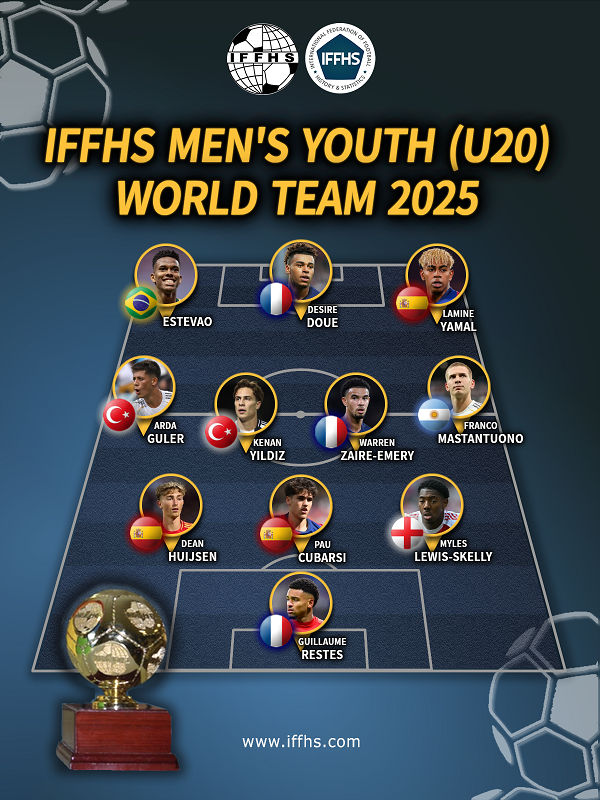
2025 IFFHS World U20 Best XI
- Goalkeeper: Guillaume Restes (Toulouse)
- Defense: Myles Lewis-Skelly (Arsenal), Pau Cubarsí (Barcelona), Dean Huijsen (Real Madrid)
- Midfield: Arda Güler (Real Madrid), Kenan Yıldız (Juventus), Warren Zaïre-Emery (Paris Saint-Germain), Franco Mastantuono (Real Madrid)
- Forwards: Lamine Yamal (Barcelona), Esevão (Chelsea), Désiré Doué (Paris Saint-Germain)
Two Different Paths, the Same Global Threshold
In a squad packed with rising stars, Arda Güler and Kenan Yıldız stand out as proof that different paths can reach the same global stage.
Güler's adaptation to Real Madrid's unforgiving standards reflects not potential alone, but tangible influence in high-pressure settings where technical quality must be matched by decision-making and composure.
At clubs where margins are thin, young players are judged quickly. Staying relevant is already an achievement; shaping games is another level entirely.
Yıldız's rise at Juventus tells a parallel story. Valued for versatility and game intelligence, he embodies a modern profile increasingly central to elite systems built on tactical flexibility.
What This Quietly Signals for Türkiye
IFFHS selections are not ceremonial. They function as a comparative snapshot of youth development worldwide, placing players from different leagues into a single analytical frame. Being named in the World U20 Best XI signals that a player has already crossed from promise into performance.
This is not about future ceilings. It is about present standards—and who already meets them.
For Türkiye, the significance lies less in symbolism and more in positioning. Turkish players are no longer appearing on global lists as exceptions or curiosities. They are being evaluated—and selected—on the same statistical and competitive grounds as their peers from Spain, France, England, and Italy.
The message from the 2025 list is understated but clear: the next phase of Turkish football is not theoretical. It is already visible, already measured, and already part of the global conversation.