
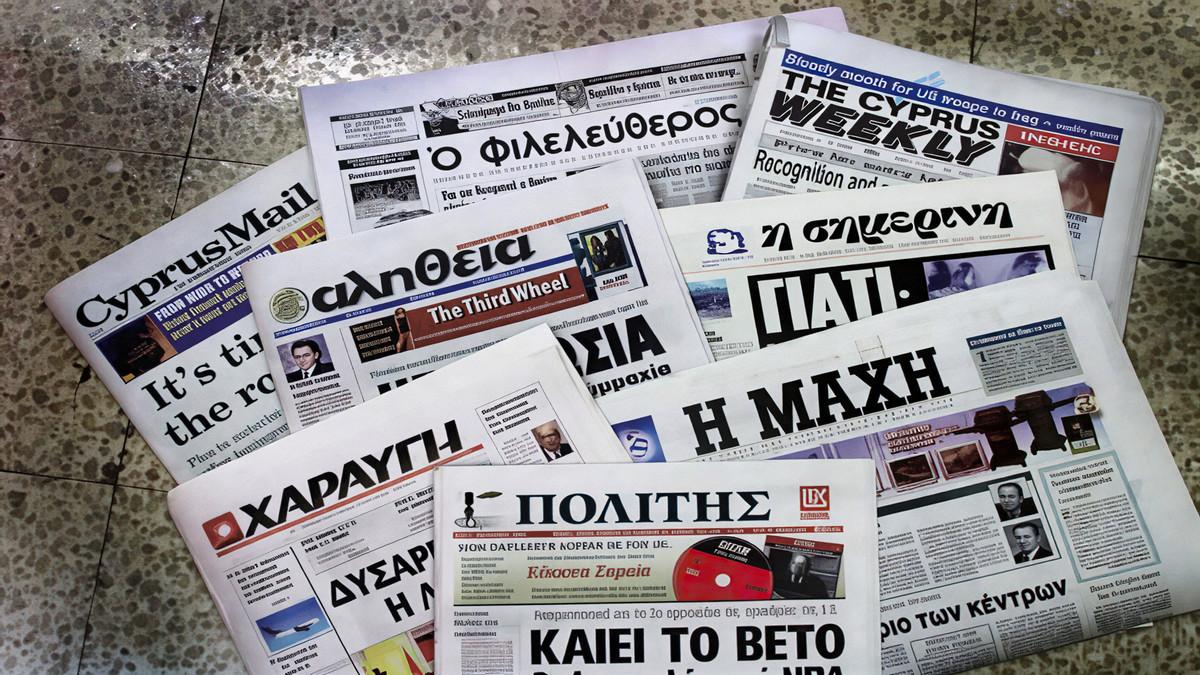
A new report examining how Cypriot media covered the war in Gaza offers a detailed account of framing choices, sourcing constraints, and editorial priorities during the conflict.
The study was prepared by the Institute for Mass Media and Communication Research in cooperation with Universitas Publications. Its findings were later reviewed and contextualised in an analysis published by IBNA – Independent Balkan News Agency, which drew attention to the report's relevance for war reporting and journalistic practice.
Scope and Methodology of the Study
The report examines coverage of the Gaza war across major Cypriot media outlets, including television, print, and online platforms. It focuses on news framing, language use, source selection, and thematic emphasis during different phases of the conflict.
Rather than assessing political positions, the study concentrates on reporting practices. It looks at how war is presented to the public when direct access to the conflict zone is limited and when media outlets rely heavily on external news flows.
Following Global News Flows in the Early Phase
According to the report, early coverage in Cypriot media closely followed international news agency narratives. Initial reporting prioritised the outbreak of hostilities, official reactions, and security developments, with limited editorial divergence between outlets.
This reliance on global news flows produced largely uniform coverage, particularly in the first phase of the war. The report notes that local editorial input was often secondary to reproducing established international frames.
How Civilian Suffering Slipped from the Agenda
As the war continued, humanitarian aspects of the conflict received less sustained attention. Civilian suffering in Gaza was increasingly reported in brief or episodic form, while diplomatic activity, ceasefire discussions, and regional security considerations moved to the foreground.
The report links this shift to both editorial choices and structural constraints, including the difficulty of accessing verified information from the ground and the dominance of secondary sources.
Reporting Without Access to the Conflict Zone
A central finding of the study concerns access. With foreign journalists largely unable to enter Gaza, Cypriot media outlets relied on international agencies, official statements, humanitarian organisations, and social media material.
The report notes that this environment limited verification and narrowed the range of perspectives available to editors, particularly in smaller media systems with limited reporting resources.
Framing Choices and the Question of Responsibility
The study identifies recurring patterns in language and framing. Certain actions were more frequently contextualised through legal or security narratives, while others were described in more general or abstract terms.
Rather than attributing intent, the report treats these patterns as editorial outcomes shaped by constraints. It argues that decisions about wording, emphasis, and story placement play a decisive role in shaping how audiences understand war.
Domestic Reactions Left Largely Outside the Frame
The report also notes that domestic responses in Cyprus, including public demonstrations related to Gaza, received limited and inconsistent coverage. Such events were often treated as secondary developments rather than integrated into broader reporting.
This approach reinforced a coverage pattern centred on external diplomacy and international actors, with less attention given to local public response.
What the Cypriot Case Shows About War Reporting
As highlighted in IBNA's analysis, the report does not present Cyprus as an exception. Instead, it uses the Cypriot case to illustrate wider conditions affecting war reporting: restricted access, dependence on global news agencies, and the constraints facing smaller media markets.
The findings document how these factors shape coverage in practice, offering a concrete case study of how contemporary wars are reported when distance, access, and information asymmetries define the newsroom environment.