
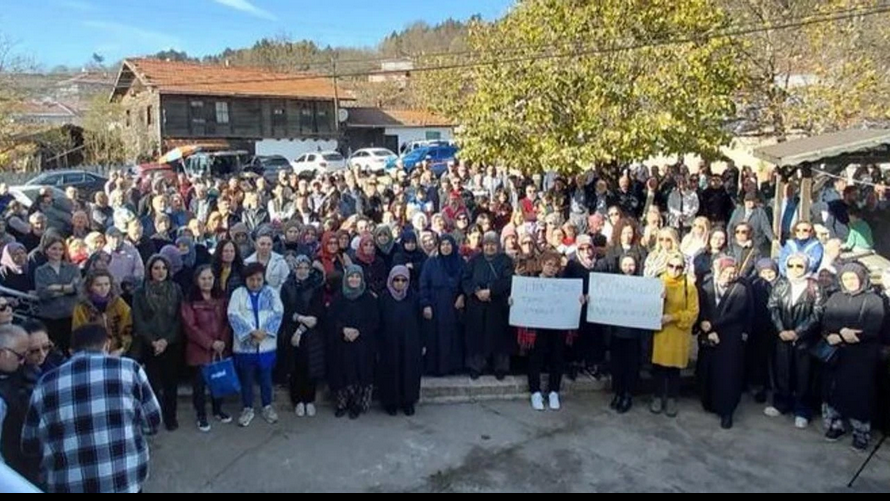
Gold Mine Project in Bilecik Raises Major Concerns Over Water Basin and Forest Destruction
A gold mine project planned by Kavak Madencilik A.Ş. in the rural area of Bozcaarmut Village, located in Bilecik's Pazaryeri district, has become the center of an intensifying environmental and legal debate. Local residents, environmental groups, technical experts, and regional councils are voicing strong objections, warning that the mine threatens both the area's natural water resources and its forest ecosystem.
Licensing area 1,163 hectares — but the EIA covers only 3 hectares
One of the most contentious elements of the project is the discrepancy between the officially licensed area and the Environmental Impact Assessment (EIA) application. Although the license covers 1,163 hectares—roughly the size of 1,600 football fields—the EIA application was submitted for only 3 hectares.
Environmental law experts describe this approach as "slice-and-approve," a method used to break a large-scale project into smaller segments to avoid full environmental scrutiny. Critics warn that such fragmentation could open the door to gradual, cumulative destruction of the forest and undermine regulatory oversight.
Similar disputes have emerged in recent years in regions such as Artvin, Fatsa, and the Kaz Mountains, where courts, including the Council of State (Danıştay), issued rulings emphasizing that large mining projects cannot be artificially divided for evaluation.
Water basin under pressure
The planned extraction zone sits just 900 meters from Bozcaarmut Pond and roughly 1,300 meters from Gedikpınar Pond. These ponds are critical components of the Sakarya Basin, a region already facing increasing water stress due to climate variability and growing demand.
The project proposes open-pit mining with heavy blasting—an approach known to alter underground water pathways, cause land deformation, generate high noise levels, and release dust and potential contaminants into the environment.
Hydrogeologists caution that repeated blasting may trigger water loss in nearby ponds, disrupt groundwater pressure, and affect agricultural irrigation capacity across surrounding villages. The long-term implications, they say, could reshape the hydrological balance of the basin.
Regional mobilization: Civil society, councils, and political actors unite
Public opposition in Bozcaarmut quickly evolved into a broader regional movement. City councils from Bursa, Bilecik, Bozüyük, and Eskişehir issued joint statements calling for the immediate cancellation of the project. TEMA Foundation specialists and environmental lawyers are closely monitoring the process, while independent environmental groups are preparing detailed technical submissions.
Political party representatives have visited the area for on-site reviews, and preparations for parliamentary questions in the Grand National Assembly of Türkiye (TBMM) are underway.
On 6 December, a well-attended meeting was held in Bursa in cooperation with Doğa-Der, bringing together environmental scientists, legal experts, council representatives, and local citizens. The session focused on potential risks to the Bozcaarmut water basin and long-term ecological impacts.
A clear message from residents: "We will not surrender our village, water, or forests"
Residents of Bozcaarmut, Kınık, Kurşunlu, and other nearby villages argue that the mine serves no public interest and poses irreversible risks to the local environment. Community leaders say that if the process moves forward, they are prepared to initiate a comprehensive legal challenge. Environmental groups have expressed readiness to support local efforts both in court and through public advocacy.
At a time when water security, forest protection, and climate resilience are becoming critical issues across Türkiye, the controversy in Bilecik has expanded beyond a local dispute and is rapidly turning into a national environmental case to watch.